


China PPI: March 2026
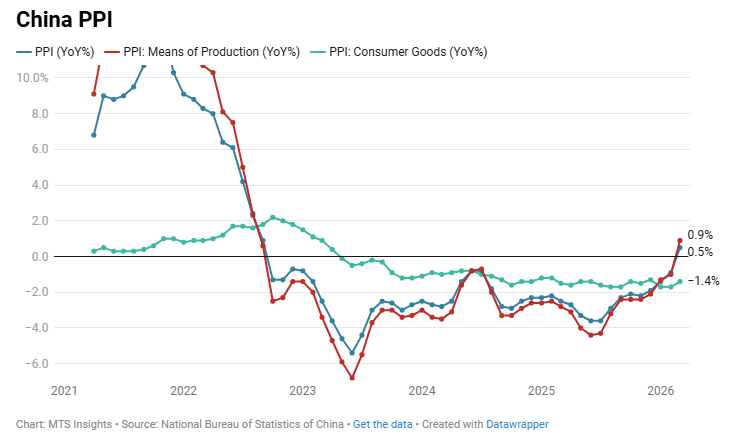
China’s industrial producer prices rose +1.0% MoM and +0.5% YoY in March 2026, while purchase prices increased +1.2% MoM and +0.8% YoY, marking a shift from prior deflation to renewed price growth.
-
Ex-factory prices of industrial producers increased +0.5% YoY (Feb: -0.9% YoY), indicating a reversal from contraction into positive territory, while MoM growth accelerated to +1.0% (+0.6 ppt vs prior month), showing strengthening short-term price momentum.
-
Purchase prices rose +0.8% YoY (Feb: -0.7% YoY) and +1.2% MoM (+0.5 ppt vs prior month), reflecting a similar transition to positive YoY growth alongside faster monthly gains.
-
In Q1, ex-factory prices declined -0.6% YoY and purchase prices fell -0.5% YoY, indicating that despite March’s rebound, producer prices remained negative on a quarterly basis.
-
Prices of means of production increased +1.0% YoY, contributing +0.81 ppts to headline PPI, with extractive industries up +2.0%, raw materials +1.1%, and processing +0.9%, showing broad-based gains across upstream sectors.
-
Prices of means of living fell -1.3% YoY, subtracting about 0.28 ppts from PPI, with food (-1.7%), clothing (-1.1%), daily necessities (-1.4%), and durable goods (-1.0%) all declining, indicating continued weakness in consumer-related goods prices.
-
On a MoM basis, means of production prices rose +1.3% (contributing +1.01 ppts), led by extractive industries (+3.9%) and raw materials (+2.4%), while means of living prices declined -0.1%, showing that monthly gains were driven by upstream sectors.
-
Among purchase price components YoY, non-ferrous metals surged +22.3%, while building materials (-4.4%), fuel and power (-3.8%), and agricultural products (-2.7%) declined, highlighting divergence across input categories.
-
MoM purchase price increases were led by fuel and power (+3.6%), chemical raw materials (+2.9%), and non-ferrous metals (+1.5%), while agricultural products (-0.5%) and building materials (-0.1%) fell, indicating uneven input cost pressures across sectors.