


Canada Employment: January 2026
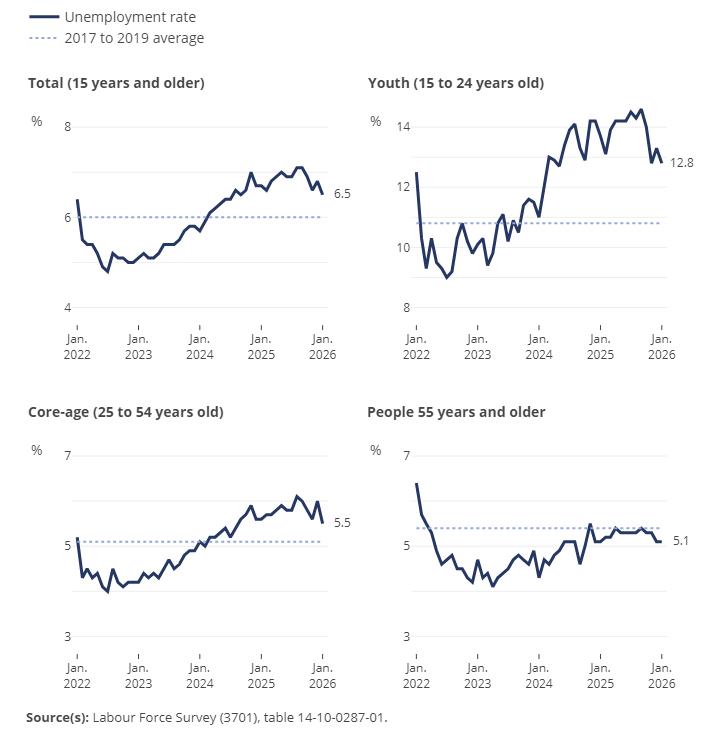
Canada’s employment edged down -25k in January (-0.1% MoM) while the unemployment rate fell to 6.5% (-0.3 ppts), reflecting fewer people searching for work.
-
The employment rate declined to 60.8% (-0.1 ppts), marking its first decrease since August 2025 after several months of relative stability.
-
Part-time employment fell -70k (-1.8%) while full-time employment rose +45k (+0.3%), showing job losses concentrated in part-time work.
-
On a YoY basis, total employment was up +134k (+0.6%), driven by full-time gains of +149k (+0.9%), indicating continued longer-term job growth despite the monthly dip.
-
The unemployment rate dropped to 6.5% from 6.8% as the number of job seekers fell -94k (-6.1%), making it the lowest rate since September 2024.
-
The labour force participation rate decreased to 65.0% (-0.4 ppts), reversing December’s increase and contributing to the lower unemployment rate.
-
Employment declined most in manufacturing (-28k; -1.5%), educational services (-24k; -1.5%), and public administration (-10k; -0.8%), while gains were seen in information, culture and recreation (+17k; +2.0%), business support services (+14k; +2.1%), agriculture (+11k; +4.5%), and utilities (+4.2k; +2.5%).
-
Provincially, employment fell in Ontario (-67k; -0.8%) but increased in Alberta (+20k; +0.8%), Saskatchewan (+6.1k; +1.0%), and Newfoundland and Labrador (+3.8k; +1.6%), showing divergent regional labor market trends.
-
Average hourly wages rose +3.3% YoY to $37.17, easing slightly from +3.4% YoY in December, indicating modest moderation in wage growth.