


Canada International Trade: November 2025 (DELAYED)
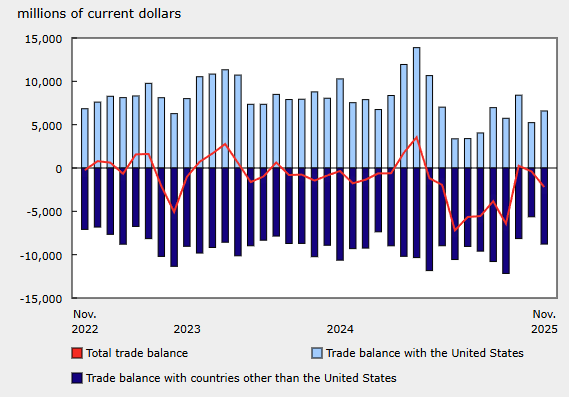
Canada’s merchandise trade balance widened to a -$2.2B deficit in November (from -$0.4B in October), as exports fell -2.8% MoM and imports edged down -0.1% MoM amid commodity-driven swings.
-
Total merchandise exports declined -2.8% MoM, even as 8 of 11 product sections increased, while real exports fell -0.9% MoM, indicating the headline drop was driven by a few large categories rather than broad weakness.
-
Exports of metal and non-metallic mineral products dropped -$3.2B (-24.4% MoM) after strong gains in September and October, led by sharp declines in unwrought gold shipments to the UK, US, and Hong Kong, reversing much of the recent surge.
-
Despite the November pullback, exports of unwrought gold, silver, and PGMs were still +39.5% YTD YoY, reflecting higher gold prices over 2025 despite month-to-month volatility.
-
Motor vehicle and parts exports fell -11.6% MoM to their lowest level in three years, with passenger cars and light trucks down -9.0% on lower production and medium and heavy vehicles down -53.8% following new US import tariffs.
-
Energy product exports rose +8.5% MoM, driven by crude oil and bitumen (+7.6%) on higher volumes after October refinery shutdowns in the US had curtailed shipments.
-
Total imports slipped -0.1% MoM, though real imports rose +0.9% MoM, as lower prices masked higher volumes across several categories.
-
Imports of motor vehicles and parts declined -4.5% MoM, while energy product imports fell -10.6% MoM on a -30.2% drop in crude oil, partly offset by refined petroleum products (+35.3%).
-
Trade with the US remained in surplus at $6.6B (up from $5.2B), while the deficit with non-US countries widened to $8.8B as imports from non-US markets hit a record high and gold-related exports abroad fell.