
Canada Manufacturing Sales: November 2025 (Final)
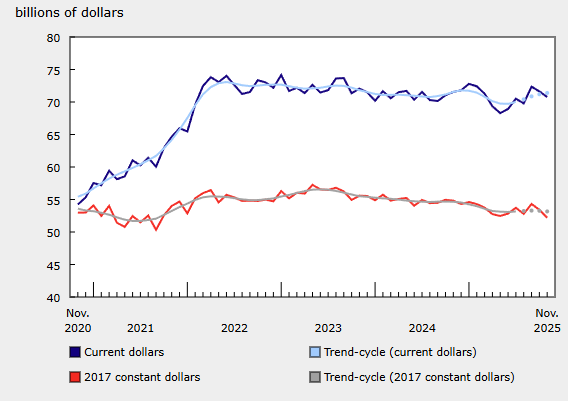
Total manufacturing sales fell -1.2% MoM and -1.1% YoY to $70.8B in November 2025, reflecting broad-based weakness across subsectors.
-
Sales declined in 15 of 21 subsectors, led by motor vehicles (-15.9%), motor vehicle parts (-6.3%), and machinery (-3.2%), following a -1.0% decline in October.
-
Motor vehicle sales fell to $3.8B (-15.9% MoM; -20.7% YoY), the second straight monthly drop and the lowest level since October 2022, with production disrupted by global semiconductor shortages.
-
Motor vehicle parts sales declined -6.3% MoM, with the report citing spillovers from the same semiconductor-driven supply chain disruptions affecting multiple auto parts plants.
-
Machinery sales dropped -3.2% MoM to $4.4B and were down -0.4% YoY, with weakness concentrated in agricultural, construction, and mining machinery as well as other general-purpose machinery.
-
Petroleum and coal product sales rose +6.8% MoM to $8.2B, supported by both higher prices and volumes; constant-dollar sales increased +3.2% as a refinery maintenance shutdown ended and refined product prices rose (diesel and motor gasoline highlighted).
-
Manufacturing sales declined in eight provinces, led by Ontario (-2.0% MoM to $30.5B; -1.8% YoY), where transportation equipment fell -9.2% and non-metallic mineral products declined -9.8%.
-
British Columbia sales fell -3.0% MoM to $5.3B, driven by food (-5.4%), wood products (-5.1%), and primary metals (-6.5%); the report notes U.S. tariffs have significantly pressured BC’s wood products subsector.
-
Total inventories edged up +0.1% MoM to $121.9B, while the inventory-to-sales ratio rose to 1.72 (from 1.70), indicating inventories grew slightly despite weaker sales.
-
Unfilled orders increased +0.1% MoM to $112.9B (+6.9% YoY), with gains led by computers and electronics (+4.3%) and fabricated metals (+1.8%), partially offset by a decline in aerospace products and parts (-0.3%).
-
Capacity utilization fell to 78.7% (from 80.4%), with the largest declines in transportation equipment (-6.4 ppts), primary metals (-3.2 ppts), and food (-1.8 ppts), while petroleum and coal products rose +3.6 ppts.