


China PPI: November 2025
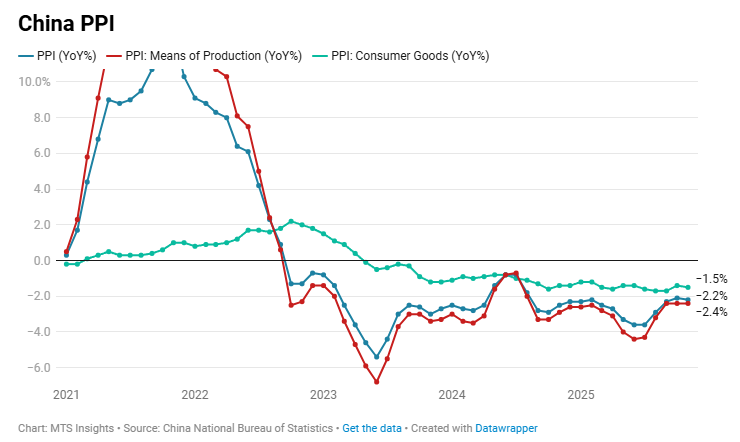
China’s producer price index (PPI) fell -2.2% YoY in November 2025 while rising +0.1% MoM, indicating continued but gradually narrowing factory-gate deflation with another month of modest sequential improvement.
-
Prices for means of production declined -2.4% YoY, contributing -1.79 ppts to the headline PPI, with sharp drops in mining (-6.1% YoY) and raw materials (-2.9% YoY) and a smaller decline in processing (-1.9% YoY), underscoring persistent weakness across upstream sectors.
-
Consumer goods prices fell -1.5% YoY, driven by declines in food (-1.5% YoY), clothing (-0.3% YoY), and durable consumer goods (-3.6% YoY), while general daily necessities rose +1.1% YoY, showing mixed price pressures on the consumption side.
-
Producer purchase prices fell -2.5% YoY, with broad declines across fuel and power (-6.9% YoY), building materials (-5.8% YoY), chemicals (-5.0% YoY), and agricultural and sideline products (-4.9% YoY), while non-ferrous metals rose sharply (+8.1% YoY), standing out as the only strong positive contributor.
-
On a monthly basis, means of production prices rose +0.1% MoM, led by mining (+1.7% MoM) and processing (+0.1% MoM), while raw materials dipped -0.2% MoM; consumer goods were unchanged overall, reflecting steady but subdued downstream pricing.
-
Purchase prices increased +0.1% MoM, driven by non-ferrous metals (+1.8% MoM), building materials (+0.2% MoM), and fuel and power (+0.1% MoM), while chemicals (-0.6% MoM) and agricultural inputs (-0.3% MoM) continued to soften.
-
Among major industries, non-ferrous metal mining posted the strongest gains (+2.6% MoM, +20.2% YoY), while coal mining (-11.8% YoY), oil and gas extraction (-10.3% YoY), and petroleum/coal processing (-7.2% YoY) remained significant drags on the PPI.
-
From January to November, PPI averaged -2.7% YoY and producer purchase prices averaged -3.1% YoY, highlighting ongoing but slowly easing industrial price deflation through most of 2025.