


S&P Global Services PMIs: March 2025
Global - 4/3/2025
Asia Pacific
- Australia - 4/2/2025
- Singapore (Composite only) - 4/3/2025
- Hong Kong (Composite only) - 4/3/2025
- Japan - 4/3/2025
- China - 4/3/2025
- India - 4/4/2025
- Russia - 4/3/2025
- Kazakhstan - 4/3/2025
Africa & Middle East
- Nigeria (Composite only) - 4/1/2025
- Qatar (Composite only) - 4/7/2025
- Kuwait (Composite only) - 4/7/2025
- Egypt (Composite only) - 4/3/2025
- UAE (Composite only) - 4/4/2025
- Uganda (Composite only) - 4/3/2025
- South Africa (Composite only) - 4/3/2025
- Lebanon (Composite only) - 4/3/2025
- Ghana (Composite only) - 4/4/2025
- Zambia (Composite only) - 4/3/2025
- Saudi Arabia (Composite only) - 4/7/2025
- Mozambique (Composite only) - 4/3/2025
- Kenya (Composite only) - 4/4/2025
Europe
- Ireland - 4/3/2025
- Spain - 4/3/2025
- Italy - 4/3/2025
- France - 4/3/2025
- Germany - 4/3/2025
- Eurozone - 4/3/2025
- UK - 4/3/2025
North & South America
Key Results
Japan
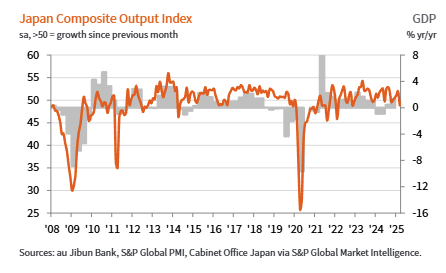
Declines in growth in both the manufacturing and services sector led to the Japanese S&P Composite PMI falling -3.1 pts to 48.9, the weakest reading since November 2022.
- Composite new orders meanwhile expanded at the softest pace in four months and only slightly. This reflected a slower increase in sales at services companies, combined with a further drop in manufacturing orders.
- Optimism around the one-year outlook for output slipped to the lowest since the start of 2021, with more companies expressing concerns around the global economic outlook and uncertain trade environment.
China
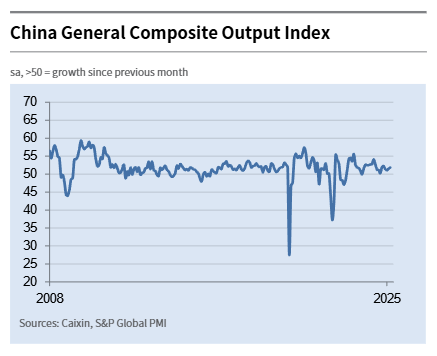
China’s S&P Composite Output Index was 51.8 in March, up from 51.5 in February, the highest since November 2024.
- This was supported by quicker rates of output growth in both the manufacturing and service sectors.
- Central to the rise in activity was greater inflows of new business, including new export business.
- Backlogs also accumulated for a second straight month. Employment levels declined, however, linked mainly to job shedding in the service sector.
- Average charges declined for a fourth straight month as input prices fell at a pace that, though marginal, was the quickest in almost five years.
Germany
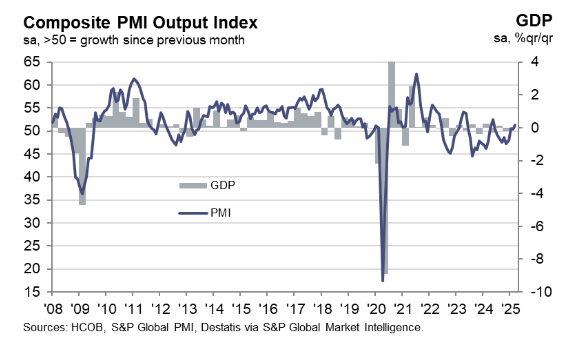
Germany’s S&P Composite PMI Output Index increased 0.9 pts to 51.3 in March, the highest in 10-months.
- The pace of growth accelerated thanks to an upturn in manufacturing production, which posted its first rise in nearly two years. This helped to nullify a slower expansion in services activity.
- Employment fell at the slowest rate in ten months as better growth improved labor market prospects.
- Data showed a broad-based improvement in expectations towards activity. Goods producers were more upbeat than their services counterparts.
Eurozone
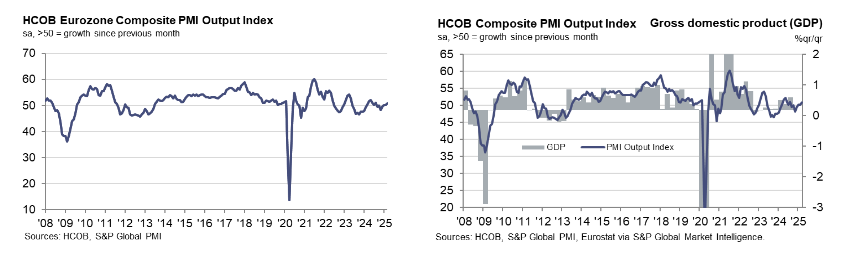
The Eurozone S&P Composite PMI improved to a 7-month high of 50.9 in March, above expectations of a smaller increase to 50.4.
- Both manufacturing and services played a role in March’s accelerated economic upturn. Goods production increased for the first time in two years, while services activity levels rose at a quicker pace than in February.
- As has been the case since last June, demand for eurozone goods and services declined during the latest survey period. Sales levels came close to stabilising, however, with the contraction cooling to a marginal pace that was the weakest over the current downturn.
- Spurring growth was a renewed uplift in employment in March. For the first time since July 2024, private sector workforce numbers increased across the euro area.
UK
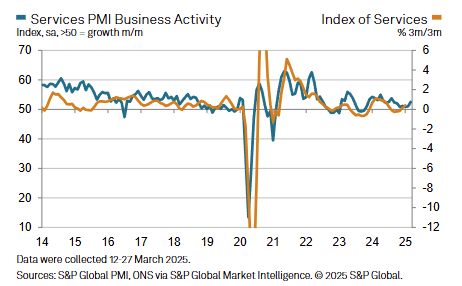
The UK saw its service sector growth improve to a 7-month high with a PMI reading of 52.5 in March, up from 51.0 in February.
- Although only marginal, the upturn in new work was the fastest since last November.
- New work from abroad increased for the first time in four months and at the fastest pace since last October.
- With stronger a service sector expansion, the S&P UK Composite PMI improved 1.0 pts to 51.5 in March, a 5-month high.
US
The US S&P Composite PMI increased 1.9 pts to 53.5 in March, the highest so far this year, as the Services PMI jumped 3.4 pts to 54.4, also the highest so far in 2025.
- Higher service sector activity was principally linked to increased volumes of new work amid evidence of strengthened customer demand.
- Services operating expenses increased in March to the greatest degree in a year-and-a-half. In general, private sector input costs increased at the fastest rate in 2 years.
- Some worries over the impact of federal government policies, especially in relation to tariffs, meant confidence in the outlook fell to its second lowest since the end of 2022.
Canada
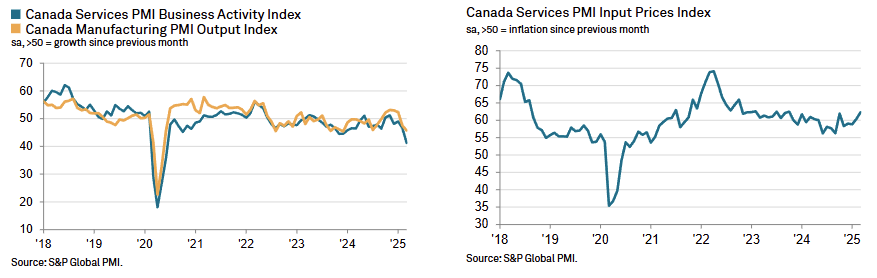
Canada’s service sector contracted at the sharpest rate since June 2020 as the Services PMI fell -5.4 pts to 41.2.
- Confidence amongst service providers slumped in March to its lowest level since May 2020.
- Operating expenses rose noticeably again in March, with input price inflation accelerating to its highest level since October 2023.
- Confidence amongst service providers slumped in March to its lowest level since May 2020.
- The private sector as a whole contracted at the sharpest rate since June 2020 with the Composite PMI down -4.8 pts to 42.0.