


US Personal Income and Outlays: May 2025
The latest personal income and spending data for May delivered a downside surprise, adding to concerns raised by the downward revision to Q1 GDP growth just a day earlier. At first glance, the report looks soft, with both income and consumption missing expectations. However, a closer look reveals that much of the weakness stems from temporary volatility in key components like government transfers and proprietors’ income. Meanwhile, PCE inflation figures came in slightly firmer than forecast, reinforcing the Fed’s cautious stance as it awaits more clarity on the inflation path.
Income and Spending
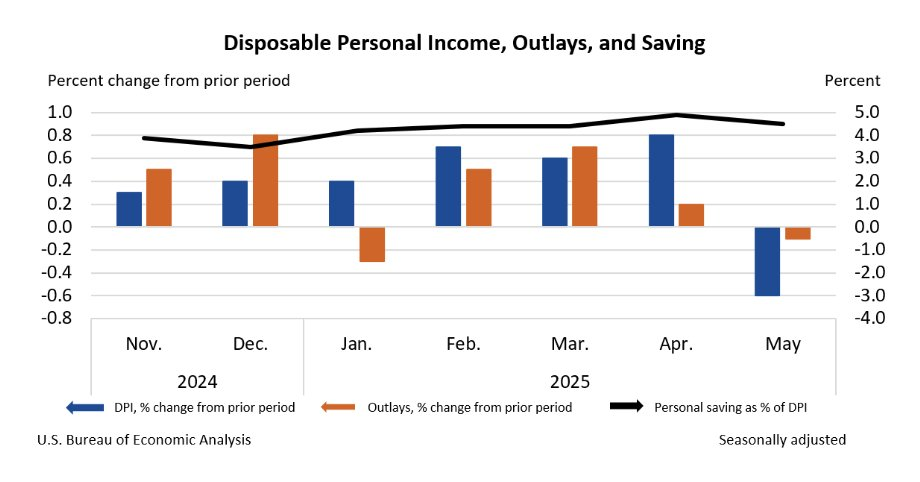
Income and spending data for May came in notably weak, compounding the pain felt from the downward revision to GDP growth in the final estimate released yesterday. Today’s personal income and outlays report reveals that personal income fell -0.4% MoM in May, slowing significantly from the 0.7% MoM increase in April and coming in well below the forecast of a slight 0.3% MoM gain. The drop in disposable income was slightly worse at -0.6% MoM, the worst drop since January 2022. These headline figures look quite soft, but the underlying data suggests they can be attributed to month-to-month volatility.
There was a large decline in personal current transfer receipts in May of -$110.4 billion, and more specifically, in Social Security benefits distributed, down -$122.4 billion, after that segment perked up in April, up $107.6 billion. The volatility in this segment more than offset the gains in employee compensation which were stable at 0.4% MoM across both April and May. Another segment that caused the downside surprise was a decrease in proprietors’ income, down -2.3% MoM in May after growth of 1.6% MoM in March and 1.2% MoM in April.
Alongside weak income data, we see a weak personal consumption expenditures (PCE) print that reflected the drop in retail sales earlier this month. PCE fell -0.1% MoM in May, the second monthly decline so far this year (first was in January) and below expectations of a slight 0.1% MoM gain. The drop was driven by goods spending down -0.8% MoM, especially durable goods spending which was down -1.8% MoM, while services spending was positive but the slowest since November 2020 at 0.1% MoM. The trend in goods spending is consistent with the retail sales blip that was caused by consumers front-running tariffs.
PCE Inflation
The Fed has been in the spotlight ever since it decided to keep rates unchanged following its June FOMC meeting as Fed Governors Waller and Bowman came out shortly after with dovish remarks and President Trump launched attacks on Chair Powell. This week, the focus on the Fed came in the form of Powell’s presentation of the Semiannual Monetary Policy Report in front of Congress. To close the week, we get the May update of the Fed’s preferred inflation gauge.
Headline PCE inflation for May was reported at 0.1% MoM and 2.3% YoY, slightly higher than the 2.2% YoY annual rate reported in April and in line with expectations. Core PCE inflation, the metric watched by the Fed, came in slightly ahead of expectations at 0.2% MoM (vs 0.1% MoM expected) and 2.7% YoY (vs 2.6% YoY expected). Ignoring analyst projections, inflation was pretty calm across all subsegments. Goods prices were up just 0.1% MoM, and services prices were up 0.2% MoM (rounded up from 0.17% MoM). Food prices increased 0.2% MoM, and energy prices fell for the 2nd time in three months, down -1.0% MoM.
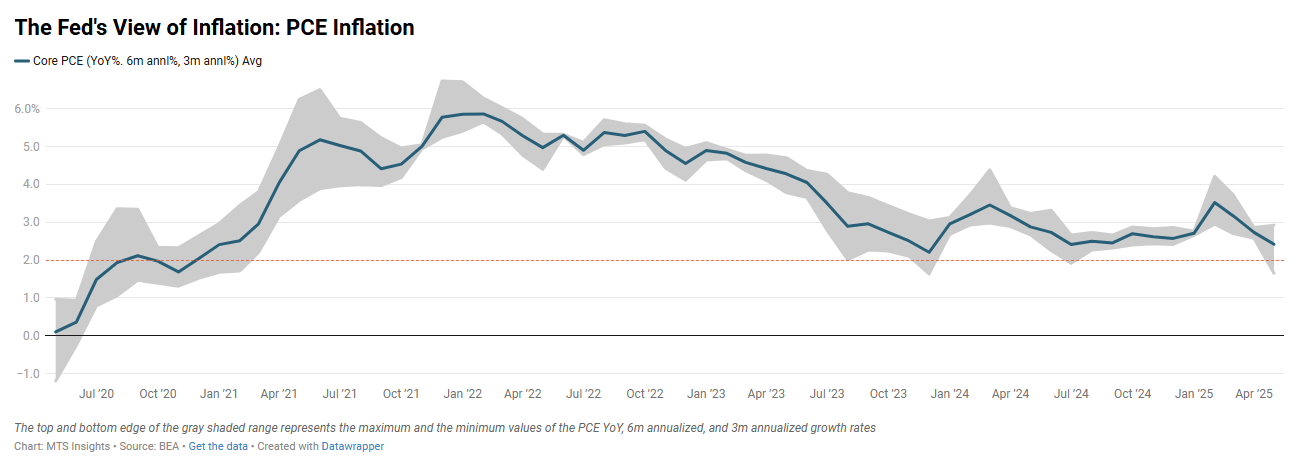
While annual core PCE inflation did accelerate slightly, short term inflation pressure is now trending at the Fed’s target. The annualized rate of the quarterly change in core PCE inflation is at 1.7% with goods prices in deflation and services prices just above target at 2.1% using the same measure. This data is now the same or slightly softer than the data that the Fed was dealing with when it chose to cut rates by 50 bps in September 2024. It is safe to say that inflation data over the last three months would contribute to a case for a rate cut.