


UK CPI: April 2025
UK inflation rebounded sharply in April, as rising household utility bills and holiday travel costs drove the annual rate to the highest since early 2024. Underlying price pressures flipped from being a bit softer in March to a hotter-than-expected monthly rise in April. The surprise uptick may complicate the Bank of England’s efforts to keep inflation under control while it looks for ways to support the economy which faces growth concerns from global trade tensions.
CPI and Key Segments
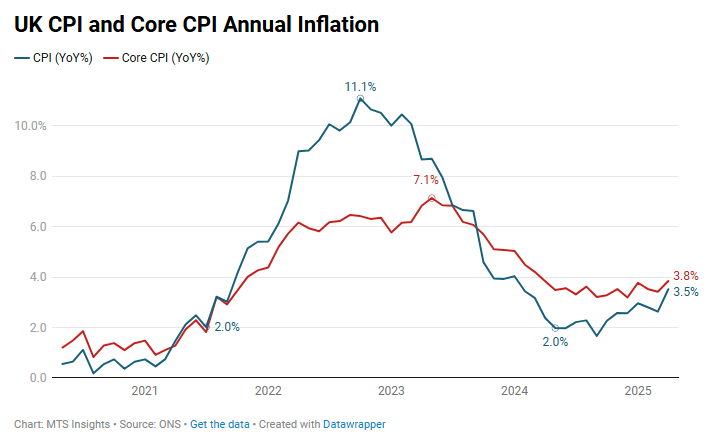
The headline CPI index increased 1.2% MoM in April, pushing the annual inflation to 3.5% YoY and topping expectations of increases of 1.1% MoM and 3.3% YoY. This acceleration follows a much weaker March’s 2.6% YoY increase which looked like a signal that disinflation was finally happening. Instead, in April we see the annual rate rise to the highest since January 2024, reflecting both hot monthly gains and strong base effect from last year’s price dynamics. Indeed, a key factor was that the 1.2% MoM increase in April 2025 was much stronger than the April 2024’s rise of 0.3% MoM. Let’s look at some key segments:
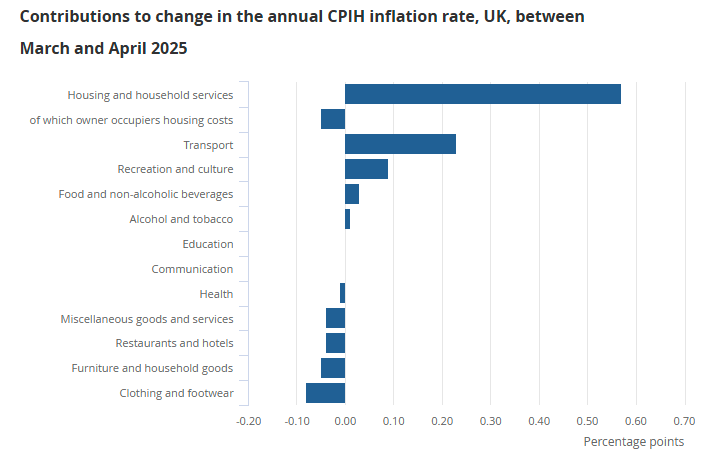
- Housing and utility costs were the single largest driver of April’s inflation surge. The housing and household services segment (which includes electricity, gas, and other fuels, as well as water supply and other utilities) saw prices rise 3.3% MoM and 7.8% YoY in April, up from 1.8% YoY in March. Not only was there a hot monthly rise, but base effects made the jump even more impactful as it compared to a -2.5% MoM drop in April 2024. The steep gain this year reflects increases in household energy bills. Notably, Britain’s energy regulator Office of Gas and Electricity Markets (Ofgem) raised its price cap by 6.4% from April, which immediately fed through to higher electricity and gas prices.
- Transport costs were another major contributor to the reheating of inflation. The segment was up 3.8% MoM in April (vs a rise of 1.7% MoM in April 2024), pushing the annual rate to 3.3% YoY from a much smaller 1.2% YoY increase in March. The surge was driven especially by an Easter-related rise in air travel prices which had airfares up 27.5% MoM in April (the rise of just 6.5% MoM in the same month a year ago). Indeed, the ONS points out that this was the 2nd highest monthly rise ever recorded for the airfare subindex. In addition to the rise in air travel costs, the government’s vehicle excise duty (VED) increase in April put upward pressure on the transport segment. Offsetting these hot trends were softer fuel prices. The overall motor fuel index was down -9.3% YoY, a stronger decline than the -5.3% YoY drop in March.
- Alongside the rise in transport costs was a rise in the recreation and culture segment which was up 1.2% MoM and 3.1% YoY (up from 2.4% YoY in March). Just as with air transport, the Easter timing meant that holiday tour prices rose more this April, whereas last year’s index captured Easter holiday costs in March (this may have also explained why March inflation was as soft as it was).
- Not all categories saw price increases, and a few provided downward pressure on the overall inflation rate. The largest offsetting movement came from clothing and footwear, which flipped into deflation, down -1.1% MoM and -0.4% YoY. This was the first negative annual rate for apparel in roughly two years. Similarly, the furniture and household goods segment saw prices ease with drops of -1.7% MoM and -0.5% MoM, as retailers of household appliances, furniture and other home goods kept prices in check or discounted products amid softer demand. Other cooler segments include education (+0.0% MoM) and health (+0.3% MoM).
Core CPI
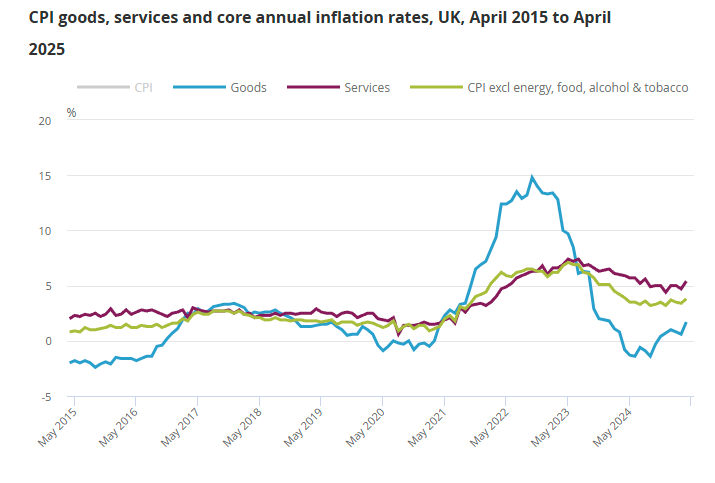
Stripping out volatile food and energy effects, core CPI inflation in the UK also strengthened in April, underscoring that underlying price momentum remains concerning even though it looked like there might be some cooling in March. Core CPI increased 1.4% MoM and 3.8% YoY, up from 3.4% YoY in March and a strong beat over expectations of core rises of 1.2% MoM and 3.6% YoY. Base effects were evident in core inflation but not as much as the 1.4% MoM April 2025 change compares to an 0.9% MoM April 2024 change. Coincidentally, this renewed pickup brings core inflation back to the highest level in a year, when the annual increase was 3.9% YoY in April 2024. Price growth in core categories had shown tentative signs of cooling in late 2024, but the first months of 2025 have seen core inflation return to and above the mid-3% range.
There continues to be a divergence between goods and services inflationary pressures and the release this month demonstrates that clearly.
- Goods inflation remained relatively subdued in April, up just 0.3% MoM, and the annual rate was 1.7% YoY. While this was a notable increase from just 0.6% YoY in March, the acceleration is mostly a result of base effects as the goods index fell -0.8% MoM a month ago. Additionally, the rise in goods inflation was driven largely by the turnaround in energy-related goods prices, so core goods prices were even cooler. The clothing and footwear and household furnishings segments, both components of core CPI inflation, are two that I pointed out were particularly weak in April. Essentially, core goods inflationary pressures is no a longer a primary driver of UK inflation, and it hasn’t been since the post-COVID supply chain crunch.
- On the other hand, services inflation continues to run hot, reflecting more persistent price pressures. The services CPI segment jumped 2.2% MoM in April, and the annual rate accelerated to 5.4% YoY, up from 4.7% in March and the highest since August 2024. Several specific service components linked to tourism saw especially large gains. As discussed, air travel saw an unprecedented surge and the recreational and personal services also rose sharply, both due to the dynamics of the Easter holiday. Some of these factors look temporary, but in fact, they highlight more entrenched economic factors that drive inflationary pressure like high service sector wage growth and consumer finances that are strong enough to support this type of spending.
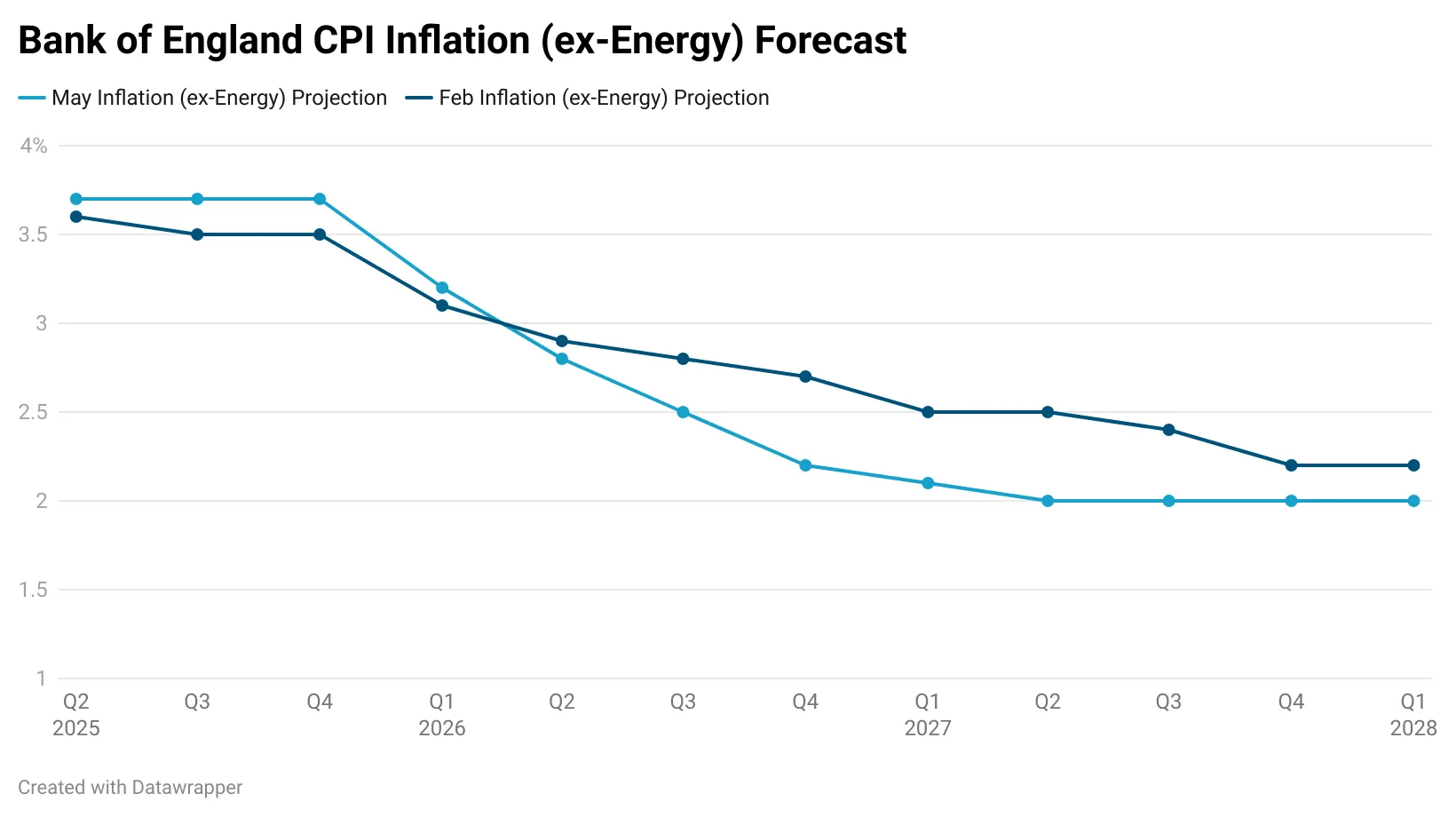
Just a few weeks ago, the Bank of England (”BoE”) opted to cut interest rates as it decided that inflationary pressures had receded just enough to justify an easing in monetary policy. The announcement came with an updated set of forecasts that set forth its expectations on prices pressures over the next four years. In that May Monetary Policy Report, its forecasts for CPI inflation and CPI inflation (ex-energy) in Q2 2025 were 3.4% and 3.7%, respectively, meaning that with the April report, inflation has already surpassed its expectations in the first month of the second quarter. This suggests that the Bank of England should be thinking more about upside risks to the inflation outlook than downside risks that it may perceive from more economic slack.