


Euro Area Inflation: January 2025 (Preliminary)
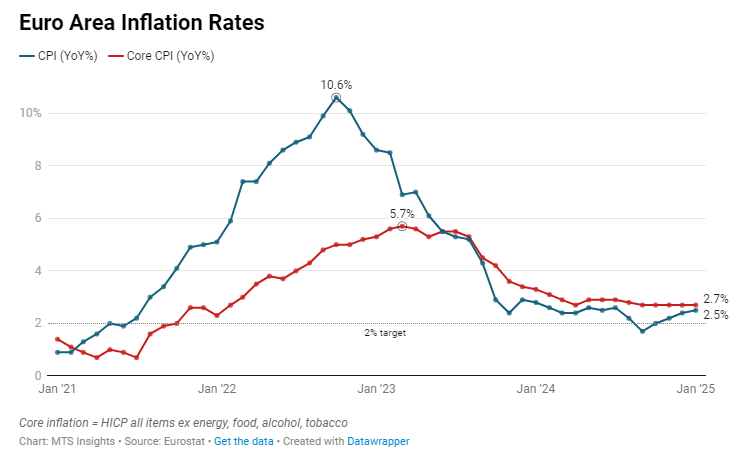
Euro area inflation comes in slightly above expectations even though there was a substantial monthly decline. The -0.3% MoM was the third monthly decline in the last five months, but it was not enough to keep the annual rate from accelerating slightly to 2.5% YoY in January from 2.4% YoY in December where analysts expected it to stay at. Similarly, core inflation beat expectations at 2.7% YoY (for the fifth consecutive month) despite a sharp -1.0% MoM decline. Analysts had expected core inflation to slow to 2.6% YoY, what would have been a new three year low.
Both food and energy prices put upward pressure on the headline index in January with the former up 0.6% MoM and the latter up 2.9% MoM. Food (and alcohol & tobacco) inflation had gotten slightly hotter in Q4 2024 but came back down in January to 2.3% YoY, the lowest since August 2024. Energy prices have reversed from being deflationary in Q3 2024 to now being up 1.8% YoY, the highest annual increase since April 2023. This is consistent with energy commodity prices seeing a strong December.
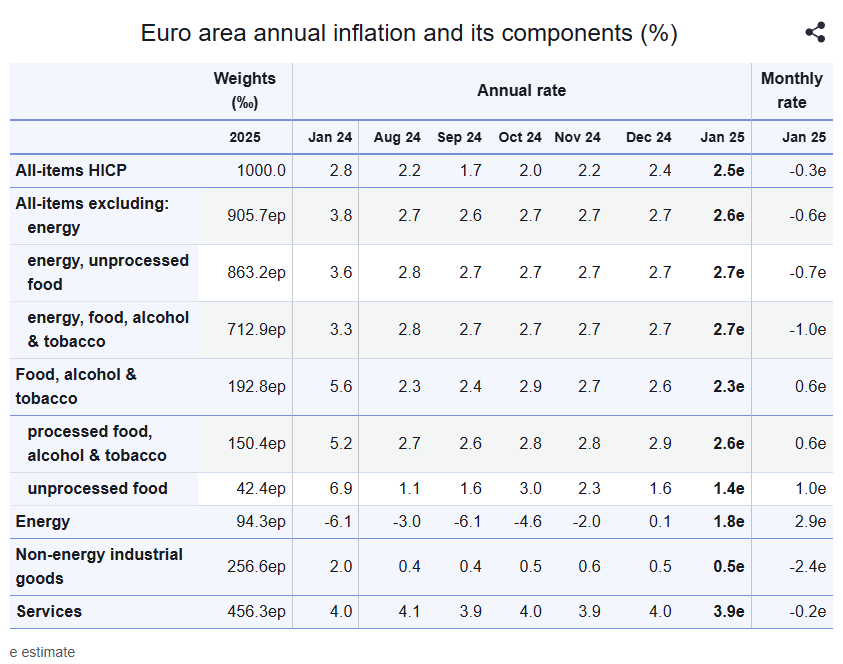
The weakness in inflation came in both goods and services. The non-energy industrial goods segment saw inflation of -2.4% MoM and 0.5% YoY in January. Goods prices continue to be depressed as a result of weak economic activity and consumer demand. Services inflation, which has been sticky as a result of strong wage growth, was -0.2% MoM and 3.9% YoY (just -0.1 ppts from the December rate). The reason we are only seeing a small deceleration in the annual rate is that services prices fell -0.1% MoM in January 2024 and the 0.7% MoM increase in December 2023 fell of, so there was no help from base effects. Regardless, short-term trends look favorable for the ECB (but also a bit concerning) as the average monthly rate for the past six months comes out to a decline -0.13%.