


China PPI: July 2026
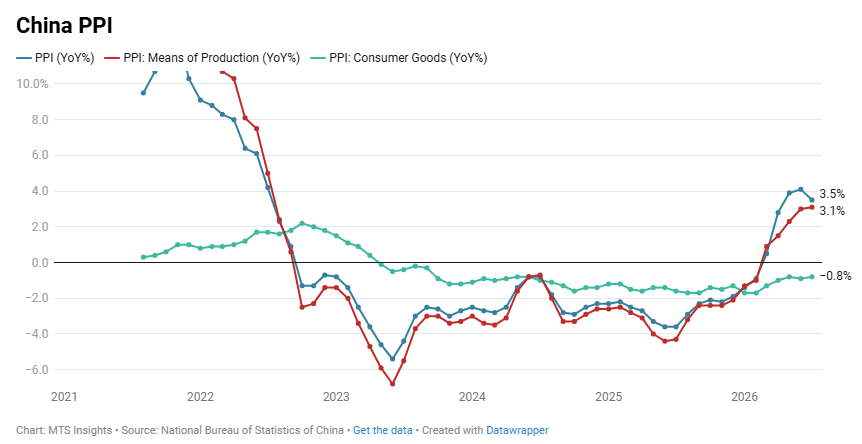
China’s PPI rose +3.5% YoY and fell -0.7% MoM in July 2026, while industrial producer purchase prices increased +5.5% YoY and declined -1.0% MoM, indicating elevated upstream inflation alongside a sharper monthly pullback.
-
Industrial producer ex-factory prices increased +3.5% YoY, with production materials rising +4.8% YoY and contributing about +3.72 ppts to the headline PPI, showing that upstream categories remained the main source of annual price growth.
-
Within production materials, mining prices increased +16.4% YoY, raw materials rose +6.1%, and processing prices gained +3.1%, indicating broad annual strength across upstream industrial stages.
-
Consumer goods prices fell -0.8% YoY, subtracting about -0.17 ppts from PPI. Food prices declined -2.1%, clothing -1.1%, and daily necessities -1.0%, while durable consumer goods rose +0.4%, showing continued weakness in downstream consumer-related pricing.
-
Industrial producer purchase prices rose +5.5% YoY, led by non-ferrous metals and wires (+19.0%), fuel and power (+9.3%), and chemical raw materials (+9.3%), indicating persistent cost pressure across key industrial inputs.
-
On a MoM basis, PPI declined -0.7%, driven by a -0.9% fall in production materials. Raw-material prices dropped -2.4%, mining prices fell -0.2%, and processing prices declined -0.1%, pointing to a broad short-term easing in upstream prices.
-
Consumer goods prices edged down -0.1% MoM, with clothing prices falling -0.3% and daily necessities -0.2%, while food and durable consumer goods were unchanged, indicating relatively limited monthly movement in downstream categories.
-
Producer purchase prices declined -1.0% MoM, with fuel and power and chemical raw materials both down -2.6%, non-ferrous metals and wires -1.4%, and ferrous and textile inputs -0.2%, while agricultural and sideline products rose +0.5%.
-
From January to July, PPI increased +1.8% YoY and producer purchase prices rose +2.8% YoY, indicating that despite strong July annual readings, year-to-date producer inflation remained more moderate.