
 USA
/
Revelio Labs
Revelio Public Labor Statistics
About
-
December 3rd, 2026 · 8:30 AM
Latest Releases
12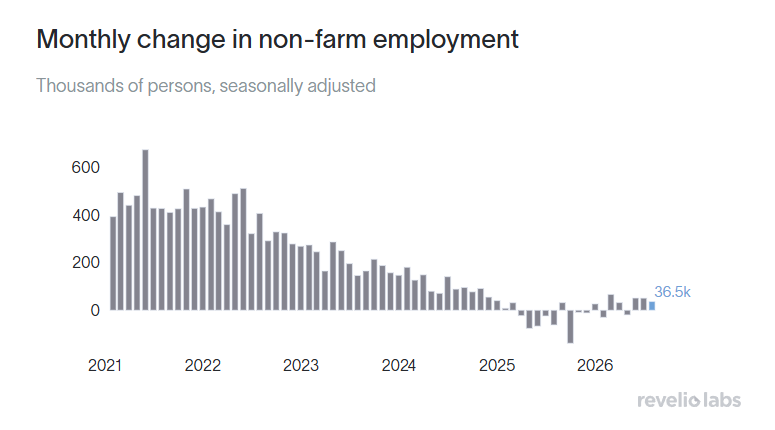
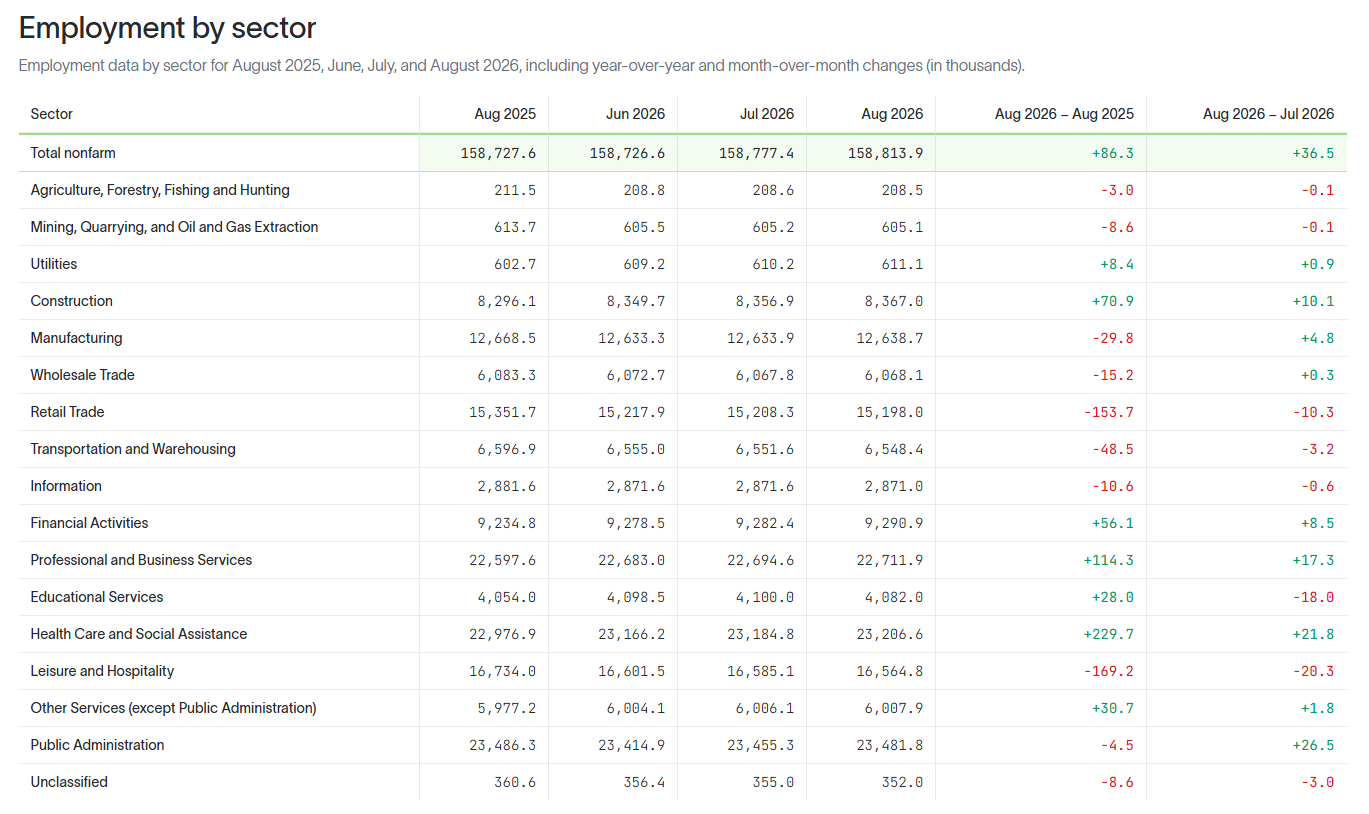
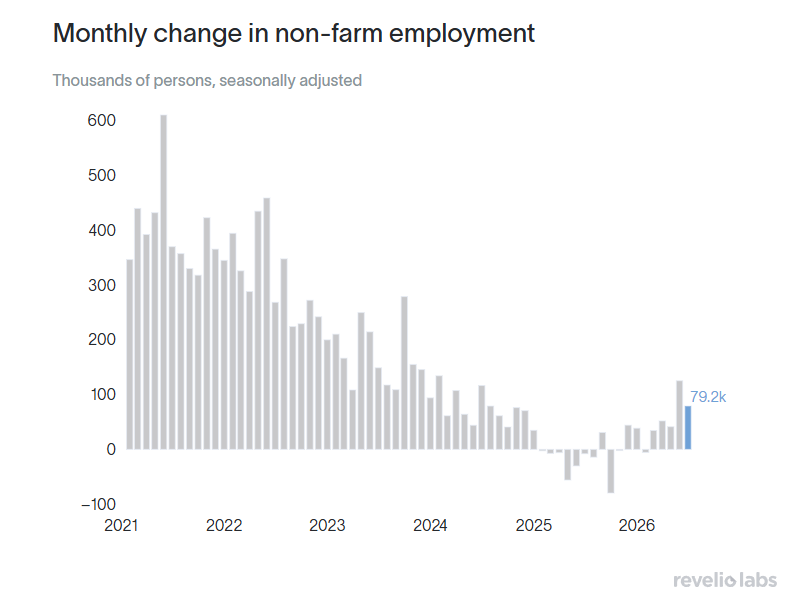
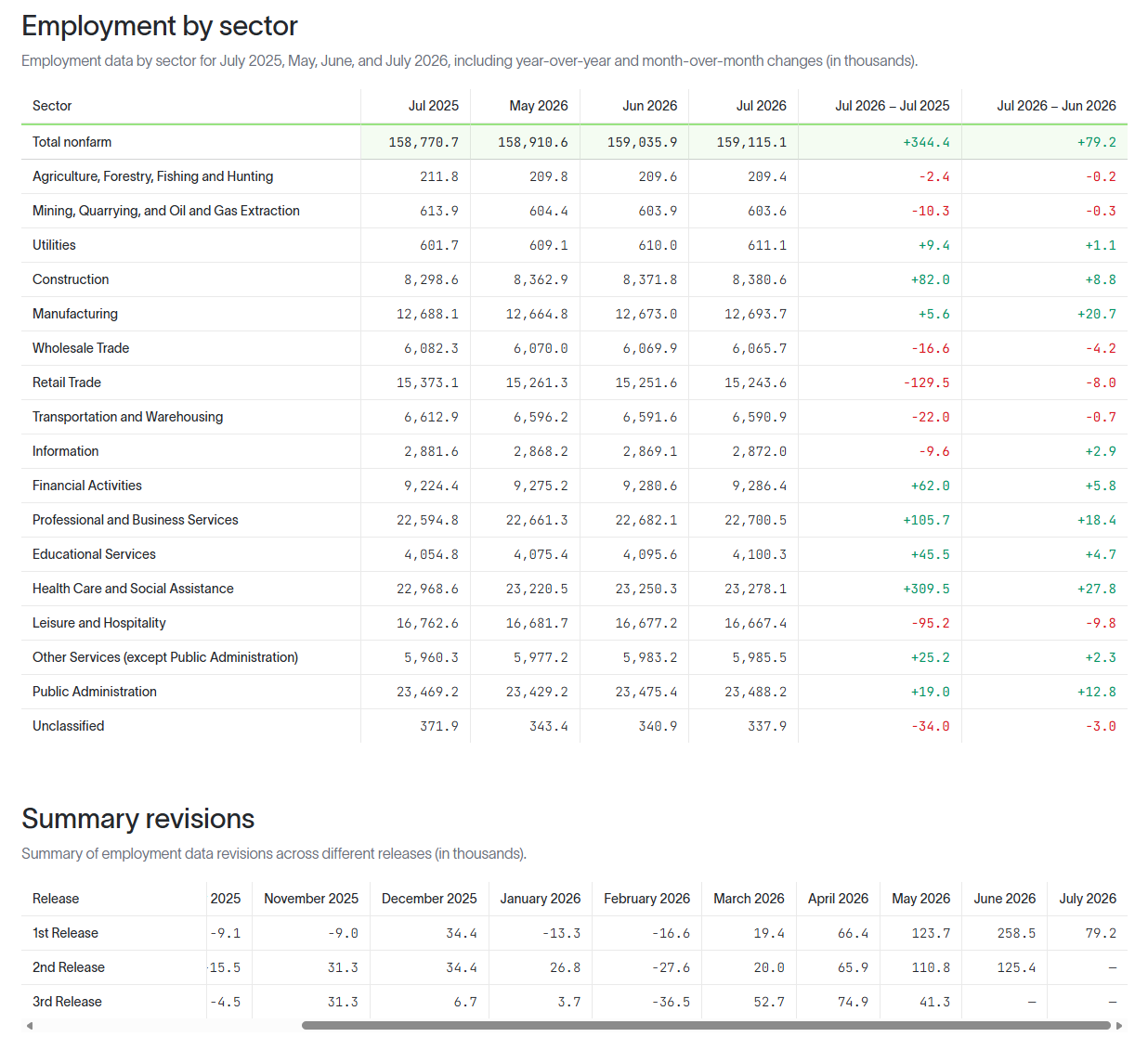
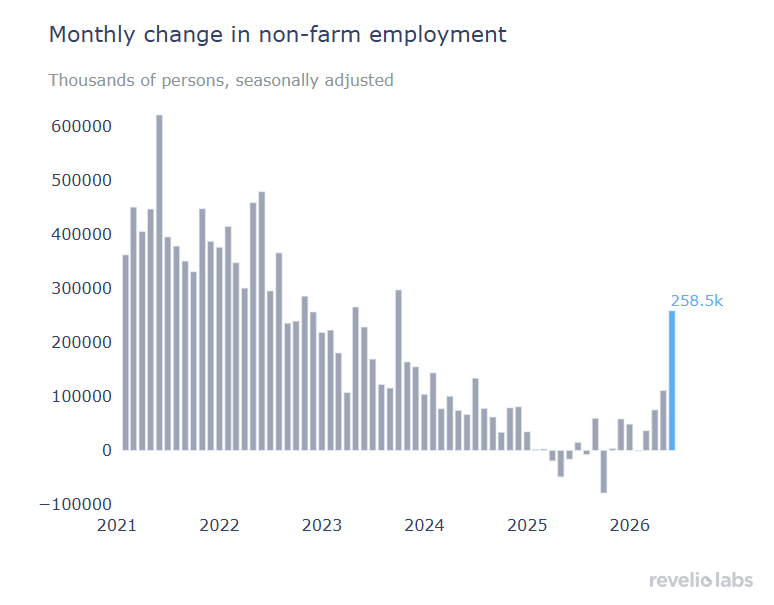
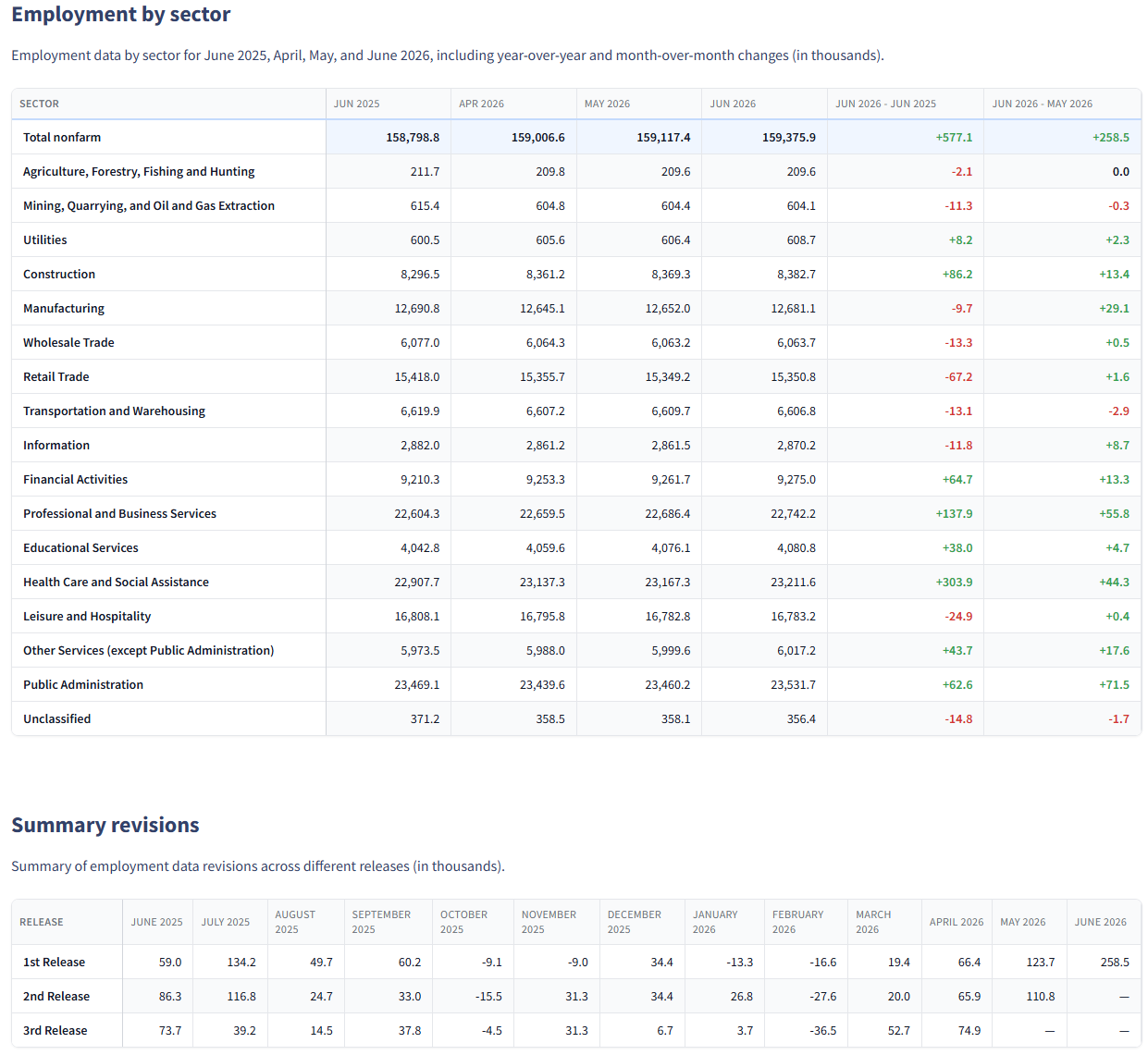
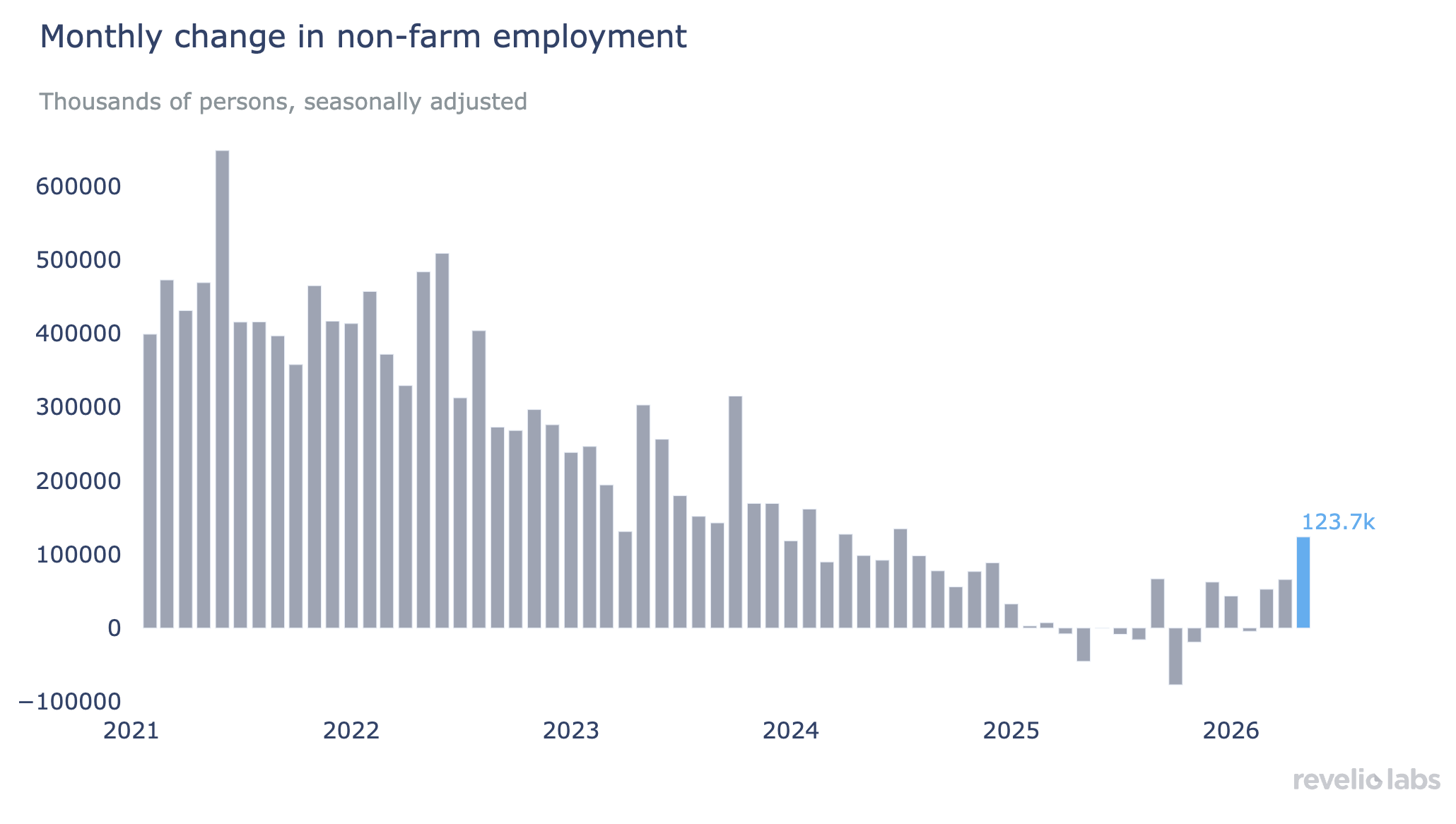
Revelio Public Labor Statistics (RPLS) shows the economy added 123.7k jobs in May 2026. This gain was driven by significant job gains in the Public Administration, Health Care and Social Assistance, and Professional and Business Services sectors. Meanwhile, Retail and Leisure and Hospitality showed significant declines again this month.
-
Within these sectors, the employers with the largest increases in employment were the US Government and the State of California in Public Administration, and Adventist Health System and HCA Healthcare in Health Care and Social Assistance. On the other hand, Starbucks and Inspire Brands (e.g. Dunkin’) had the largest employment losses in the Leisure and Hospitality sector.
-
Labor demand was largely unchanged in May. RPLS active postings ticked down by 0.3% in May compared to April. Decreases in active postings were led by the Information sector, although other sectors like Leisure and Hospitality and Finance saw notable increases.
-
Salaries from new job postings ticked down in May, decreasing by 0.4% from April to May. Sectors driving the decline were Retail Trade, and Mining and Oil Extraction.
Employment
Revelio Public Labor Statistics (RPLS) shows the economy added 123.7k jobs in May 2026. This gain was driven by significant job gains in the Public Administration, Health Care and Social Assistance, and Professional and Business Services sectors. Meanwhile, Retail and Leisure and Hospitality showed significant declines again this month, continuing an ongoing downward trend.
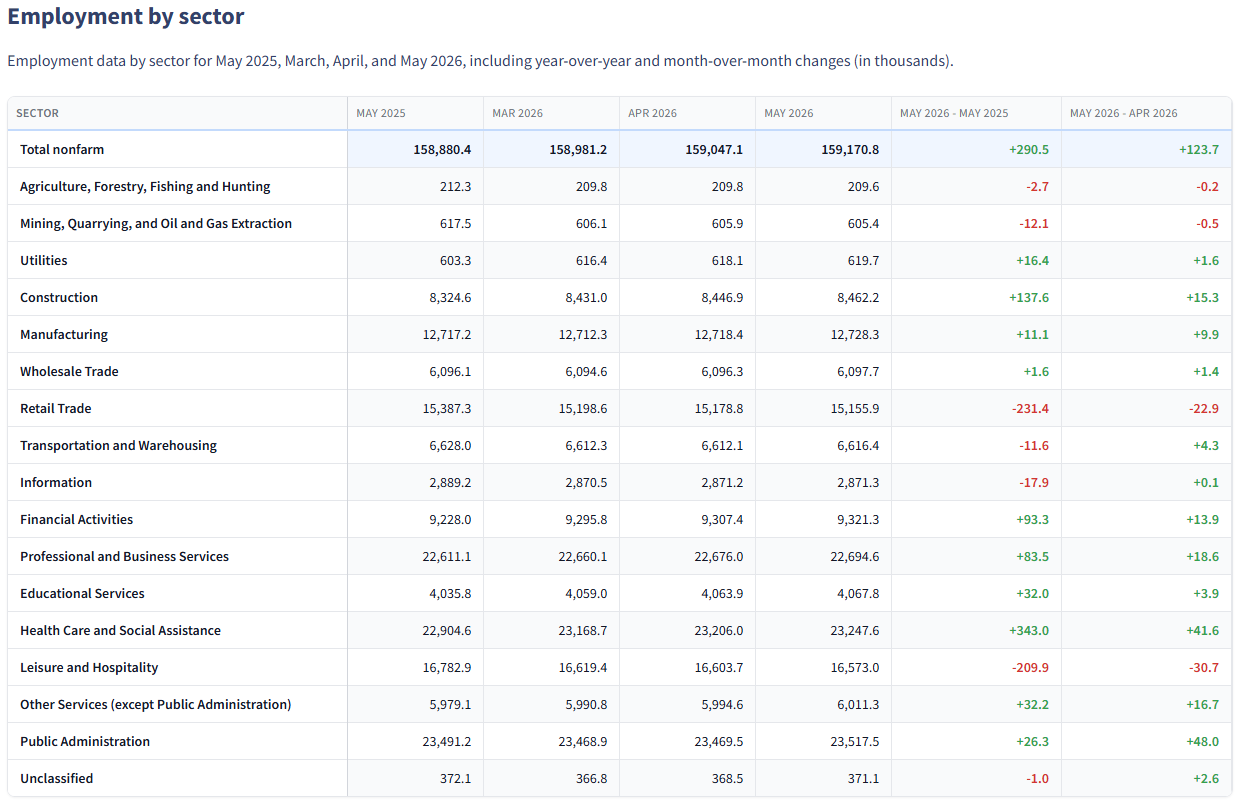
Within these sectors, the employers with the largest increases in employment were the US Government and the State of California in Public Administration, and Adventist Health System and HCA Healthcare in Health Care and Social Assistance. On the other hand, Starbucks and Inspire Brands (e.g. Dunkin’) had the largest employment losses in the Leisure and Hospitality sector.
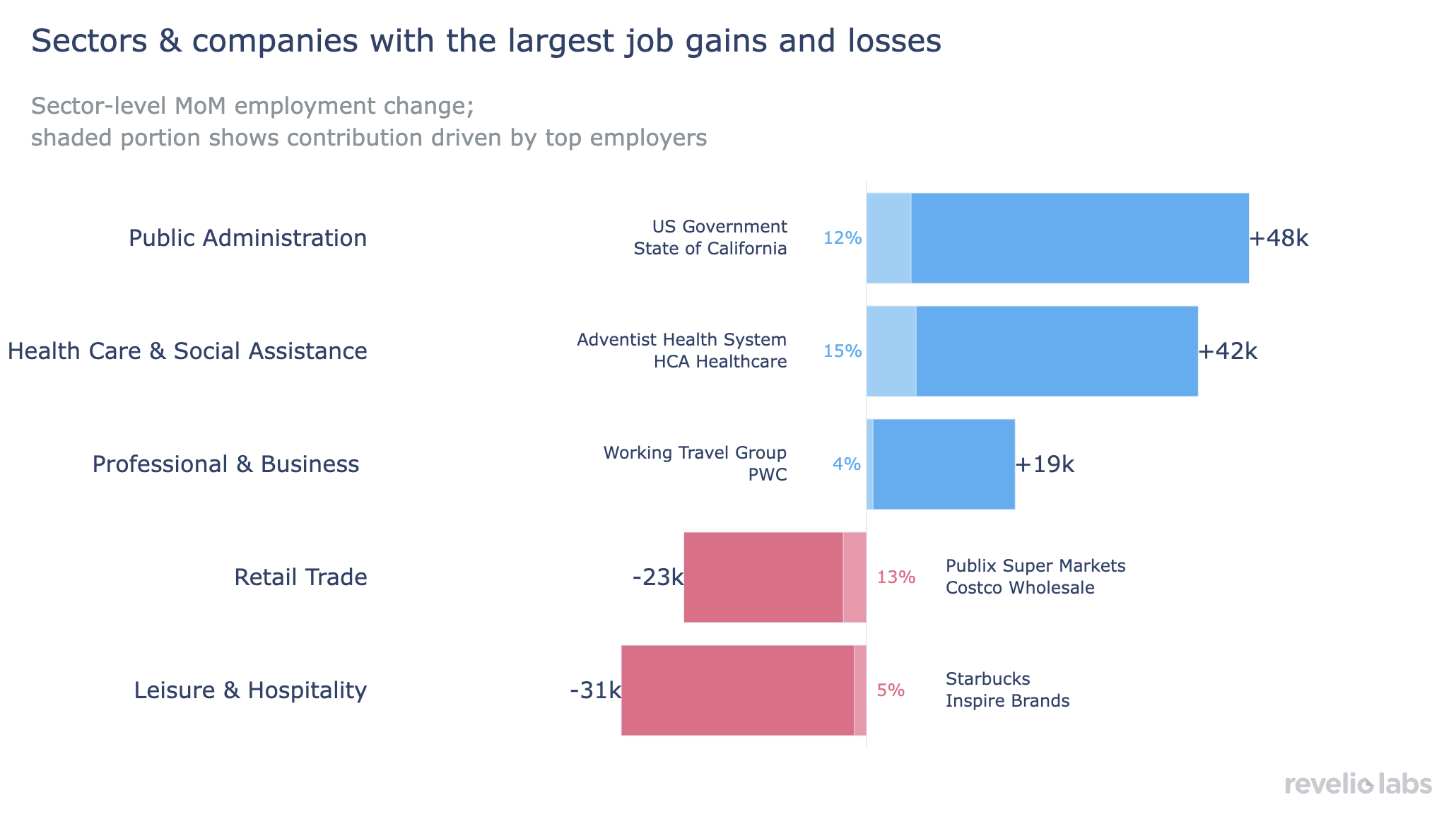
The composition of job growth remains uneven. Public Administration, Health Care, and Professional and Business Services accounted for a large share of employment gains in May, while Retail Trade and Leisure and Hospitality posted substantial losses. This pattern suggests continued strength in knowledge-intensive and professional services alongside persistent weakness in consumer-facing industries.
Mass layoff notices
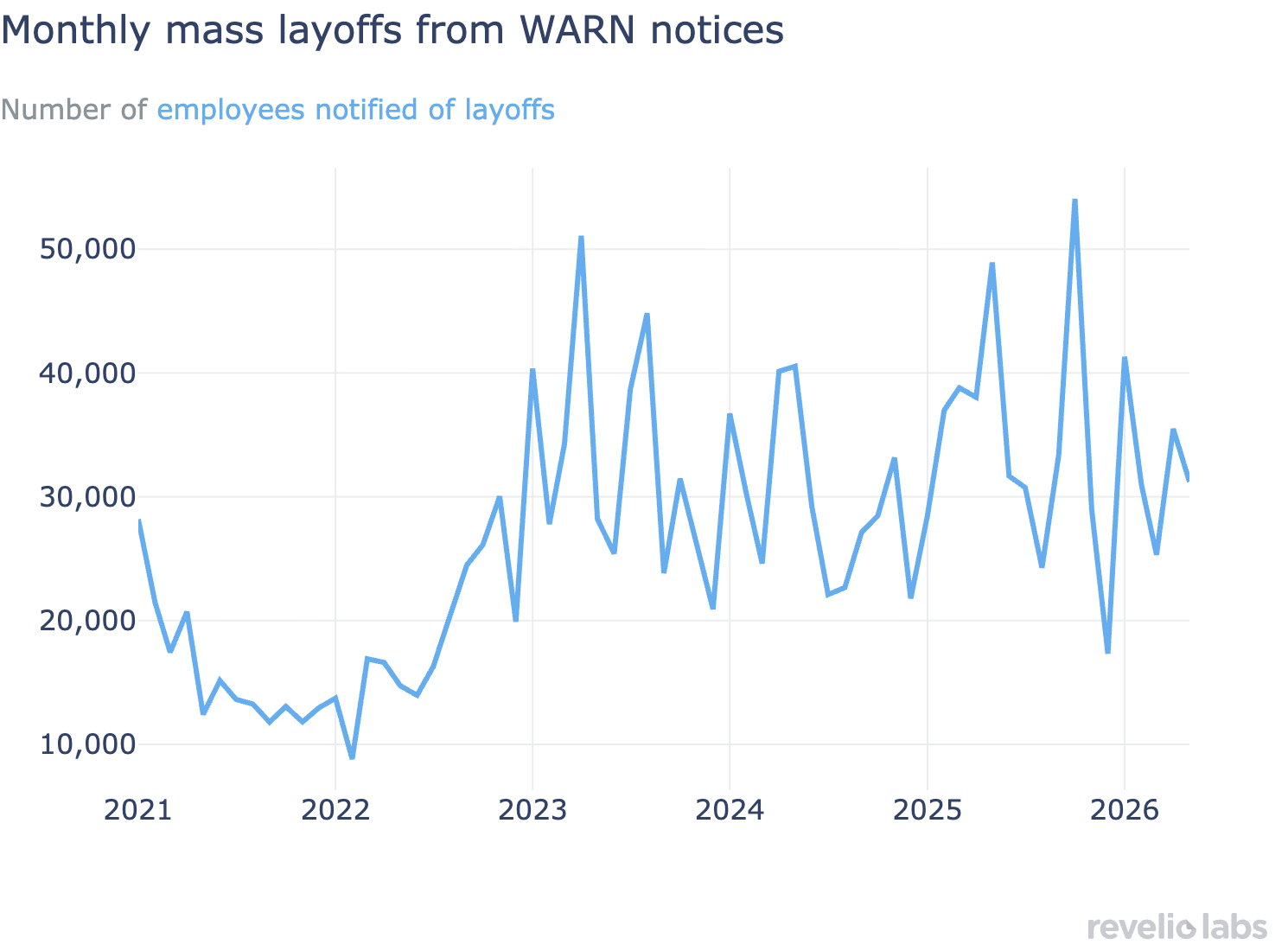
We observe a slight decline in the number of employees notified of layoffs as part of WARN layoff notices in May. In general, mass layoffs have been largely stable since the beginning of 2026, with very minor fluctuations every month. The number of employees notified of layoffs declined to ~31k employees in May compared to 34.8k employees in April.
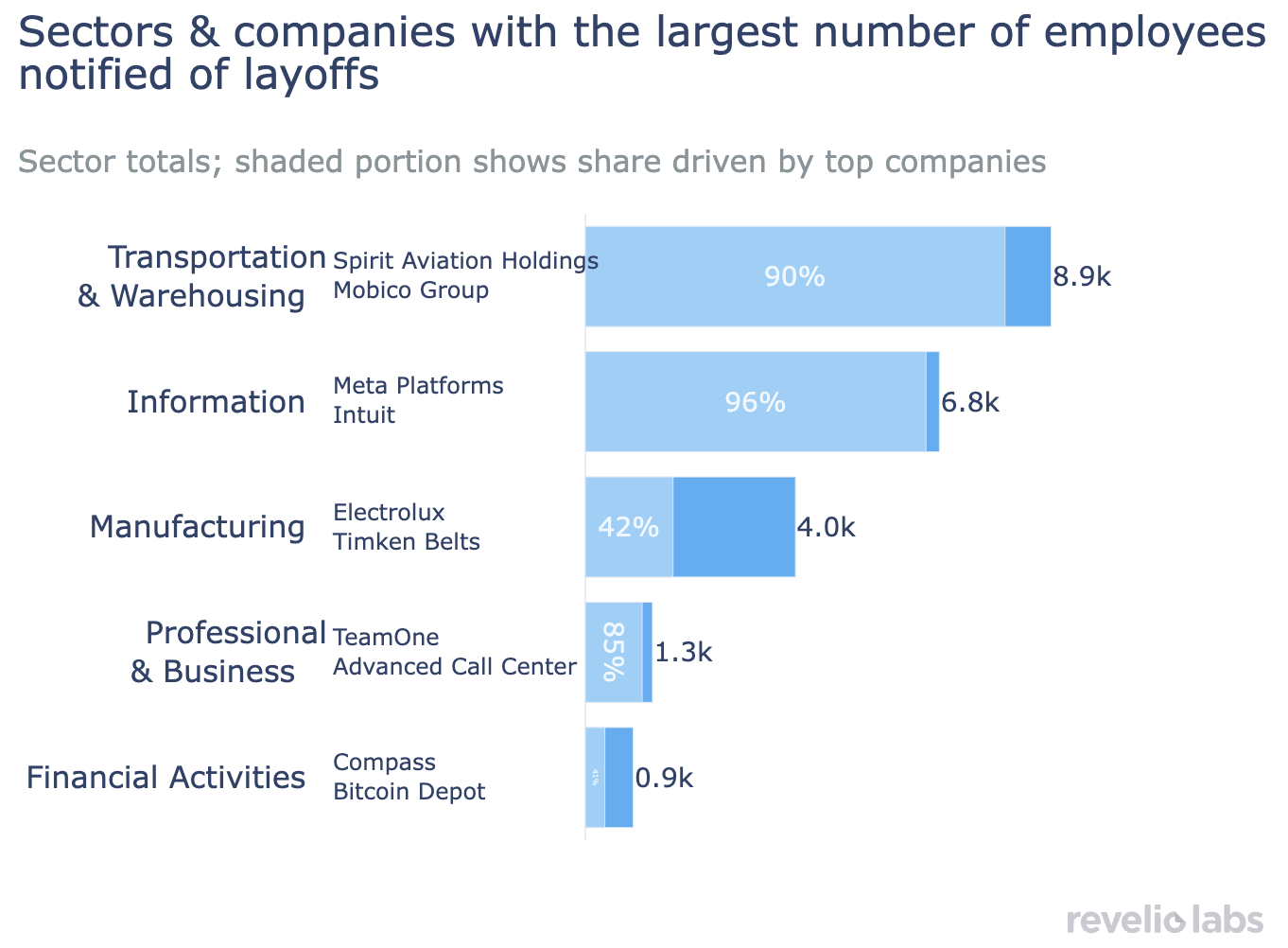
The Transportation and Warehousing sector saw the largest number of employees notified of layoffs in May, followed by the Information sector. The layoffs in the Transportation sector are primarily driven by the permanent shutdown of Spirit Airlines on May 2nd. Even though the WARN act requires companies to file for mass layoffs 60 days in advance of the layoff, there are some exceptions to the law. One of these exceptions is unforeseeable business circumstances, which was the case for Spirit Airlines following the collapse of a last-minute government bailout and the surge in fuel prices. Within the Information sector, Meta stands out as the company driving the mass layoffs after its recent announcement to lay off 10% of the workforce to offset their investments in AI.
Hiring and Attrition
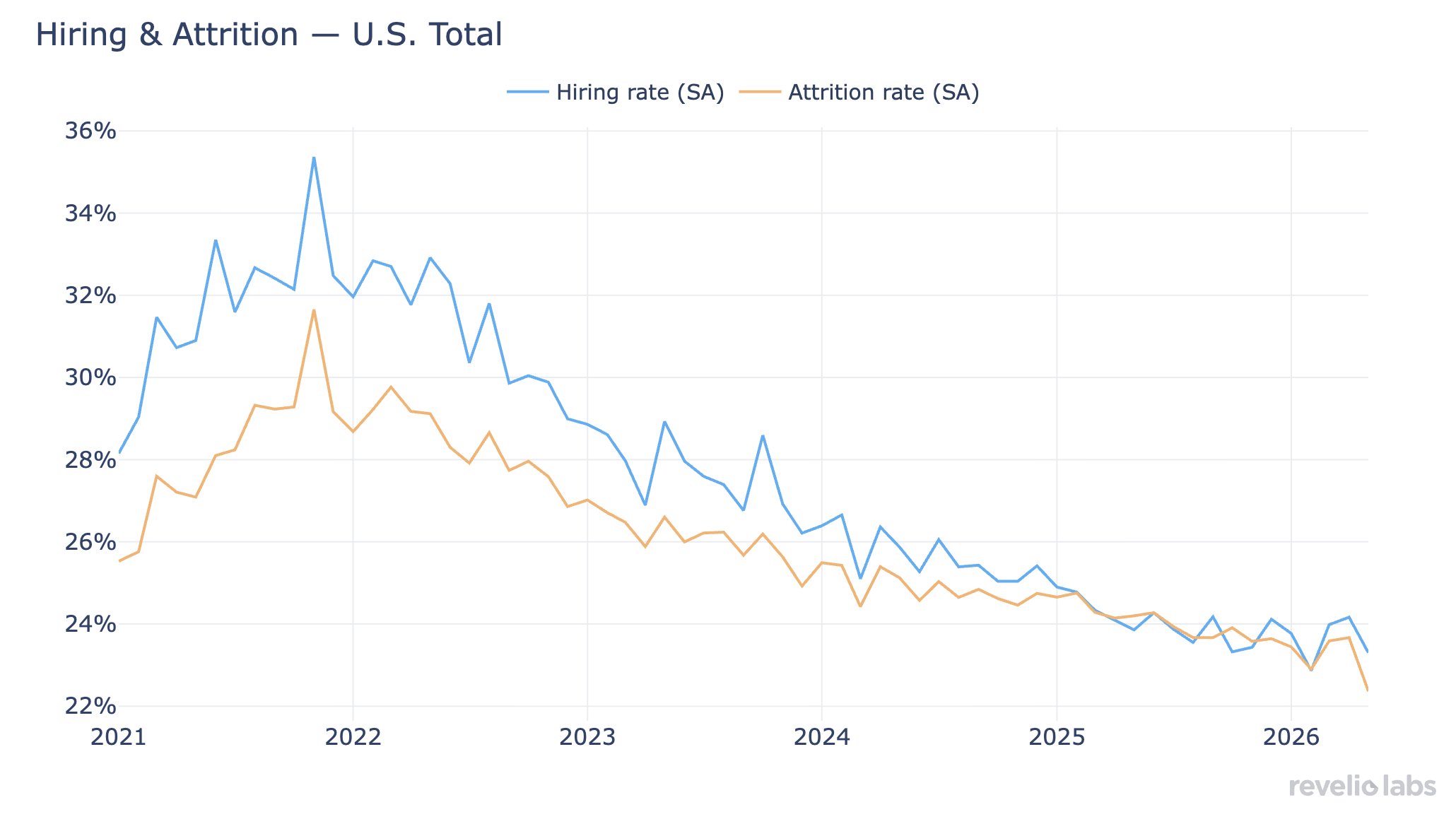
The hiring and attrition rates both ticked down in May. Hiring declined by 0.9 percentage points, while attrition declined by 1.3 percentage points. Because attrition declined by more than hiring, employment continued to grow in May. The sharpest pullback in hiring occurred in Leisure and Hospitality, where it fell 4.0 percentage points month-over-month, while most other sectors also experienced slower hiring. Public Administration was a notable exception, with hiring continuing to edge higher.
The largest declines in attrition were concentrated in Other Services, Leisure and Hospitality, Public Administration, and Transportation and Warehousing, and Health Care and Social Assistance, Financial Activities, and Professional and Business Services also saw declines. While employers are largely holding on to the workers they have, a lack of opportunities elsewhere is pushing down voluntary separations as well, leading to the sharp decline in attrition. Information remained an outlier, with attrition ticking up slightly and remaining elevated relative to other sectors.
Job Postings
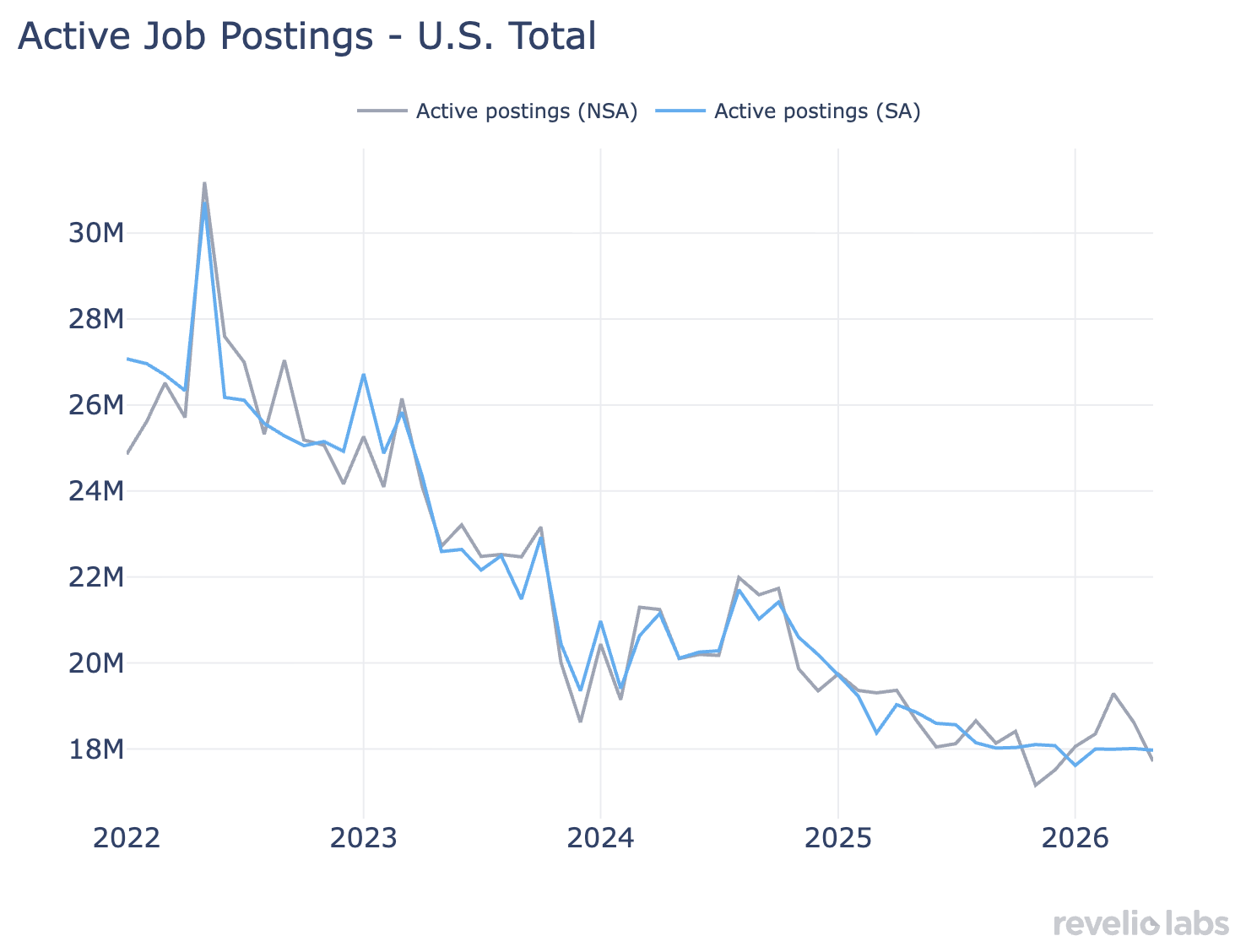
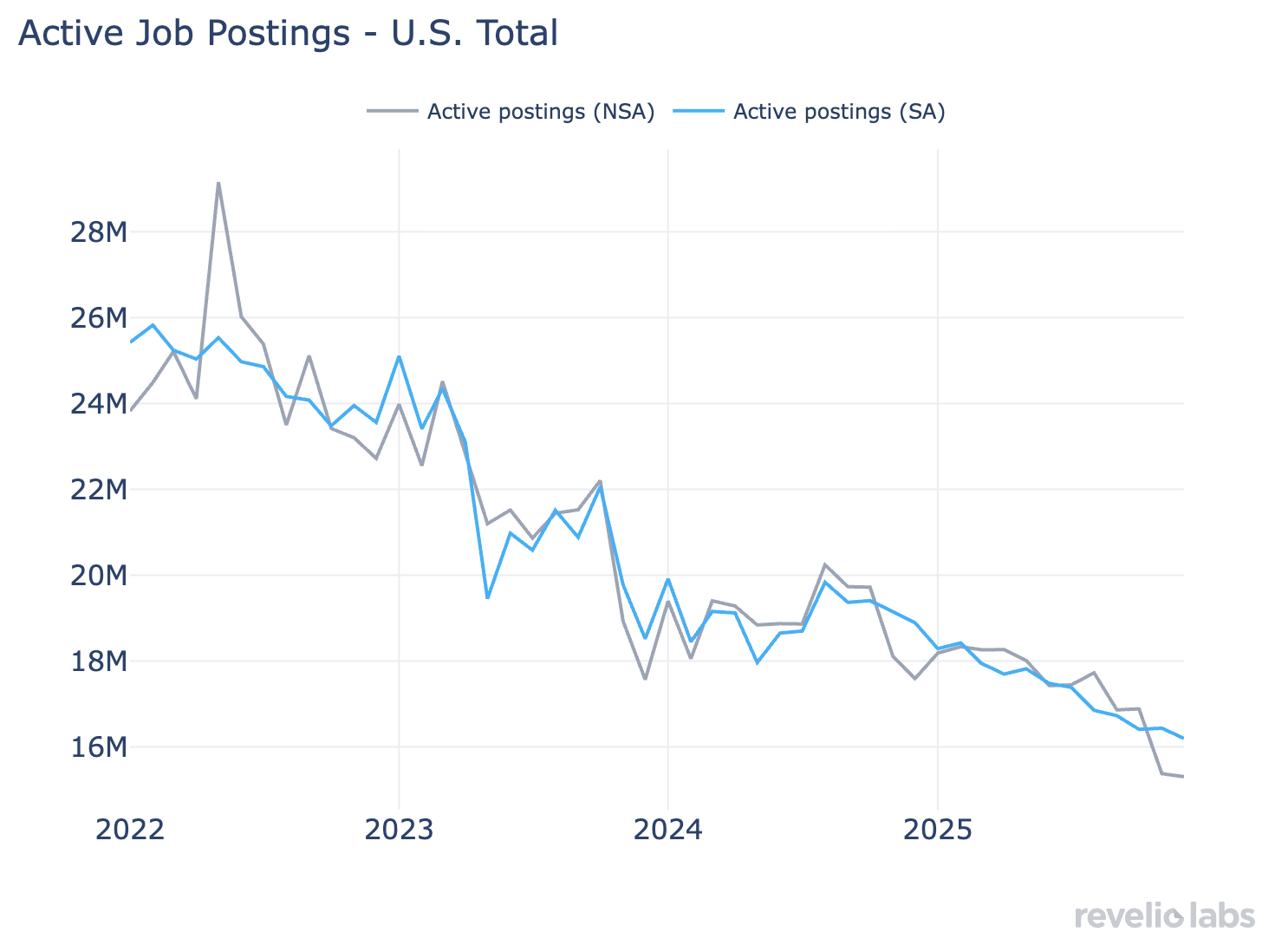
The number of active job postings in the US economy was largely unchanged from April to May, ticking down just 0.3%. Overall, job openings have largely leveled off since the second half of 2025, after several years of declines following the 2022 hiring boom.
Many sectors saw declines month-over-month, with the Information sector leading this group with a 3.6% decrease. However, several sectors have seen notable improvements this month, with active postings in Leisure and Hospitality rising 2.6% and those in Financial Activities rising 1.0%.
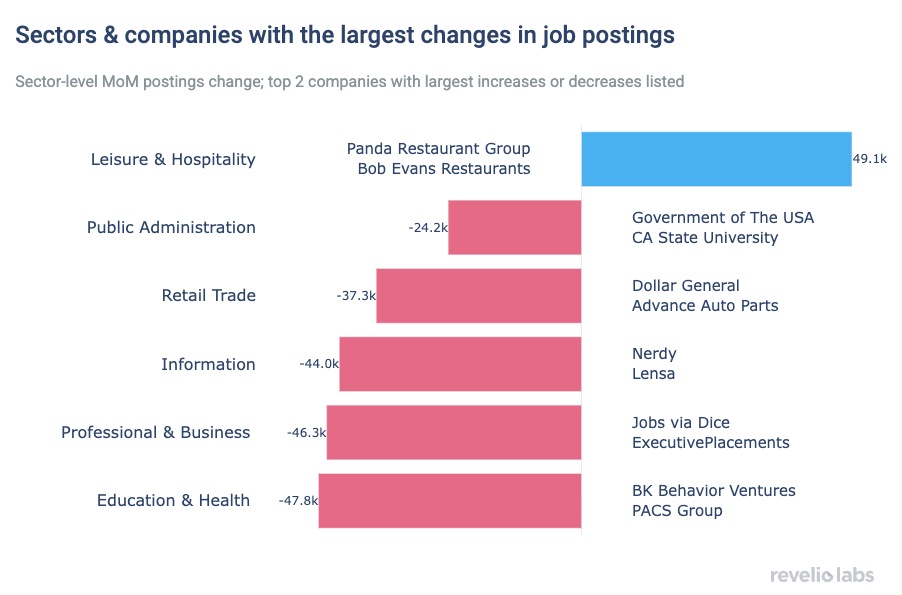
The sectors that saw the biggest declines in terms of total job postings volumes were Education and Health Services, Professional and Business Services, and Information. Retail Trade and Public Administration also saw notable declines. Within these industries, Dollar General saw decreased postings, following declines by fellow discounters Family Dollar and Dollar Tree last month, while the US Government also saw declines amid continued downsizing of Federal employment.
Salaries from new job openings
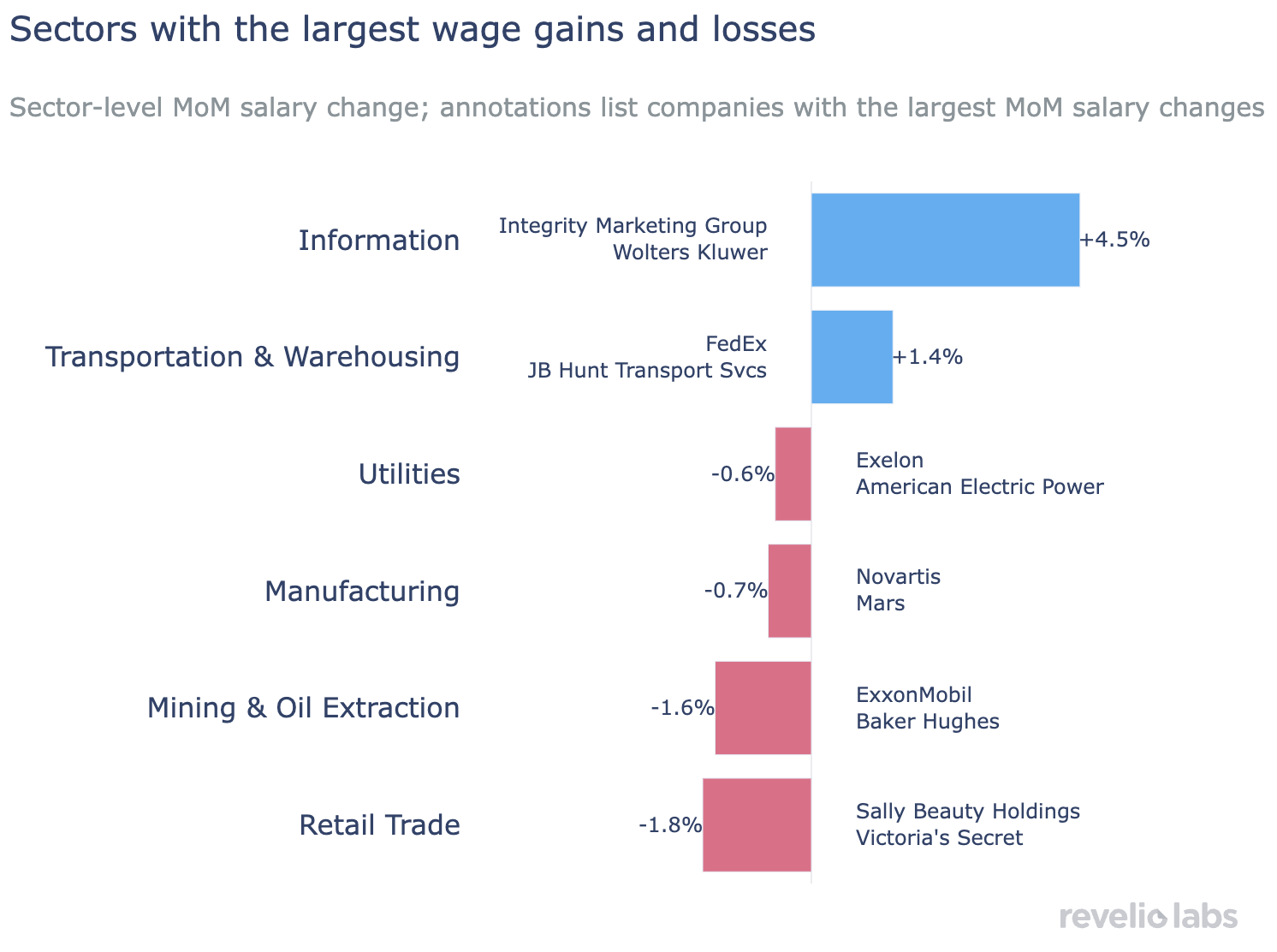
Salaries from new job postings ticked down in May, decreasing by 0.4% from April to May. Sectors driving the decline were Retail Trade, and Mining, Quarrying, and Oil and Gas Extraction. Sally Beauty Holdings and Victoria's Secret were among the companies with the largest month-over-month declines in salaries from new job postings for Retail Trade; as were ExxonMobil and Baker Hughes in the Mining, Quarrying, and Oil and Gas Extraction sector. Information as well as Transportation and Warehousing saw increases in salaries from new job postings.
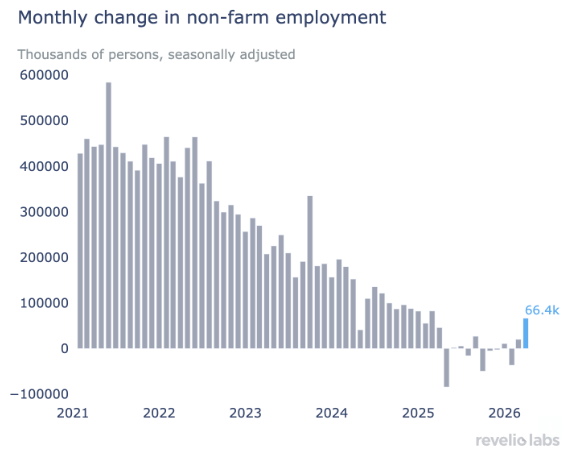
Revelio Public Labor Statistics (RPLS) shows the economy added approximately 66k jobs in April 2026. This gain was driven by the Health Care and Social Assistance sector. Finance and Construction also saw significant employment gains. Meanwhile, Retail and Leisure and Hospitality showed significant declines.
-
Within these sectors, the employers with the largest increases in employment were LifeBridge Health and Adventist Health System in Health Care and Social Assistance and Fidelity and Bank of America in Financial Activities. On the other hand, Darden Restaurants and Starbucks had the largest employment losses in the Leisure and Hospitality sector.
-
Labor demand continued to cool in April, with RPLS showing active job postings declining further month-over-month. Decreases were led by the Education and Health Services and Financial Activities sectors.
-
Salaries from new job postings ticked down very slightly in April, decreasing by a tenth of a percent from March to April. This is the second consecutive month of falling salaries. Sectors driving the decline were Leisure and Hospitality, and Utilities.
Employment
Revelio Public Labor Statistics (RPLS) shows the economy added approximately 66k jobs in April 2026. This gain was driven by the Health Care and Social Assistance sector. Finance and Construction also saw significant employment gains. Meanwhile, Retail and Leisure and Hospitality showed significant declines.
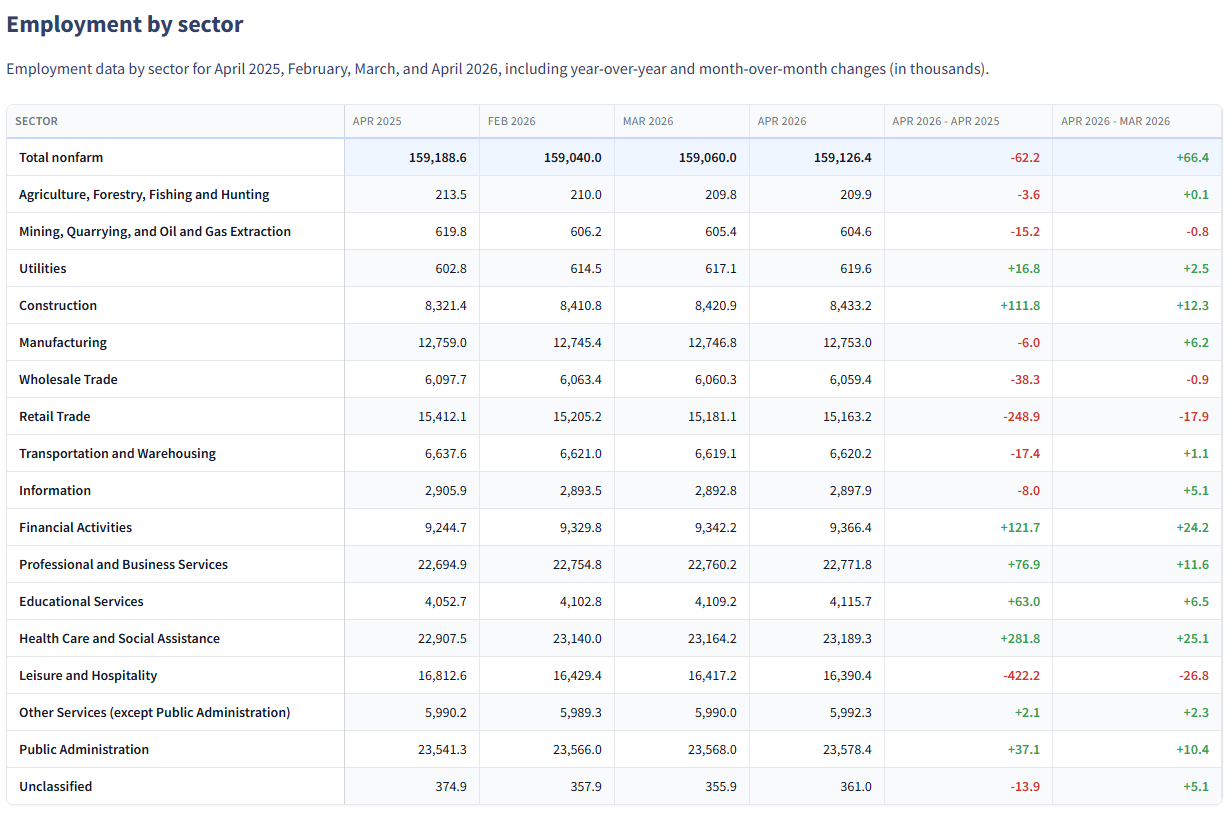
Within these sectors, the employers with the largest increases in employment were LifeBridge Health and Adventist Health System in Health Care and Social Assistance and Fidelity and Bank of America in Financial Activities. On the other hand, Darden Restaurants and Starbucks had the largest employment losses in the Leisure and Hospitality sector.
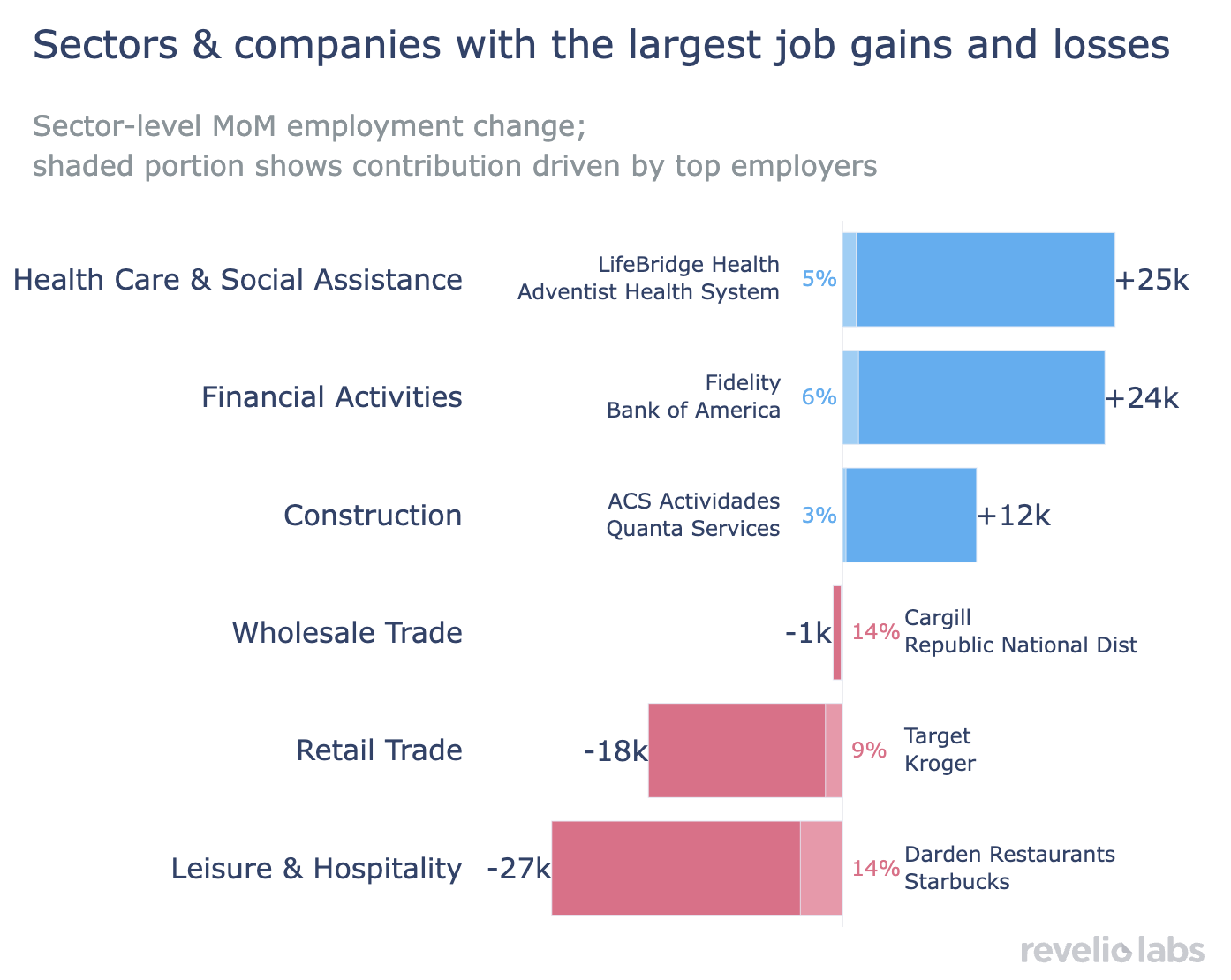
The sectors adding and losing jobs look familiar from past months. Health Care and Social Assistance continues to lead the modest job gains, and retail trade and Leisure and Hospitality continue to lose a lot of jobs. This continues to widen the divide between relative strength in professional service industries and greater losses in blue collar jobs.
Mass layoff notices
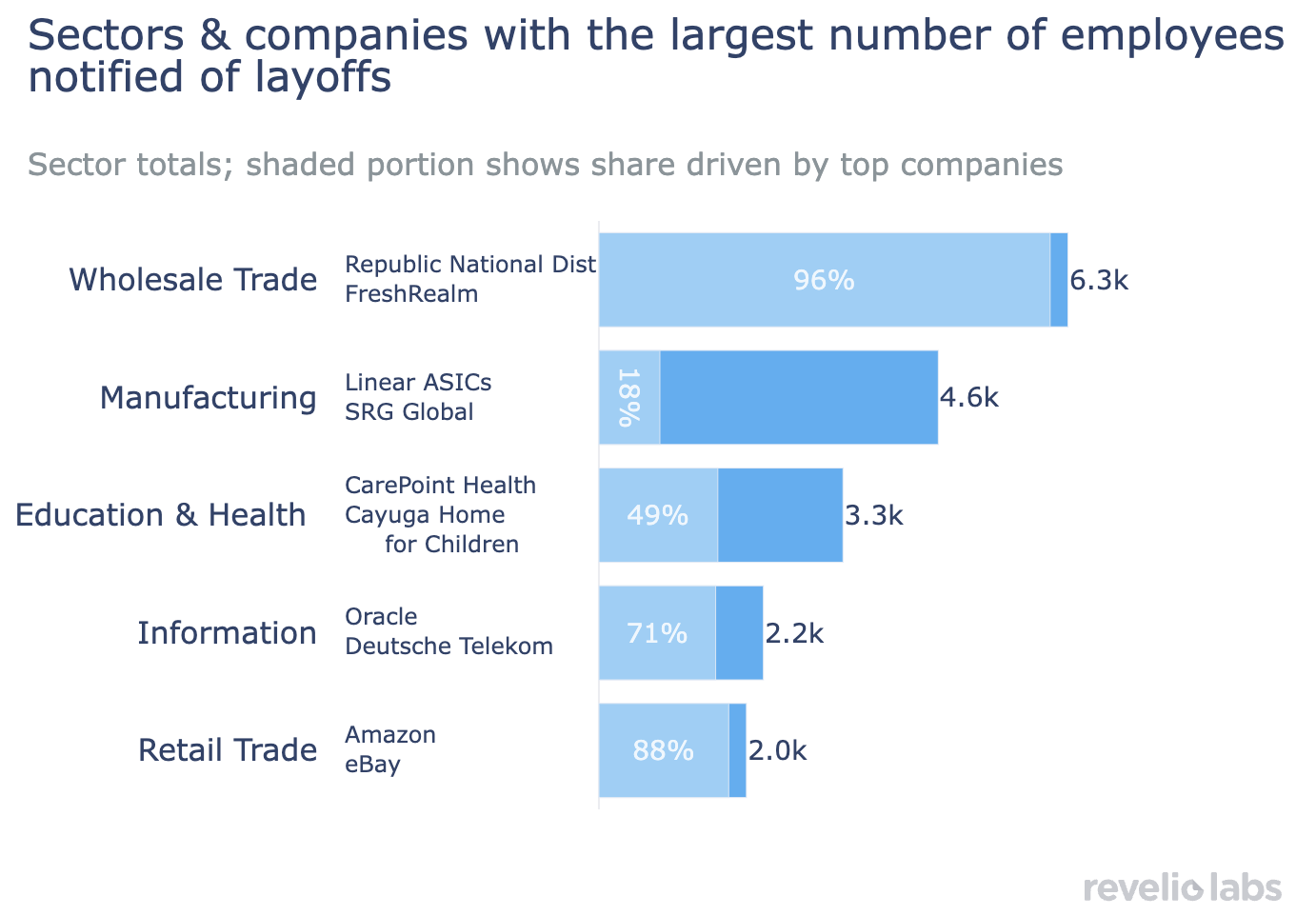
We observe a slight increase in the number of employees notified of layoffs as part of WARN layoff notices in April. The number of employees notified with layoffs increased from ~25.2k employees in March to 32.5k employees in April.
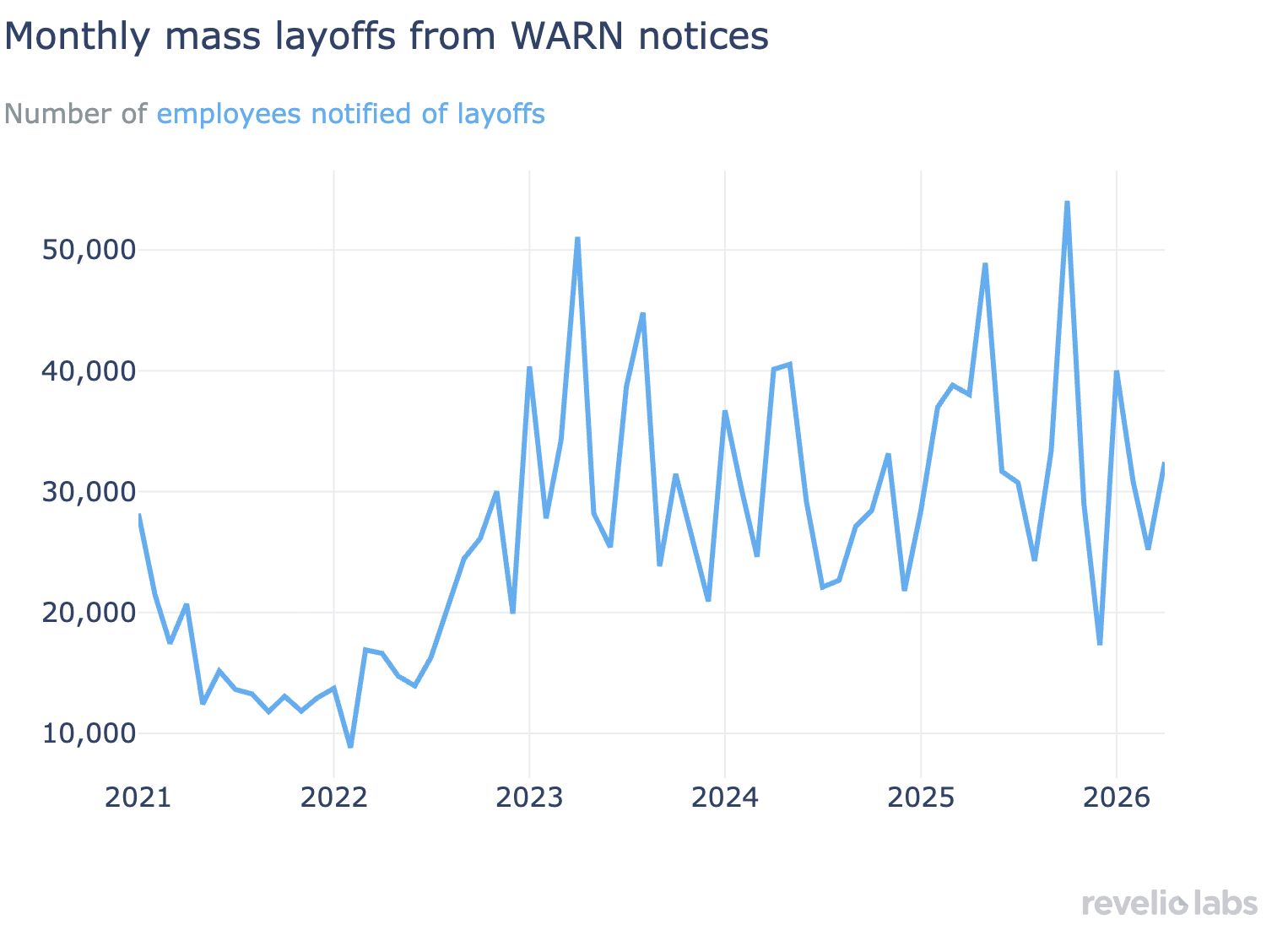
The Wholesale Trade sector saw the largest number of employees notified of layoffs in April, followed by the Manufacturing sector, and the Education and Health Care sector. Within the Wholesale Trade sector, Republic National Distributing Company, the second largest beverage alcohol distributor of premium wine and spirits in the US, contributed the largest share of layoffs, followed by FreshRealm. In Information, we still see notices from Oracle’s major layoff announced at the end of February. We also see Amazon and eBay contributing the largest share of layoff notices in Retail Trade.
Hiring and Attrition
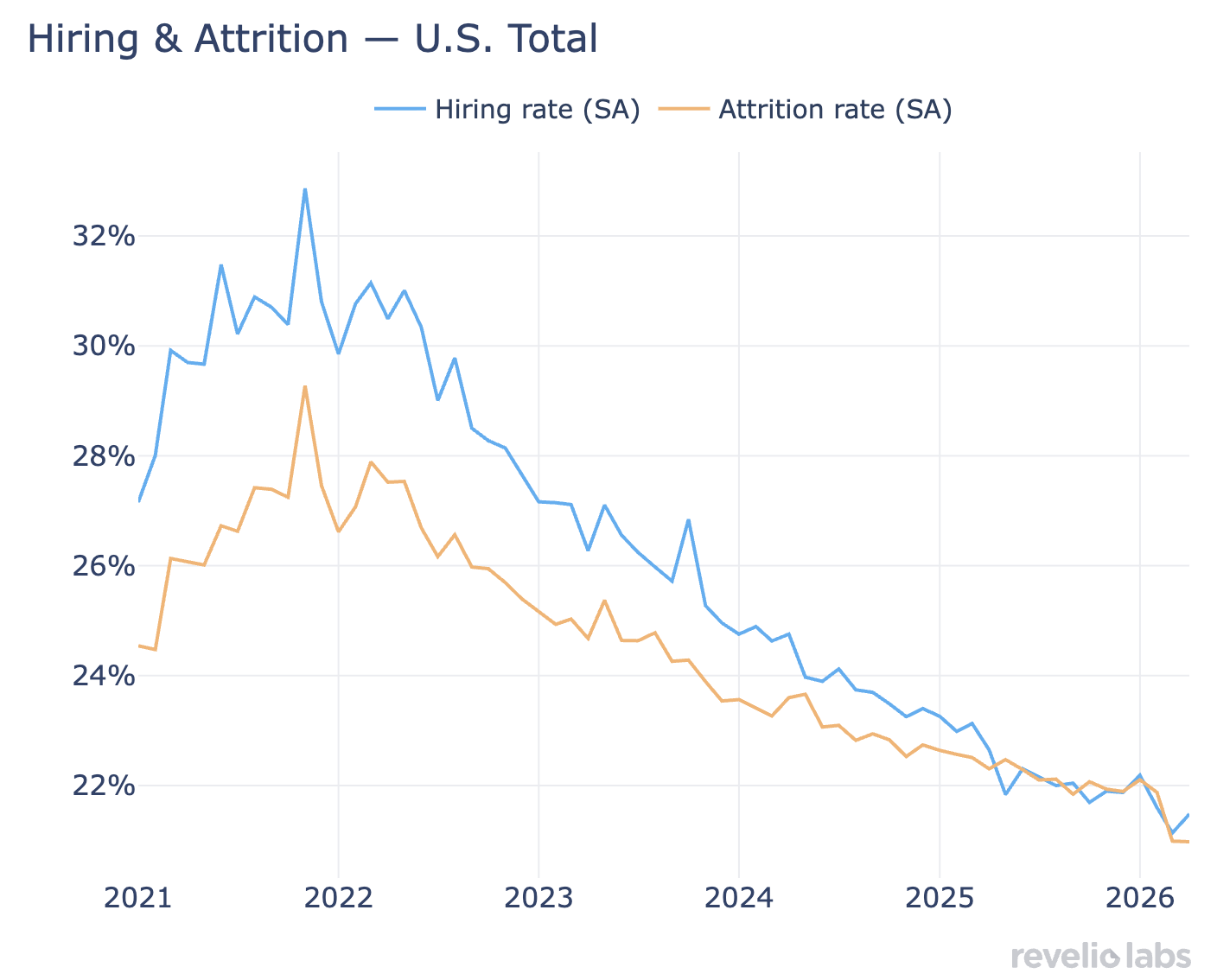
The hiring rate ticked up in April, while attrition remained flat, resulting in positive job growth last month. While still in a downtrend, hiring finally moved higher, with the overall hiring rate rising 0.3pp from March to April. Gains were led by the Information and Financial Activities industries, which rose 1.2pp and 0.9pp, respectively.
While hiring moved higher, the rate of attrition remained unchanged last month. The biggest decline in the attrition rate was also seen in the Information sector, indicating an improving situation for workers in a sector increasingly impacted by AI. RPLS also showed declining attrition in Agriculture, Transportation and Warehousing, and Financial Activities, while attrition in the Leisure and Hospitality and Utilities sectors moved higher.
Job Postings
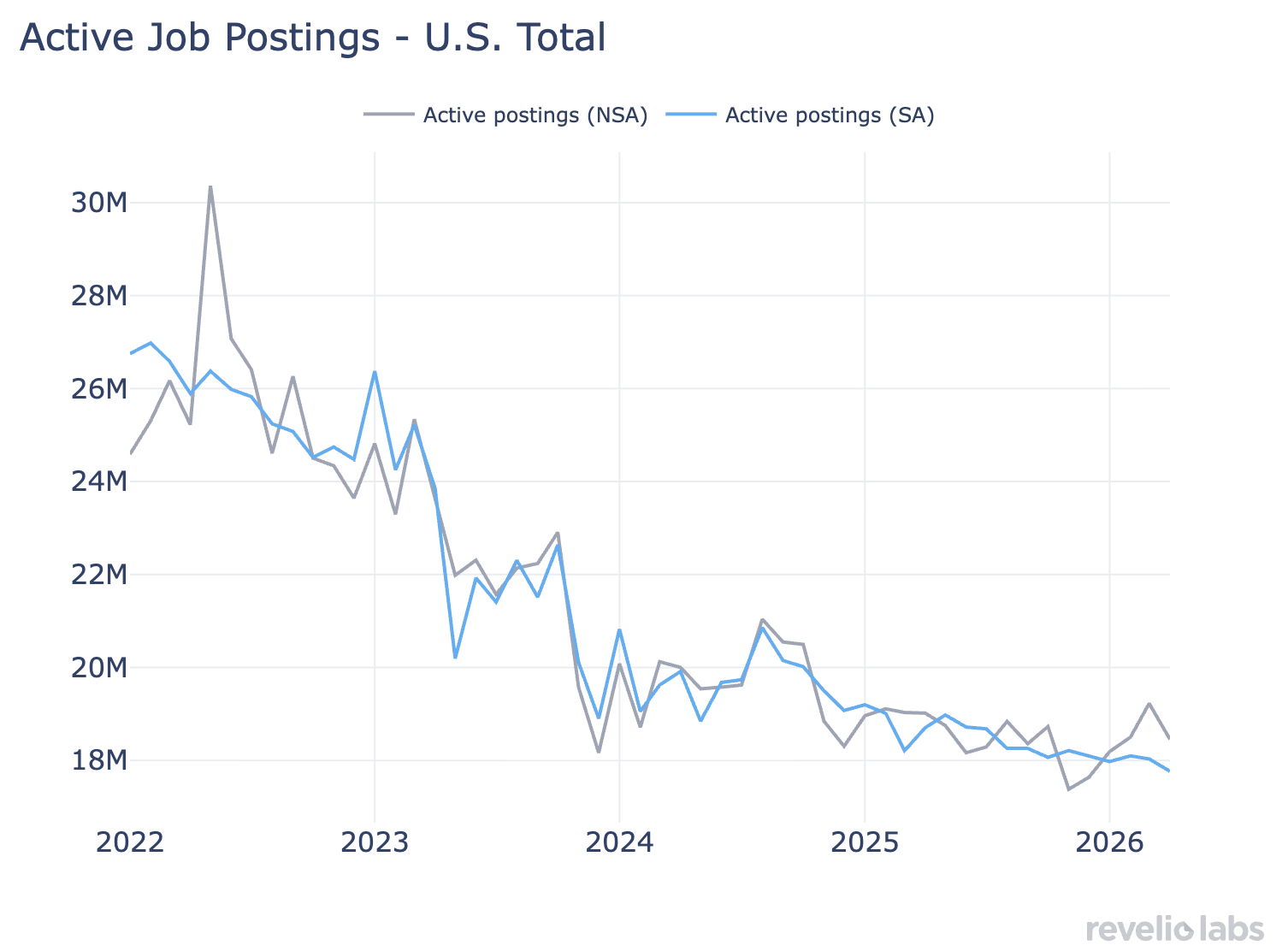
The number of active job postings across the US economy ticked down again in April, as labor demand continues to cool. Overall job postings were down 1.5% month-over-month, and 5.0% year-over-year.
All industries except for one (Wholesale Trade) saw a net decrease in job postings from March to April, with the largest decreases in percentage terms seen in Education and Health Services, Financial Activities, and Leisure and Hospitality.
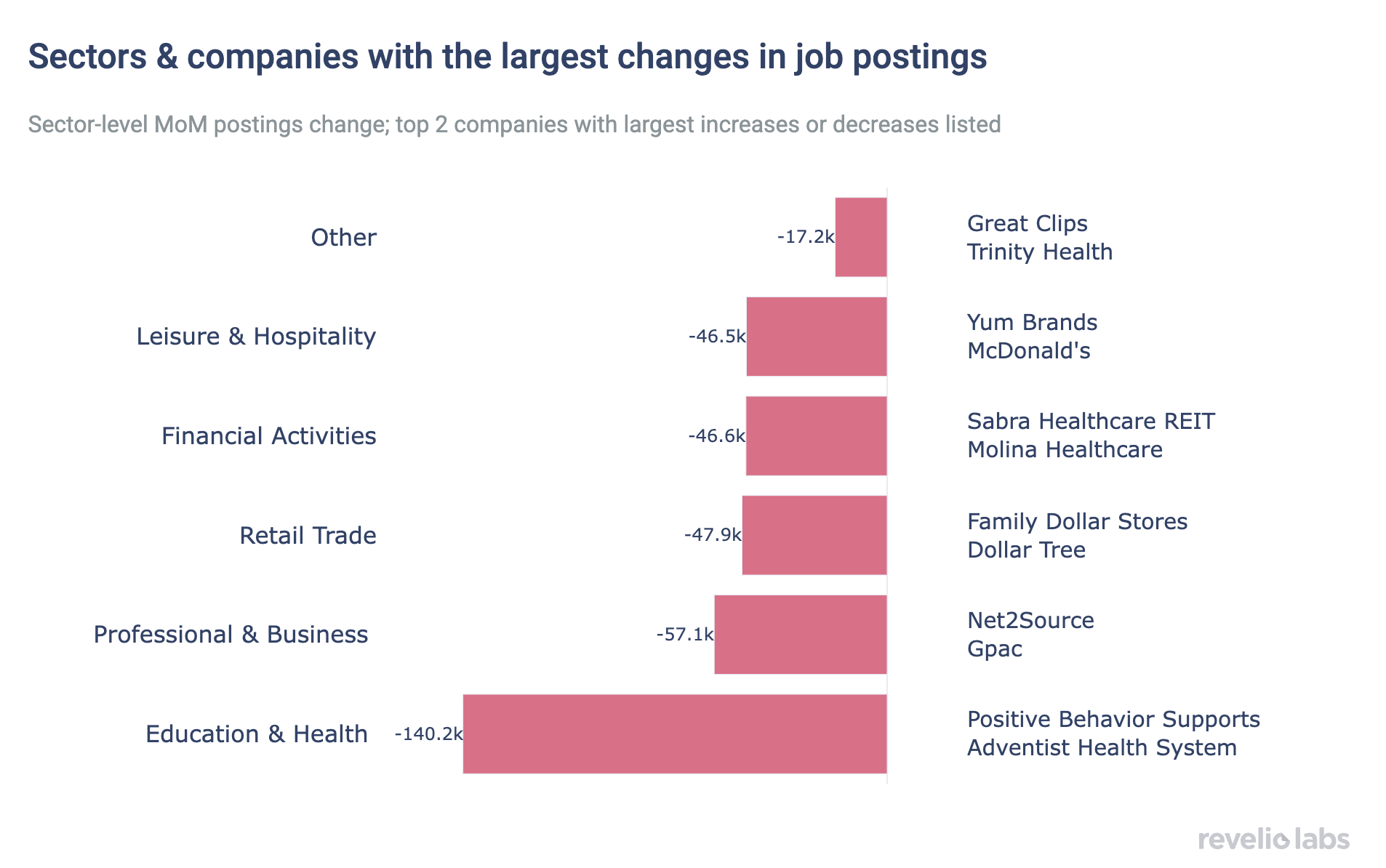
In terms of total volumes of job postings, we saw the biggest decreases in Education and Health Services, Professional and Business Services, and Retail Trade. Within Retail, low-price retailers Family Dollar and Dollar Tree both saw significant declines in job postings last month, and within Leisure and Hospitality, both Yum Brands and McDonald’s pulled back on active job postings.
Salaries from new job openings
Salaries from new job postings ticked down very slightly in April, decreasing by a tenth of a percent from March to April. This is the second consecutive month of falling salaries. Sectors driving the decline were Leisure and Hospitality, and Utilities.
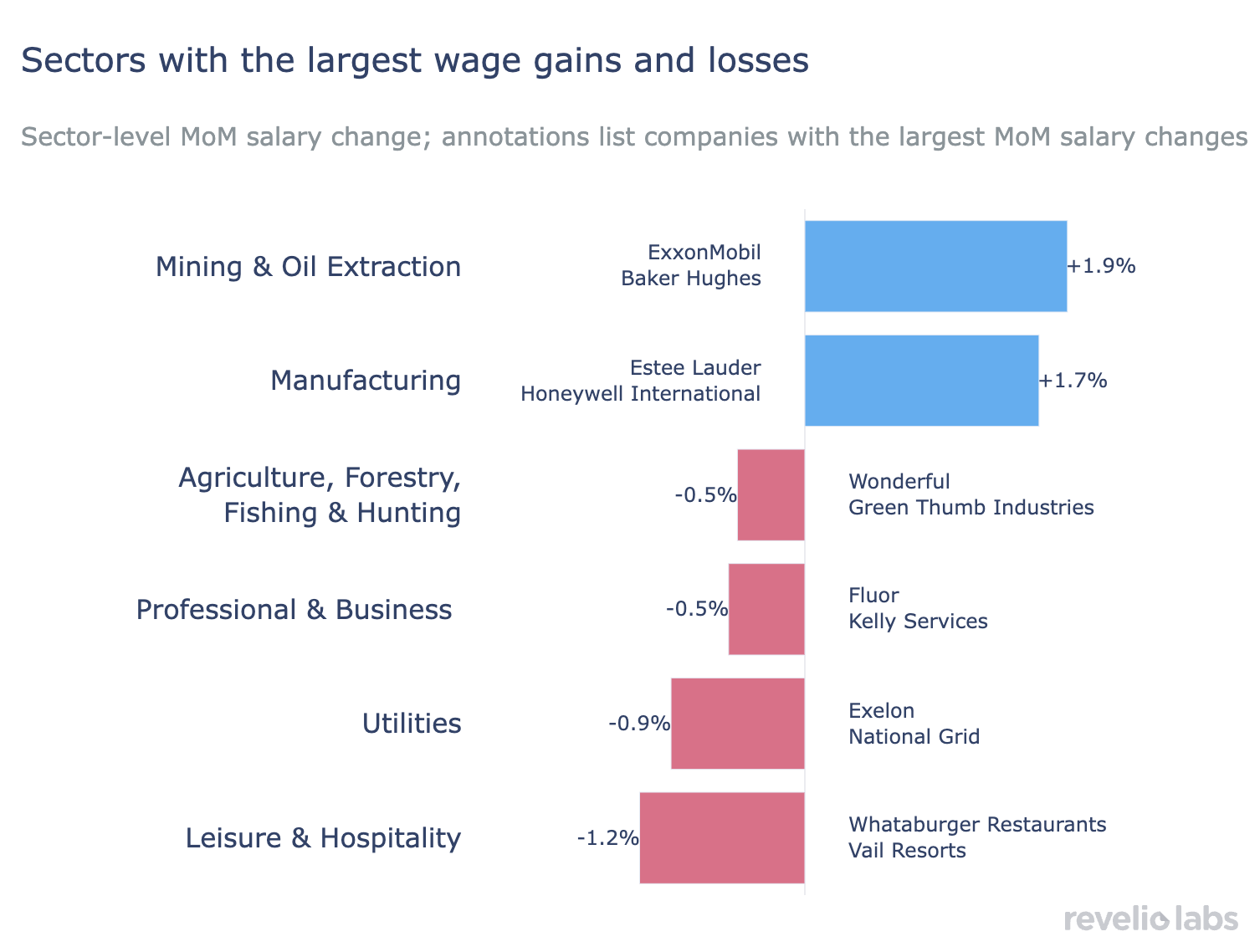
Whataburger and Vail Resorts were among the companies with the largest month-over-month declines in salaries from new job postings for Leisure and Hospitality; as were Exelon and National Grid in the Utilities sector. Mining and Oil Extraction as well as Manufacturing saw increases in salaries from new job postings.
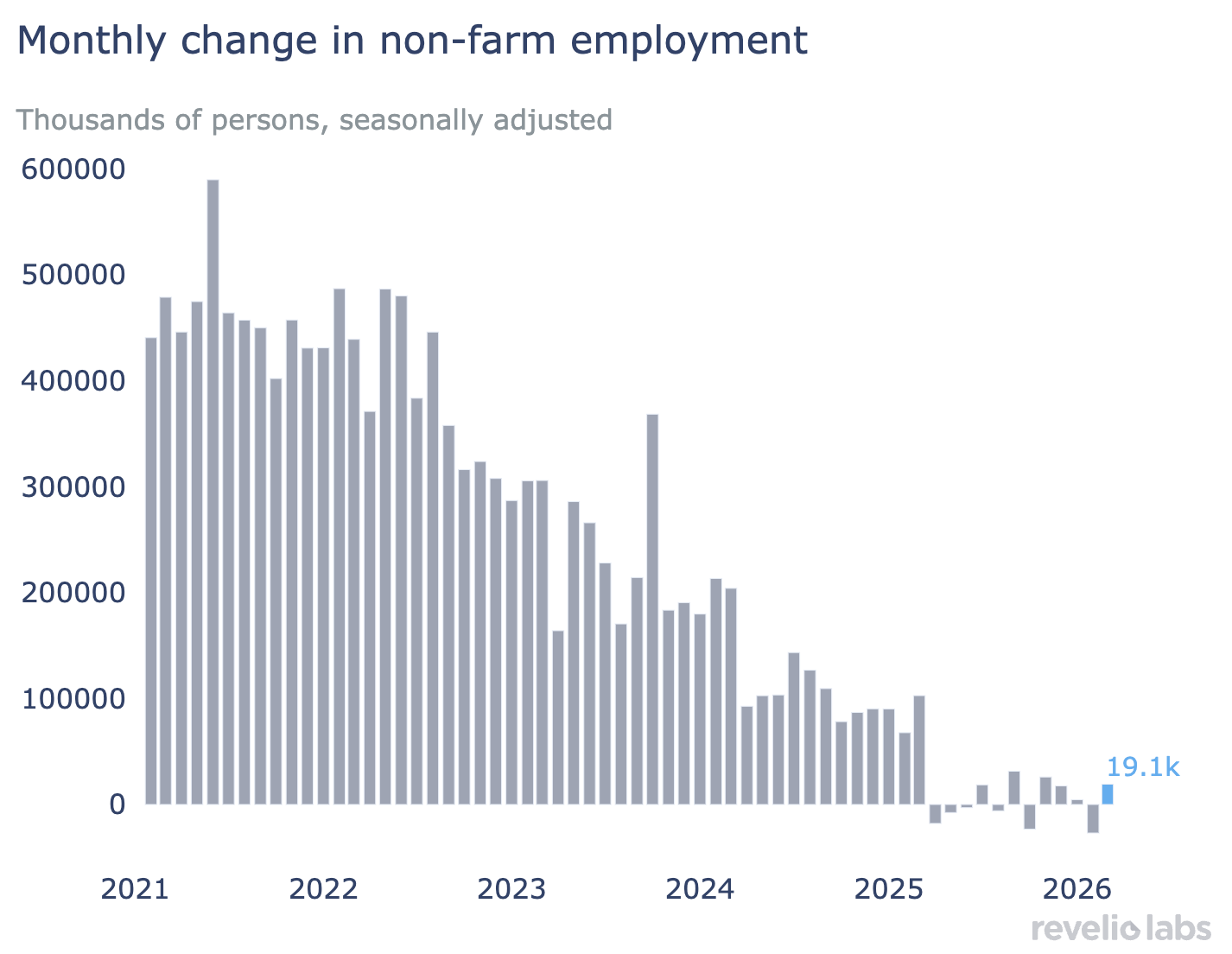
Revelio Public Labor Statistics (RPLS) shows the economy added approximately 19k jobs in March 2026. This modest gain was driven by the Health Care and Social Assistance sector. Meanwhile, Retail and Leisure and Hospitality showed significant declines.
-
Within these sectors, the employers with the largest increases in employment were HCA Healthcare and Kaiser Permanente in the Health Care and Social Assistance sector, and Keller Williams Realty and JPMorgan Chase in Financial Activities. On the other hand, Hy-Vee and Target had the largest employment losses in the Retail sector.
-
Job openings continued to decline in March, as labor demand cools broadly across the economy. Month-on-month declines were led by Professional and Business Services, Leisure and Hospitality, and Retail.
-
Salaries from new job postings ticked down slightly in March, decreasing by 2.6% from February 2026. Sectors driving the decline were Education and Health, Leisure and Hospitality, and Mining & Oil.
Employment
Revelio Public Labor Statistics (RPLS) shows the economy added 19.1k jobs in March 2026. The gain was driven by Health Care and Social Assistance, Financial Activities, and Public Administration. Meanwhile, Retail, Leisure and Hospitality suffered the largest job losses in March 2026.
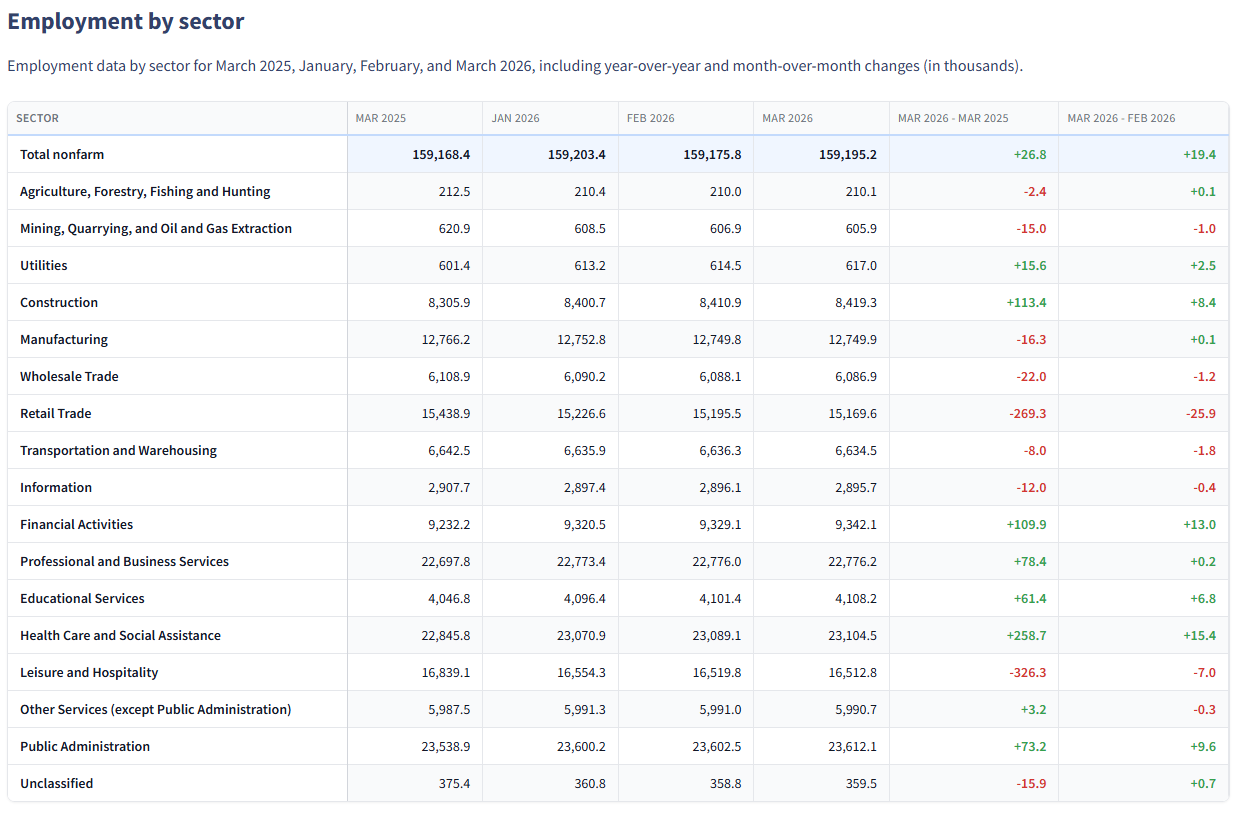
Within these sectors, the employers with the largest declines were Target and Hy-Vee in Retail, and Starbucks and Brinker International in Leisure and Hospitality. On the positive side, the employers adding the largest number of jobs were HCA Healthcare and Kaiser Permanente in Health Care; Keller Williams Realty and JPMorgan Chase in Finance.
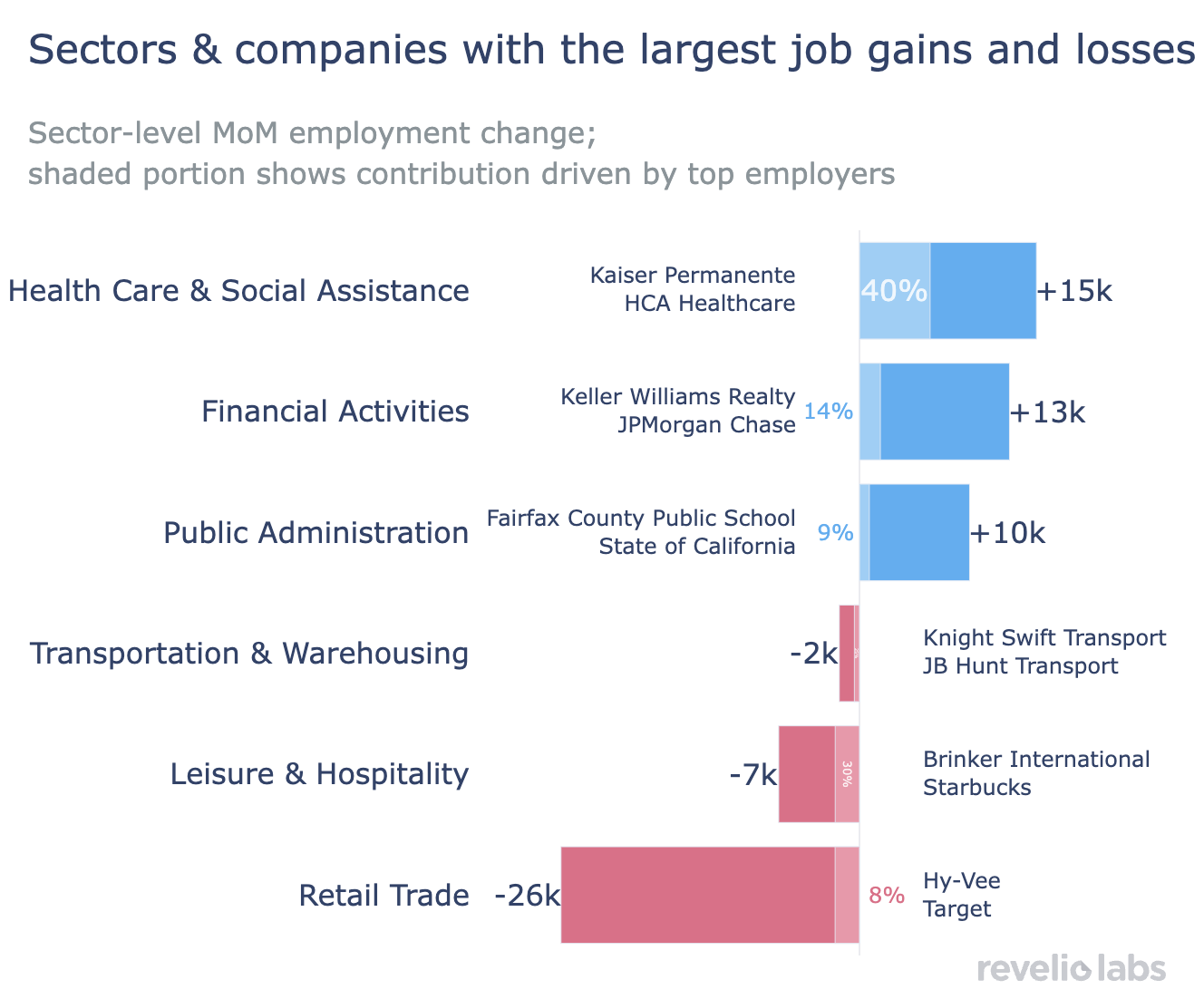
The sectors adding and losing jobs look familiar from past months. Health Care and Social Assistance continues to lead the modest job gains, and retail trade continues to lose a lot of jobs. This continues to widen the divide between relative strength in professional service industries and greater losses in blue collar jobs.
Mass layoff notices
We observe a further decline in the number of employees notified of layoffs as part of WARN layoff notices in March. The number of employees notified of layoffs declined from ~30.4k employees in February to 16.6k in March.
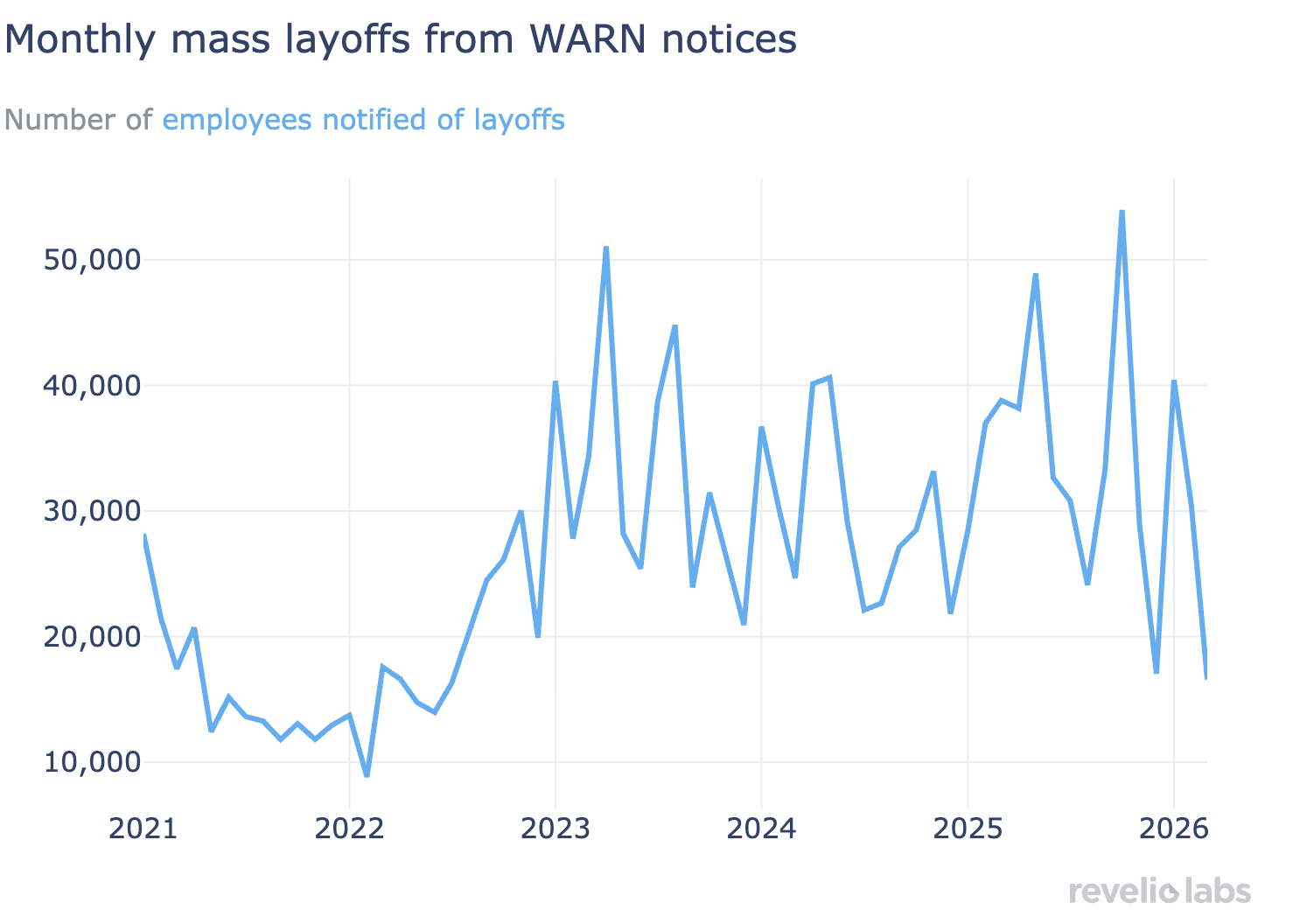
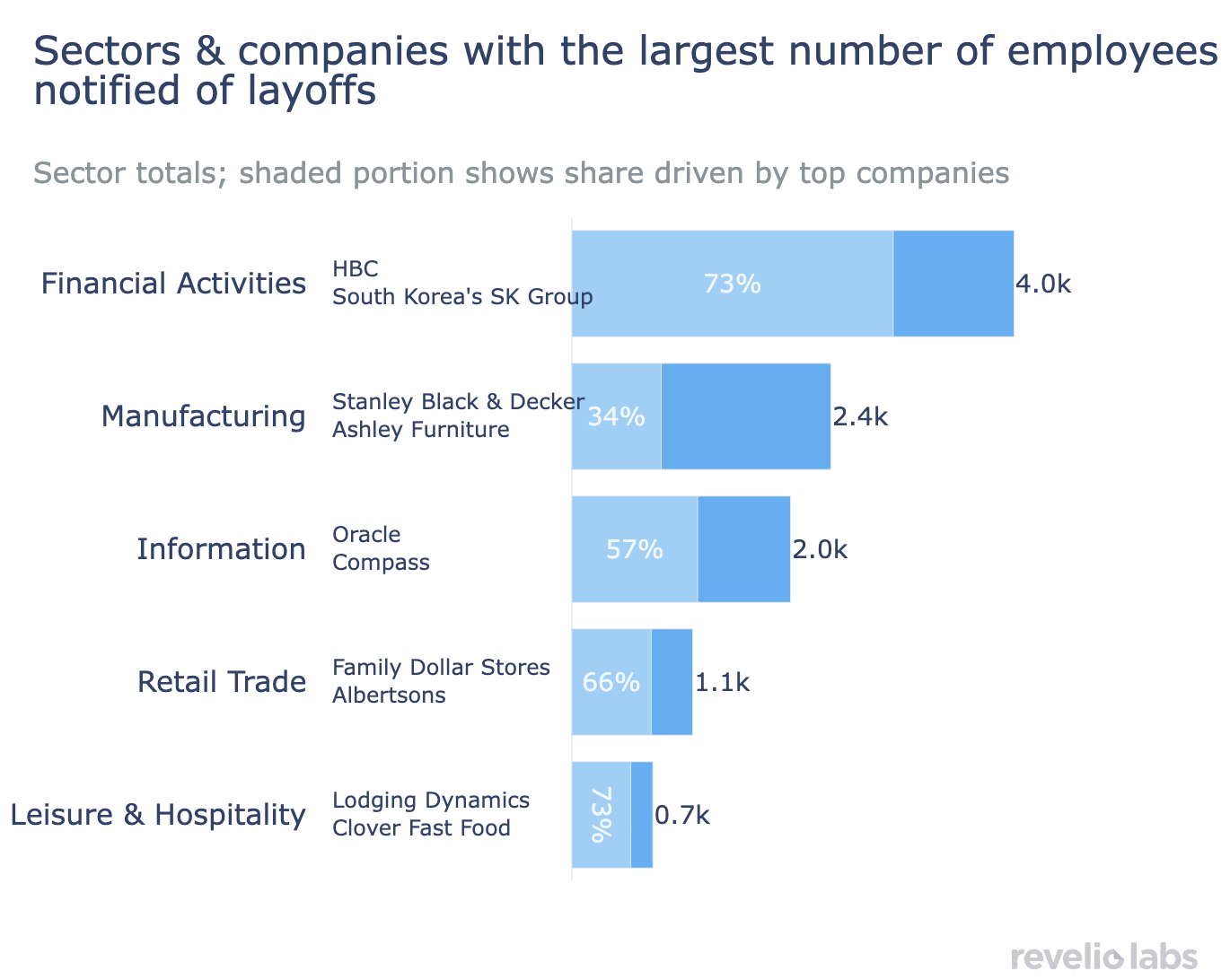
The Financial Activities sector saw the largest number of employees notified of layoffs in March 2026, followed by the Manufacturing sector, and the Information sector. Within the Financial Activities sector, HBC and South Korea’s SK group (through its subsidiary company SK Batteries America) contributed the largest share of layoffs. In Information, we see an initial signal from Oracle as a major contributor to layoffs following yesterday’s announcement to cut thousands of jobs.
Hiring and Attrition
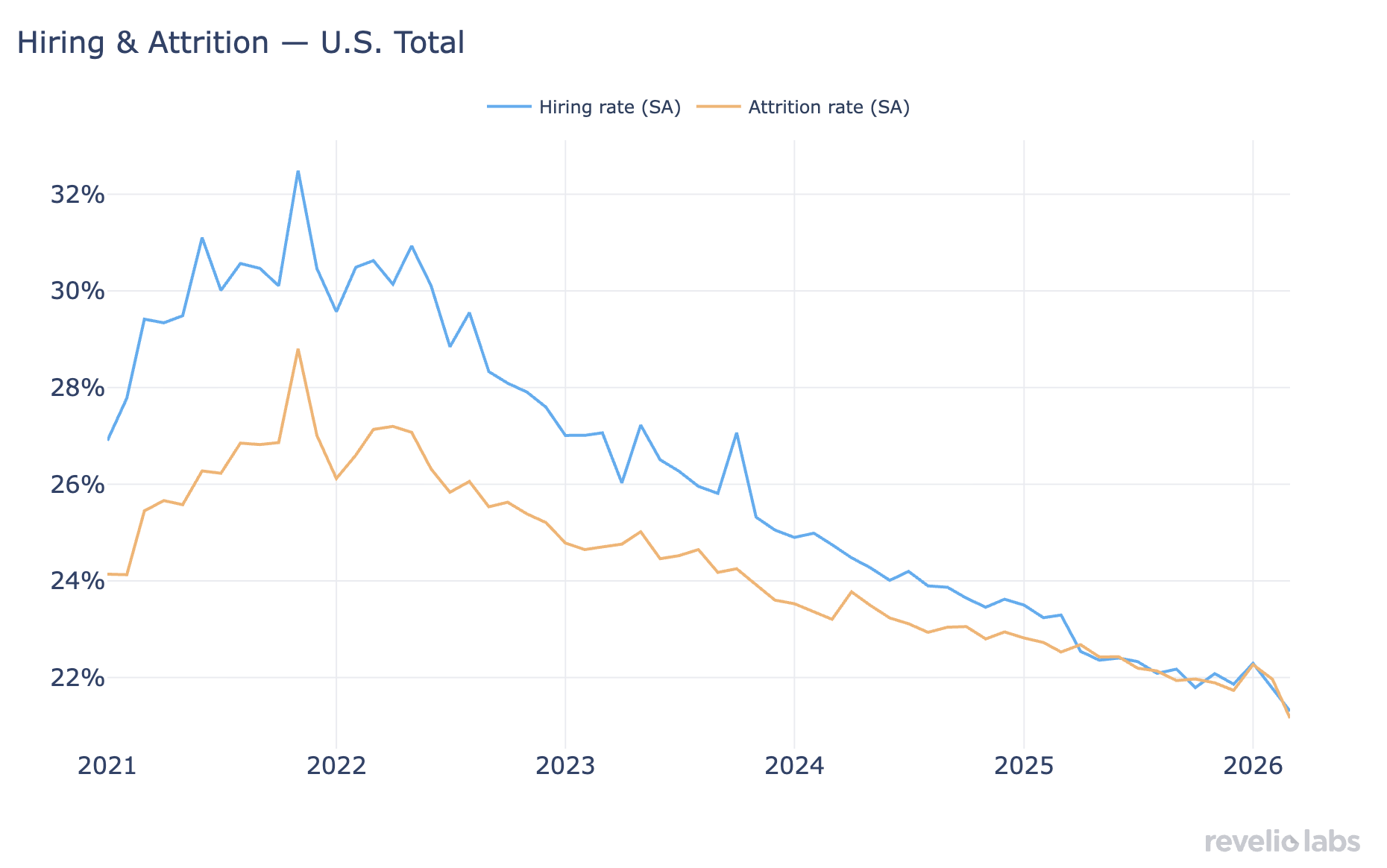
Both hiring and attrition ticked down in March, as the labor market continues to be defined by low churn. JOLTS data through February show the openings rate is now as low as it was at the peak of the pandemic, and comparable to 2017 levels before that. Our data, which is highly correlated with JOLTS, show a continuation of this trend into March, with hiring continuing to reach new lows in our series.
Looking across industries, we see substantial declines in Agriculture and Forestry, Information, Retail, Health Care, and Construction. Weaker hiring in the Health Care Sector is especially worrying, as it has been at the center of recent jobs growth.
Job Postings
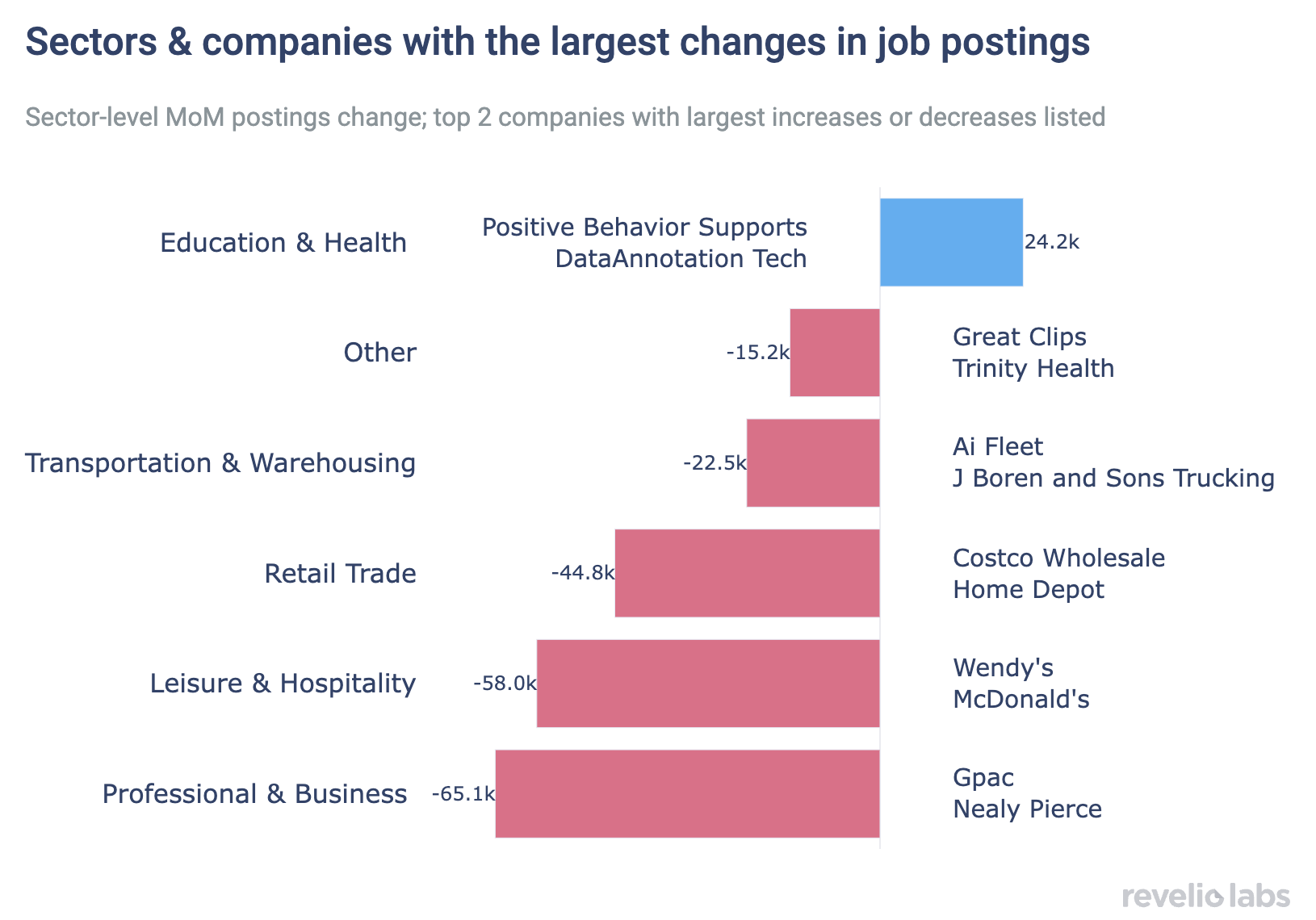
Labor demand continues to cool in the US, as the number of active job postings across the country ticked down again in March. The vast majority of industries experienced a net decrease in job openings, with Education and Health and the Construction sectors being the sole exceptions.
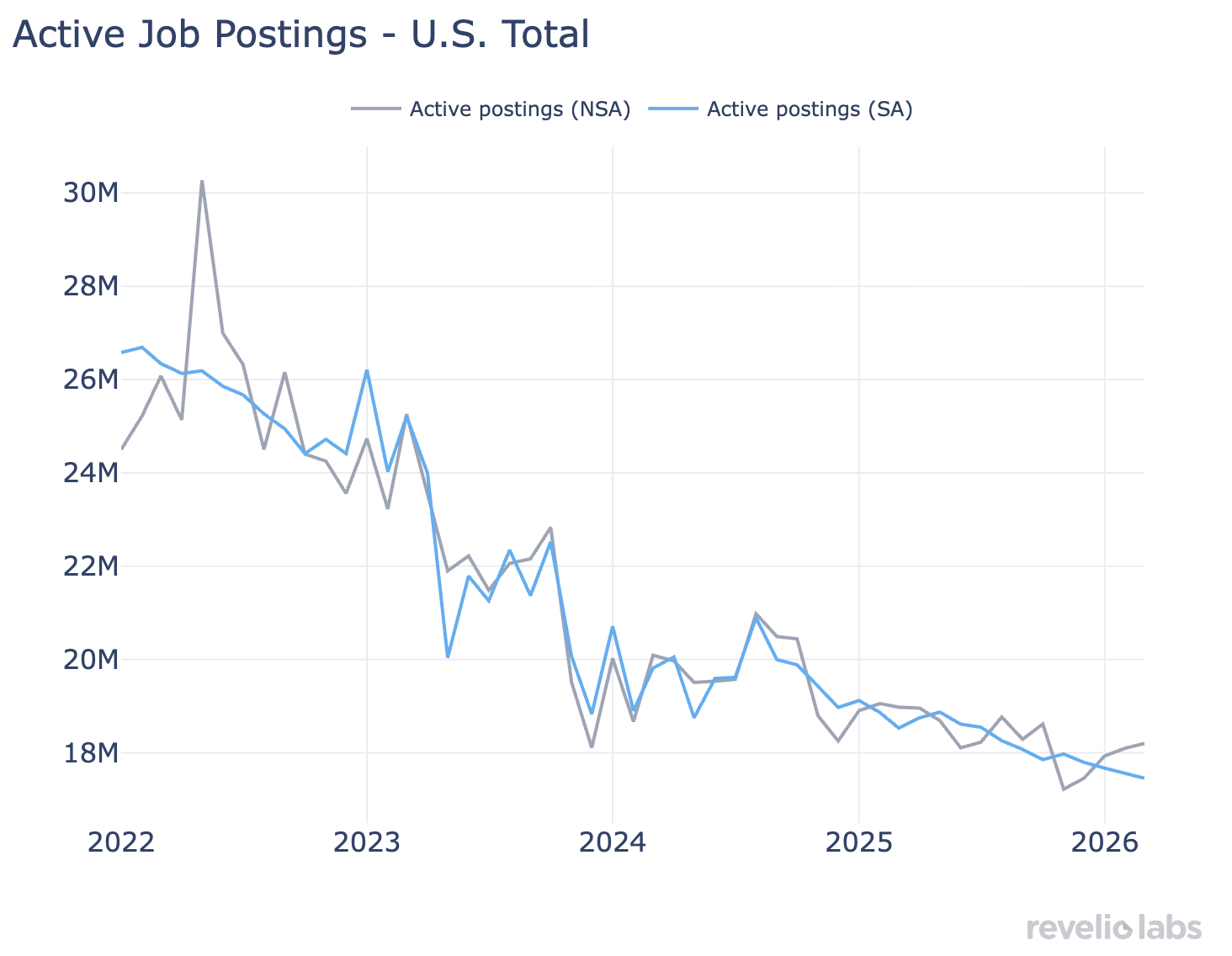
Looking at the total volume of job openings, the largest decreases were in Professional and Business Services, Leisure and Hospitality, and Retail. Many of the largest declines were among job placement and staffing firms, along with major food chains (Wendy’s and McDonald’s) and retailers (Costco and Home Depot).
Salaries from new job openings
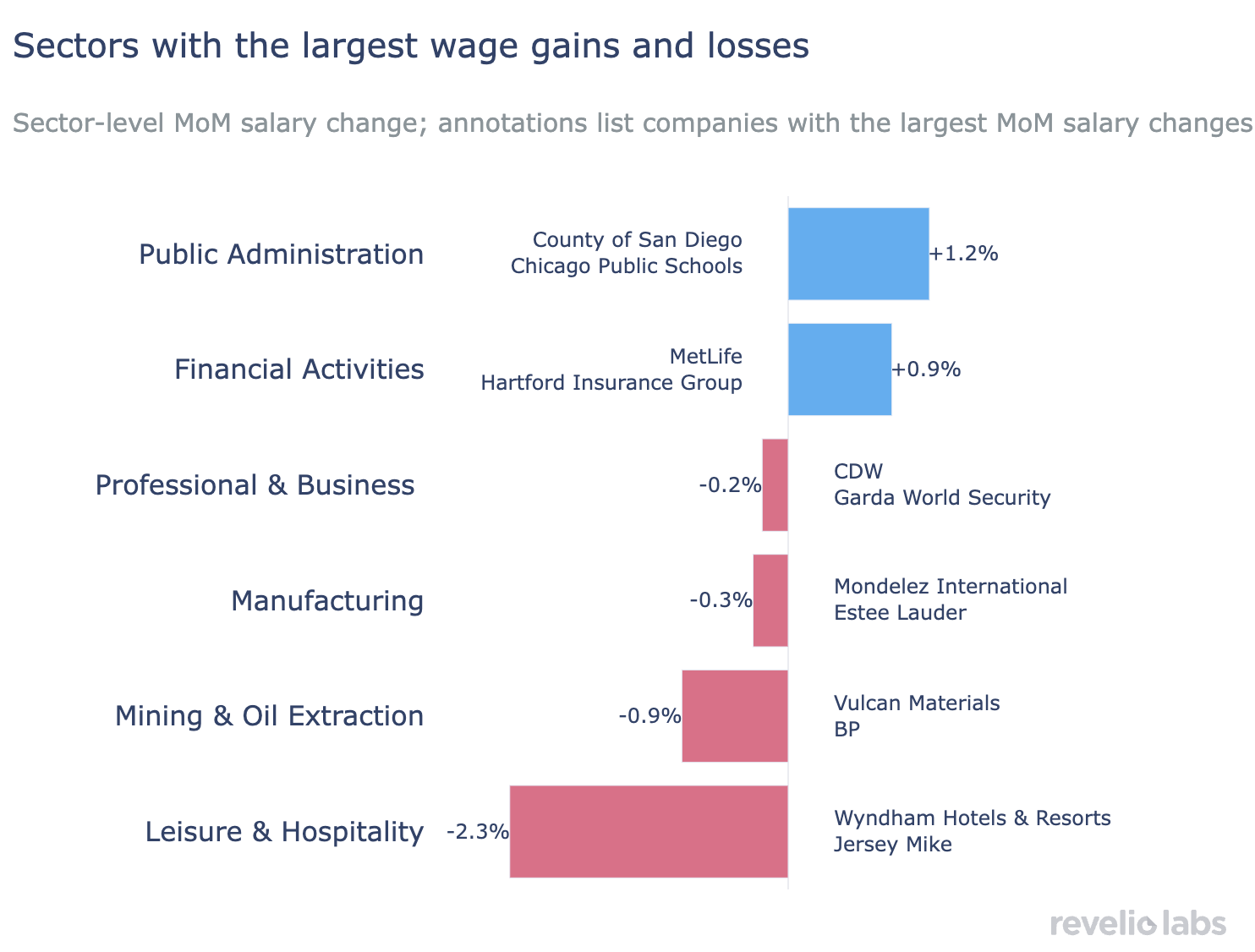
Salaries from new job postings ticked down slightly in March, decreasing by 2.6% from February 2026. Sectors driving the decline were Leisure and Hospitality, Mining & Oil and Manufacturing.
Within these sectors Wyndham Hotels and Resorts and Jersey Mike’s Subs for Leisure and Hospitality, Vulcan Materials and BP for Mining & Oil and Mondelez and Estee Lauder for Manufacturing were among the companies with the largest month-over-month declines in salaries in new job postings. Public Administration and Financial Activities saw increases in salaries from new job postings.
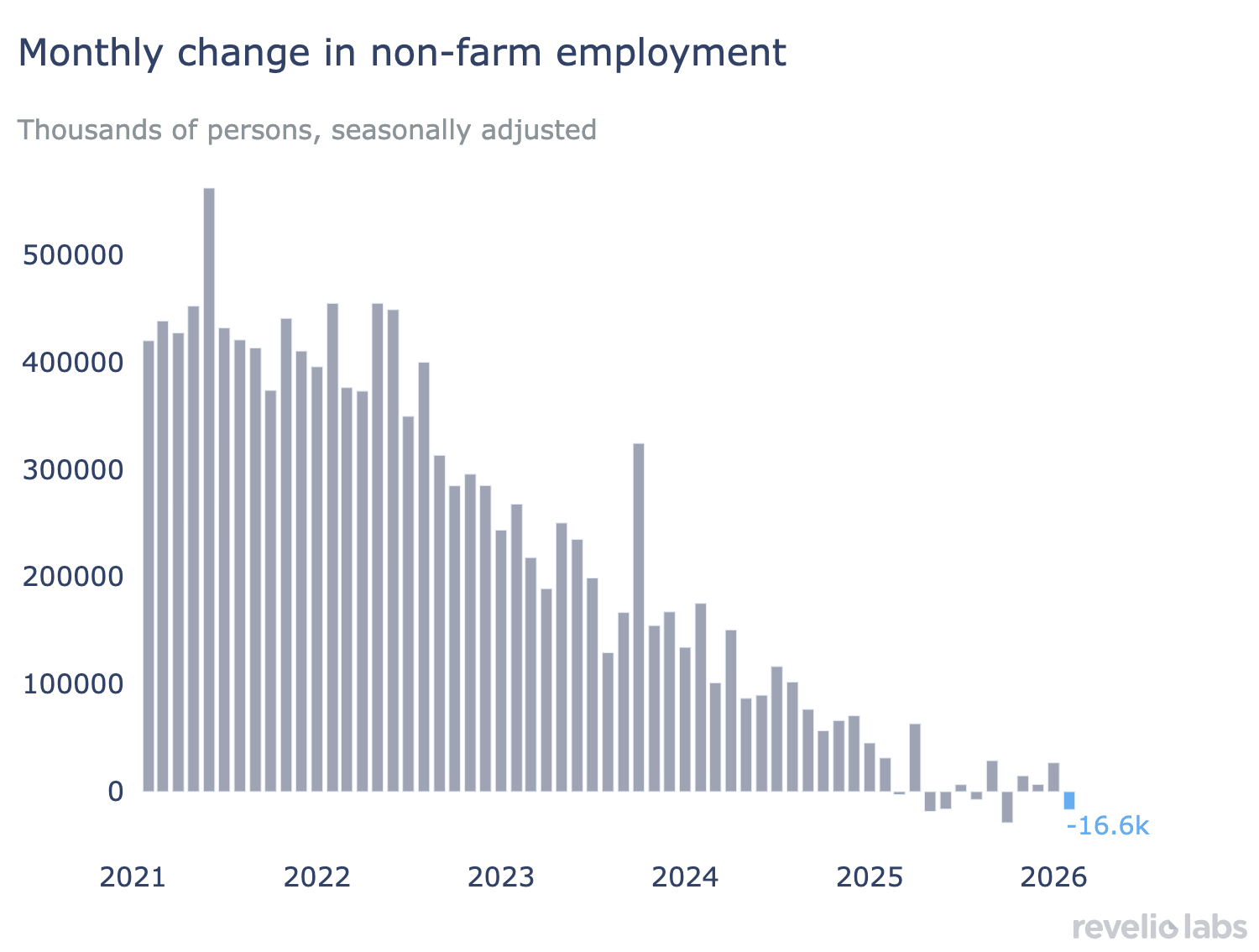
Revelio Public Labor Statistics (RPLS) shows the economy lost approximately 16.6k jobs in February 2026. The loss was driven by Retail Trade and Leisure and Hospitality. Healthcare, Professional and Business Services and Financial Activities had positive job gains.
- Within these sectors, the employers with the largest declines were Amazon after the large layoff announcement in January as well as CVS in Retail, and Starbucks and McDonald’s in Leisure and Hospitality. On the positive side, the employers adding the largest number of jobs were PwC and HCL in Professional and Business Services and JP Morgan Chase and Goldman Sachs in Financial services.
- Job openings continued to decline in February, led by declines in the Professional and Business Services, and Retail sectors, as the United States remains at the forefront of cooling global labor demand.
- Salaries from new job postings ticked down slightly in February, decreasing by 1.4% from January 2026. Sectors driving the decline were Leisure and Hospitality, Retail and Manufacturing.
Employment
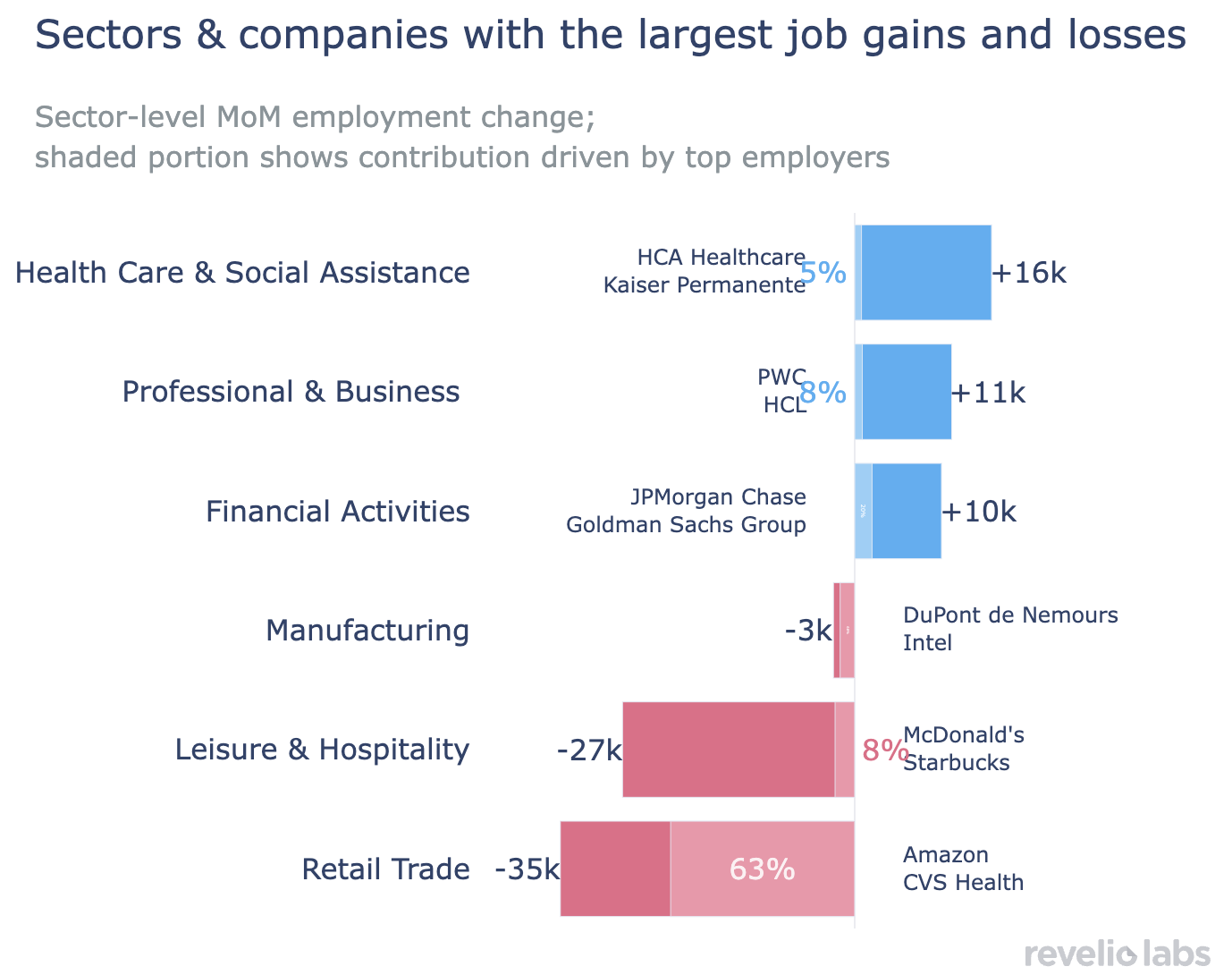
Revelio Public Labor Statistics (RPLS) shows the economy lost 16.6k jobs in February 2026. The loss was driven by Retail Trade and Leisure and Hospitality. Healthcare, Professional and Business Services and Financial Activities had positive job gains.
Within these sectors, the employers with the largest declines were Amazon after the large layoff announcement in January as well as CVS in Retail, and Starbucks and McDonald’s in Leisure and Hospitality. On the positive side, the employers adding the largest number of jobs were HCA Healthcare and Kaiser Permanente in Health Care; PricewaterhouseCoopers and HCL in Professional and Business Services and JPMorgan Chase and Goldman Sachs in Financial Activities.
The sectors adding and losing jobs look familiar from past months. This continues to widen the divide between relative strength in professional service industries and greater losses in blue collar jobs.
Mass layoff notices
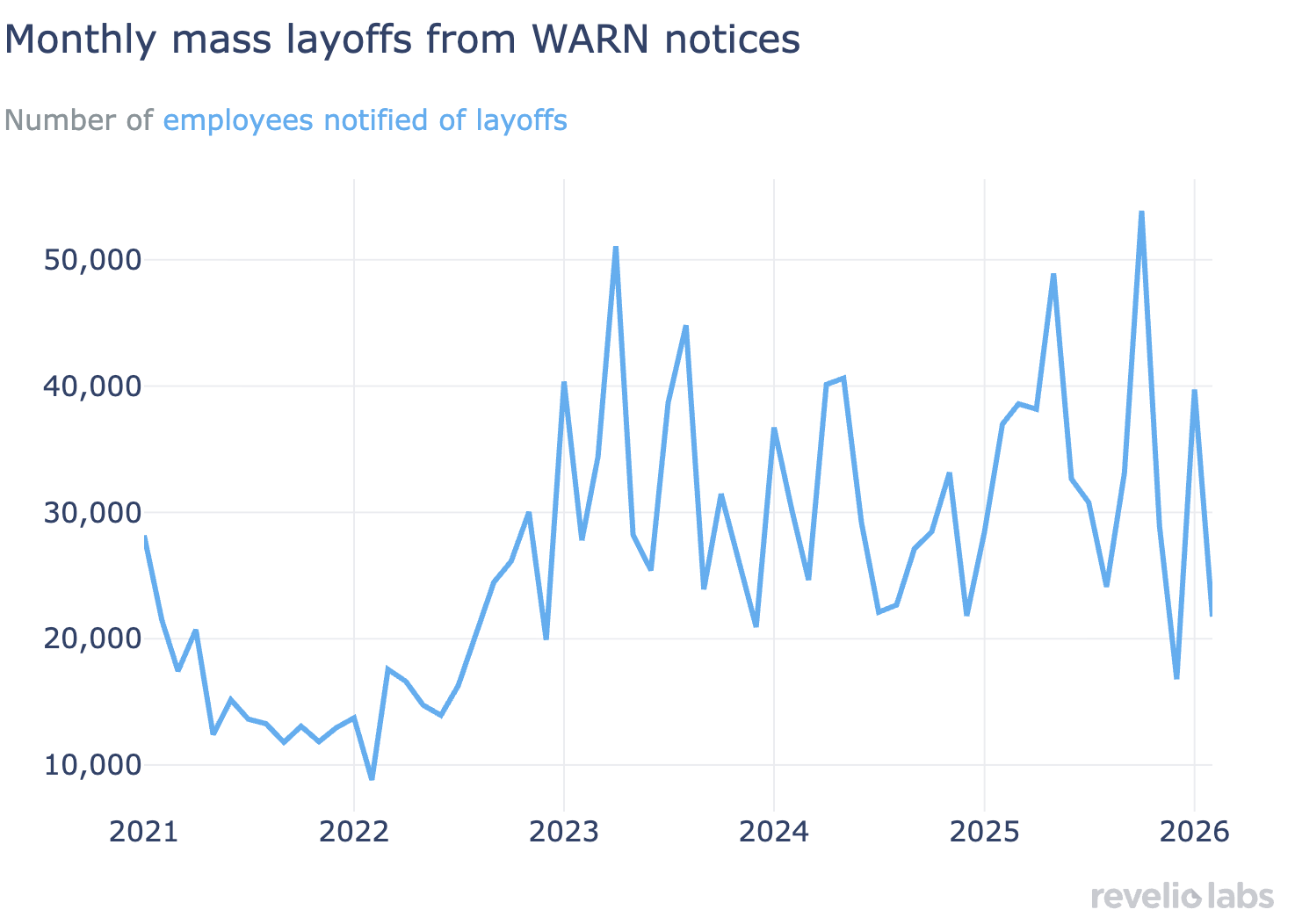
We observe a decline in the number of employees notified with layoffs as part of WARN layoff notices in February. Layoff notices declined by ~35% (from 530 in January to 345 in February 2026). The number of employees notified with layoffs declined from ~40k employees in January to 22.7k in February.
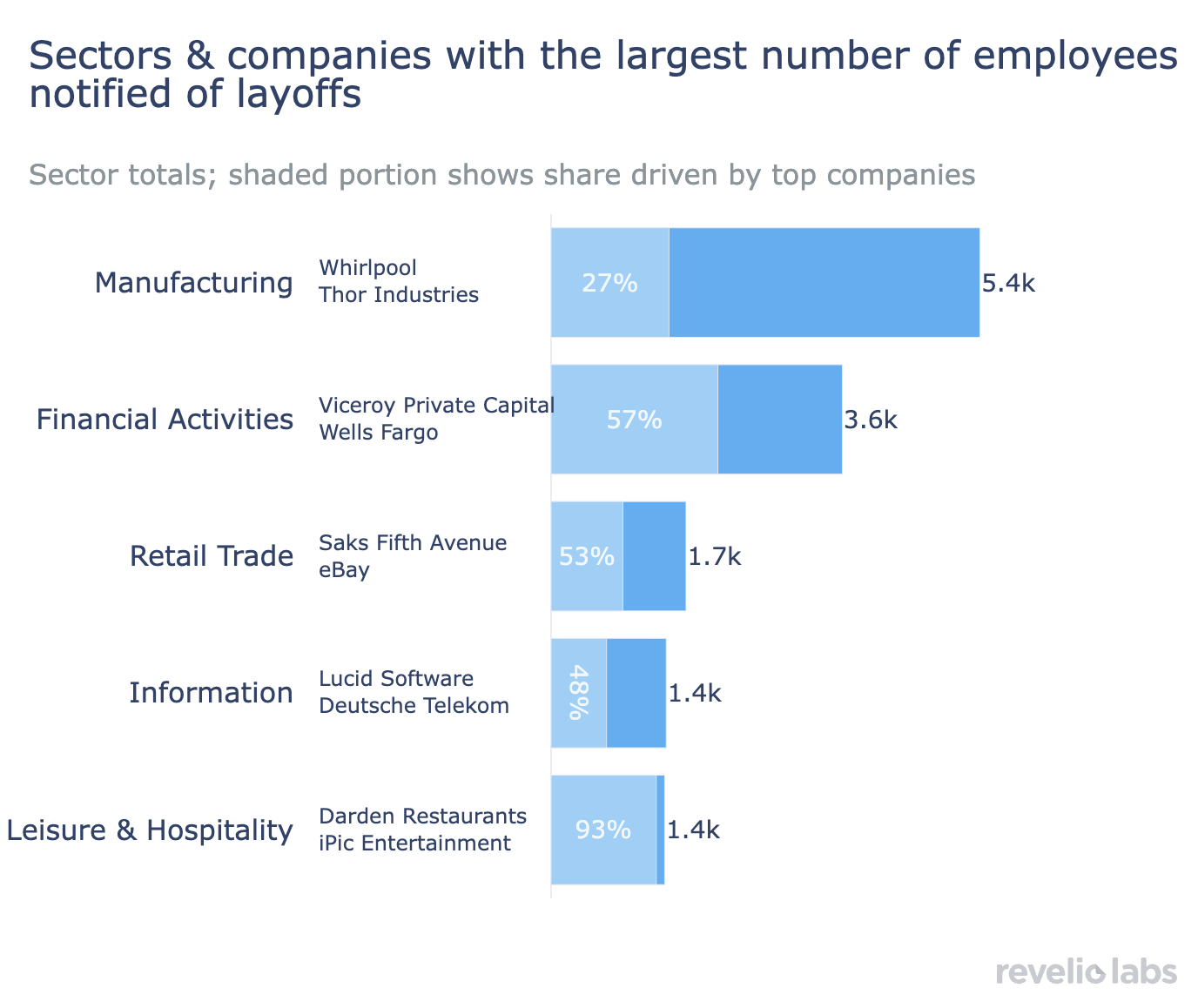
The Manufacturing sector saw the largest number of employees notified of layoffs in February 2026, followed by the Financial Services sector, and Leisure and Hospitality. Within the Manufacturing sector, Whirlpool and Thor Industries contributed the largest share of layoffs.
Hiring and Attrition
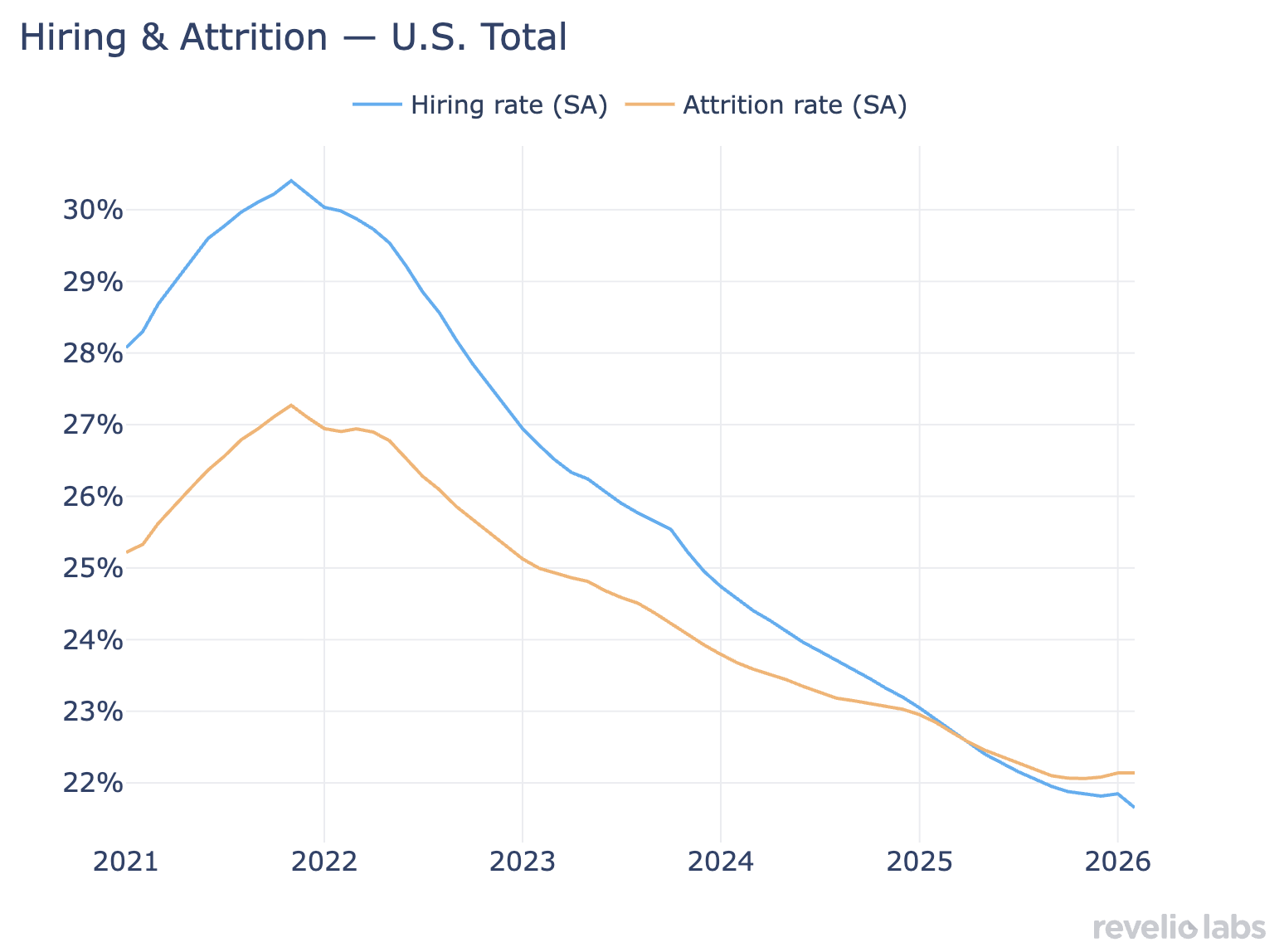
While the hiring rate continued to tick downward in February, attrition remained steady, leading to the decrease in net job creation. Some of the larger month-on-month slowdowns in hiring were seen in Public Administration, and Mining, Quarrying & Oil, and Professional and Business Services. Overall, the US labor market remains close to stall speed when it comes to hiring new workers.
Job Postings
Labor demand continues to cool in the US, as the number of active job postings across the country ticked downwards again in February. Nearly all industries experienced a net decrease in job openings, with the largest declines in percentage terms occurring in the Transportation & Warehousing, Construction, and Public Administration.
Geographically, some of the largest declines in labor demand have occurred in northern states, with active postings dropping more than 20% year-over-year in both Dakotas, Maine, and Rhode Island.
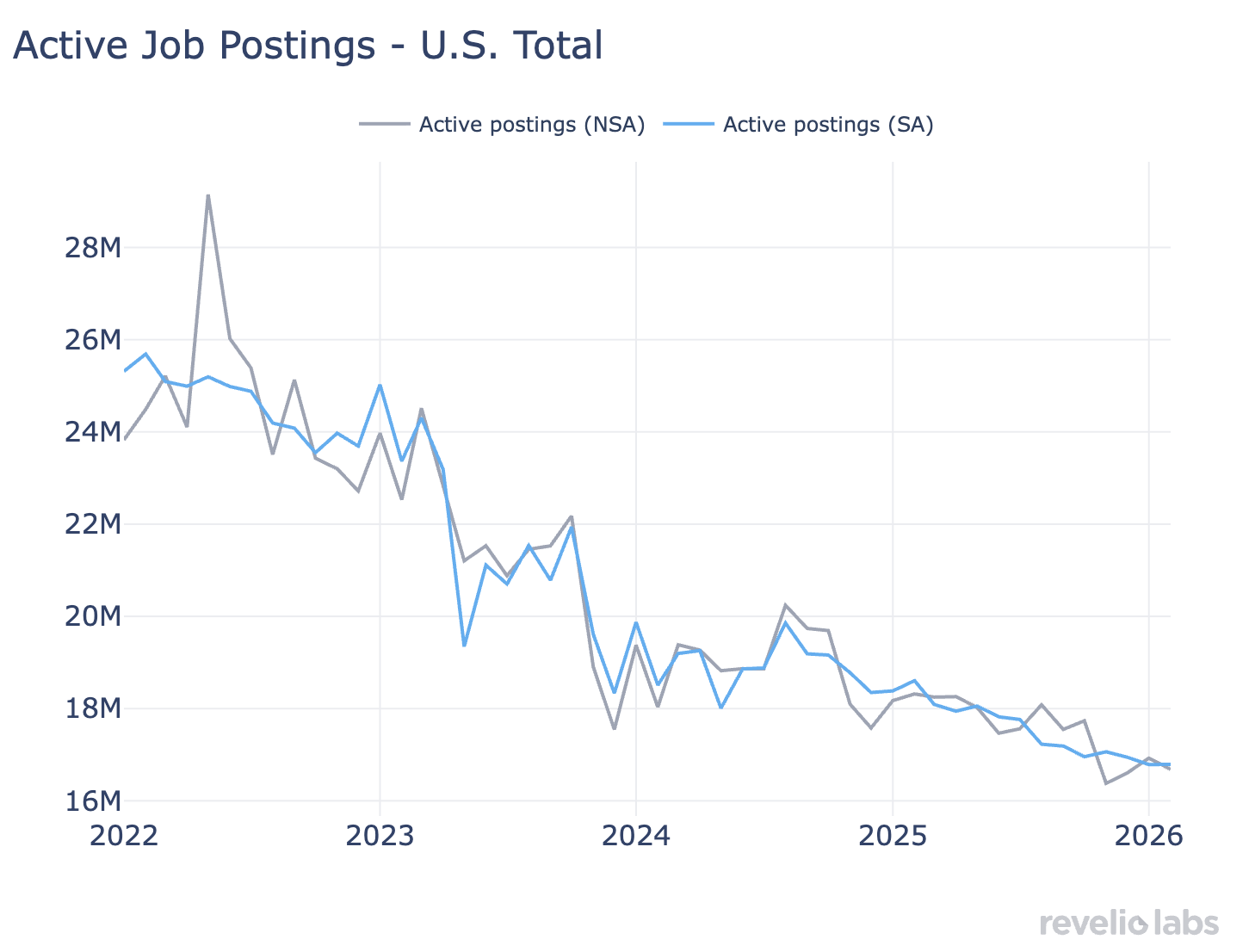
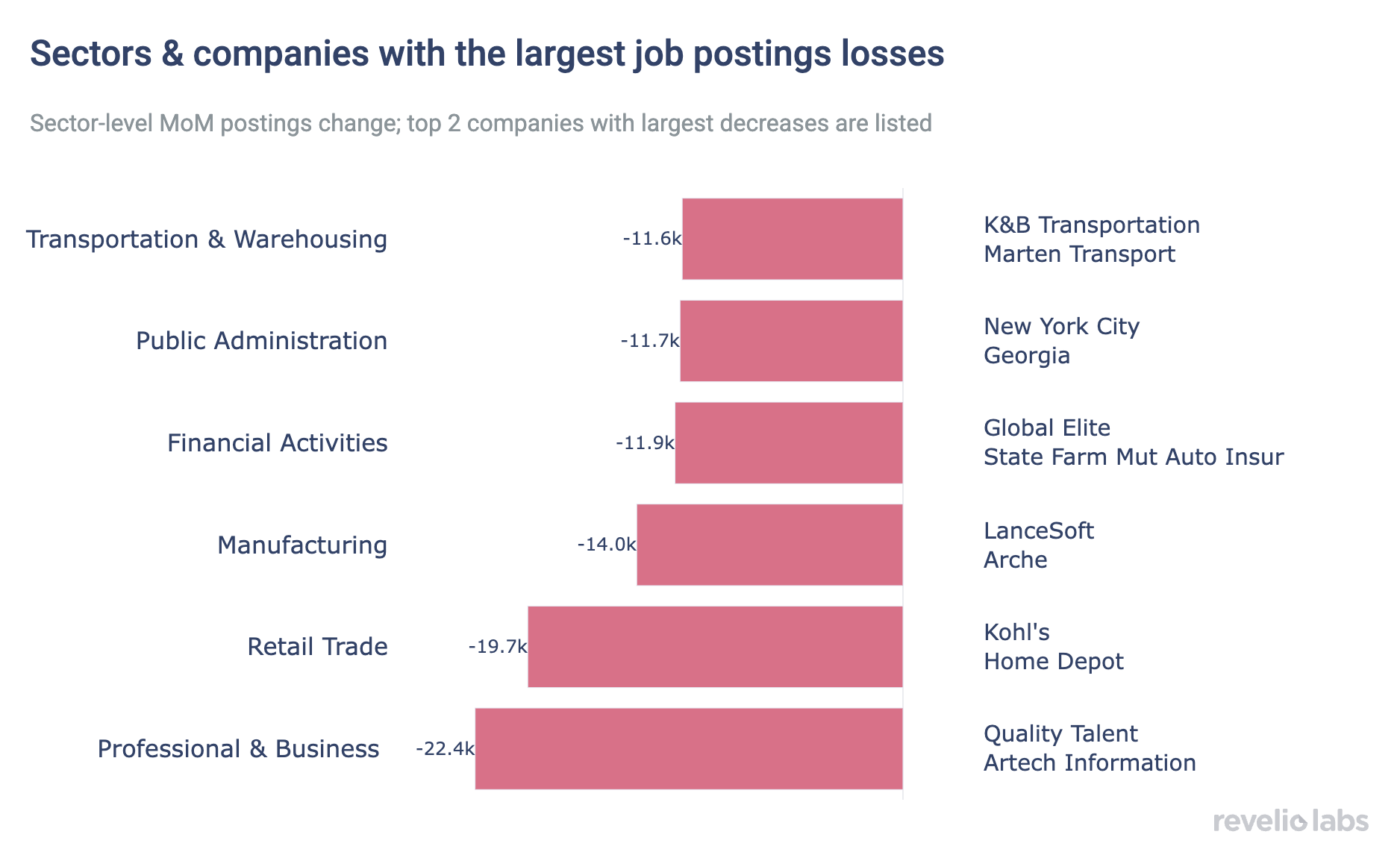
Looking at the total volume of job openings, the Industries that were responsible for largest declines in headline labor demand from January to February were the Professional Business Services, Retail, and Manufacturing. Within these industries, major staffing firms, and retailers like Kohl’s and Home Depot saw some of the most significant declines.
Salaries from new job openings
Salaries from new job postings ticked down slightly in February, decreasing by 1.4% from January 2026. Sectors driving the decline were Leisure and Hospitality, Retail and Manufacturing. Within these sectors, Performance Food Group and Subway in Leisure and Hospitality, Costco and Casey’s General Store in Retail and Mondelez and Stryker in Manufacturing were among the companies with the largest month-over-month declines in salaries in new job postings. Financial Activities and Education saw slight increases in salaries from new job postings.
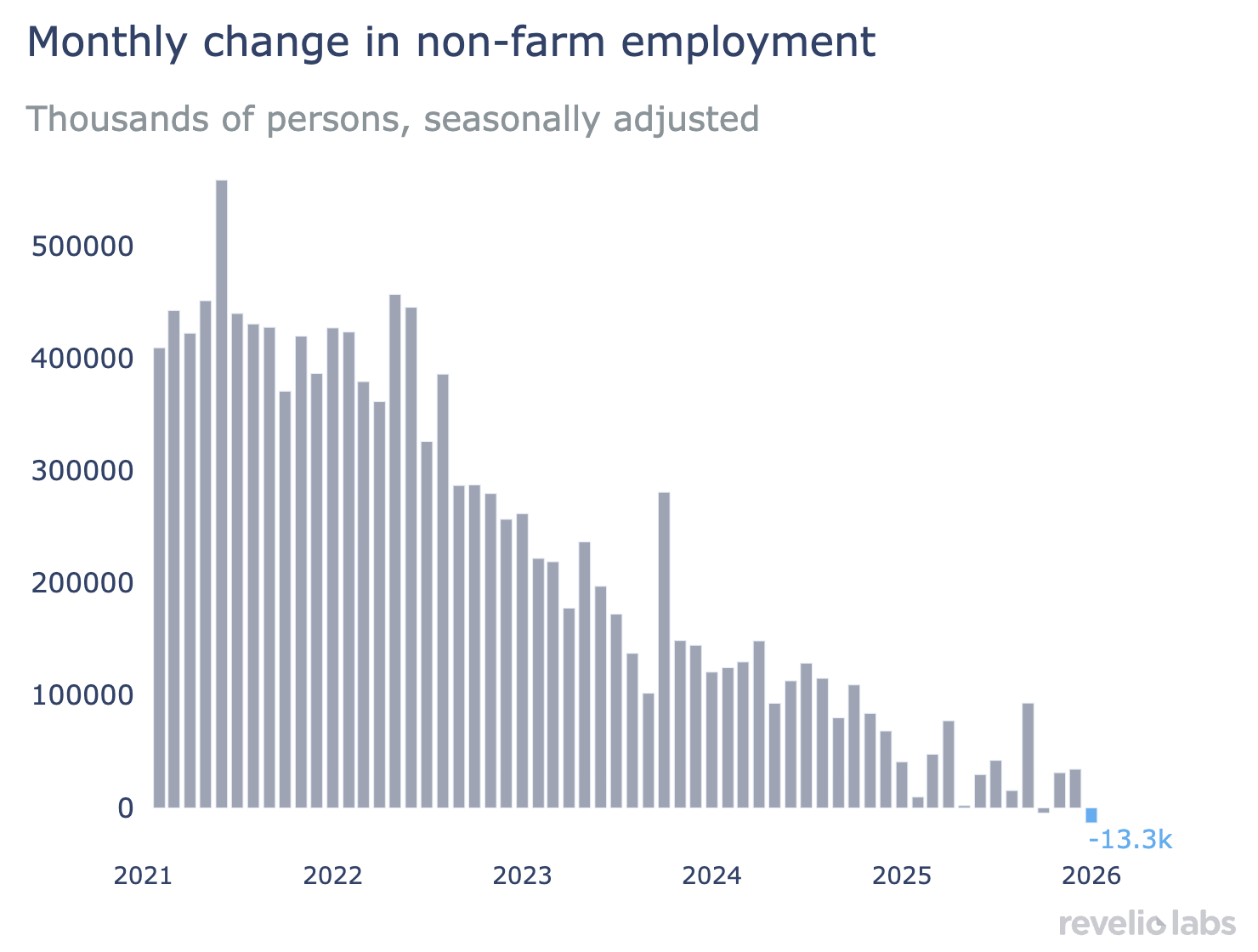
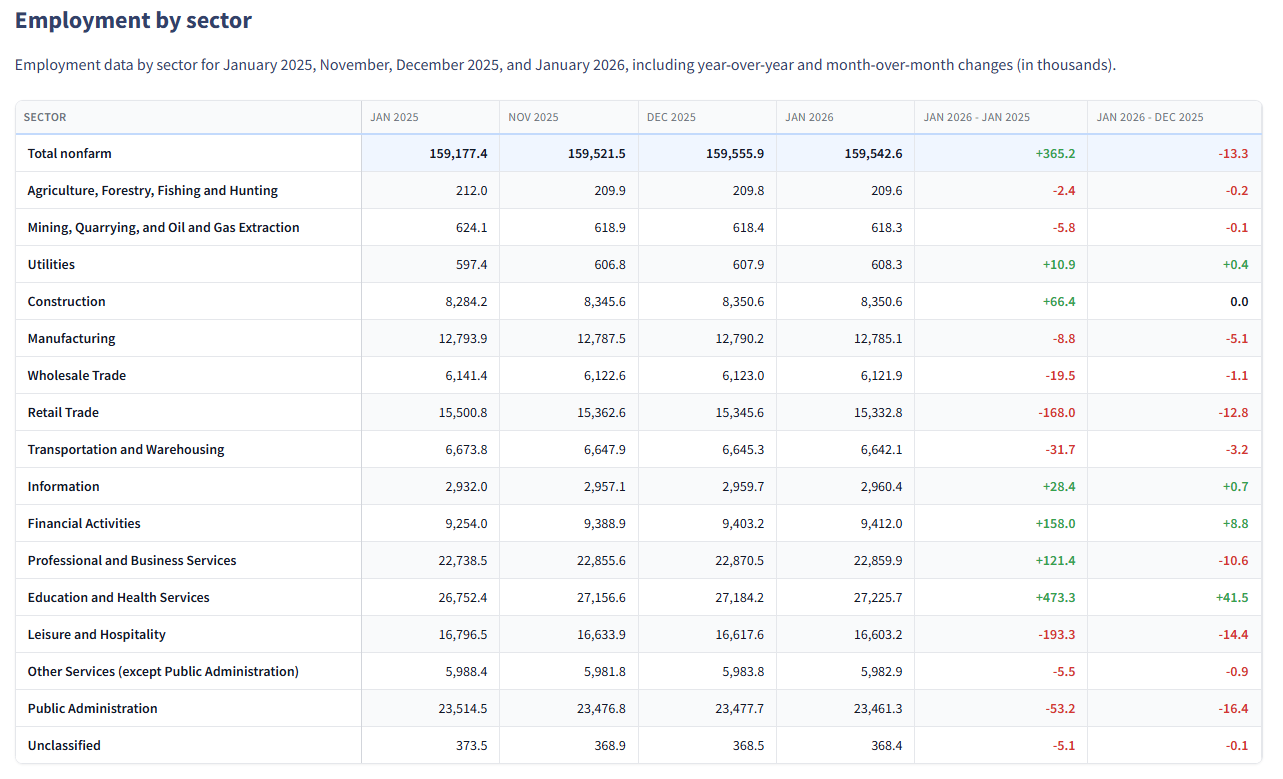
Revelio Public Labor Statistics (RPLS) shows the economy lost approximately 13k jobs in January 2026. The loss was driven by Public Administration, Leisure and Hospitality and Retail Trade. Education and Health, Financial Services and Information show positive employment gains last month.
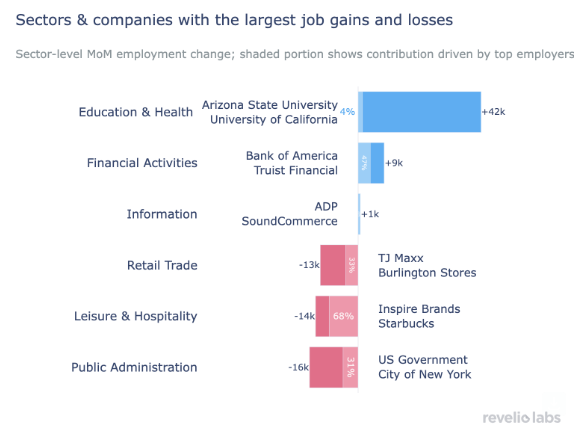
- Within these sectors, the employers with the largest declines were TJ Maxx and Burlington Stores in Retail, Starbucks and Inspire Brands (Dunkin’, Baskin-Robbins, etc.) in Leisure and Hospitality, the US Government as well as the City of New York City in Public Administration. On the positive side, the employers adding the largest number of jobs were Arizona State University and the University of California in Education and Health Services, Bank of America and Truist Financial in Financial Services, and ADP and SoundCommerce in the Information sector.
- Job openings continued to tick down in January, led by declines in the Information and Leisure and Hospitality sectors, as the United States remains at the forefront of cooling global labor demand.
- Salaries from new job postings ticked up notably in January, increasing by 2.5% from December 2025. Sectors driving the increase were Leisure and Hospitality, Mining and Oil Extraction and Manufacturing.
Employment
Revelio Labs Public Labor Statistics (RPLS) shows that the US economy lost approximately 13k jobs in January. The loss was driven by Public Administration, Leisure and Hospitality and Retail Trade. Education and Health, Financial Services and Information show positive employment gains last month.
Within these sectors, the employers with the largest declines were TJ Maxx and Burlington Stores in Retail, Starbucks and Inspire Brands (Dunkin’, Baskin-Robbins, etc.) Leisure and Hospitality, the US Government as well as the City of New York City in Public Administration. On the positive side, the employers adding the largest number of jobs were Arizona State University and the University of California in Education and Health Services, Bank of America and Truist in Financial Services, and ADP and SoundCommerce in the Information sector.
Mass layoff notices
We also observe a notable increase in the number of employees notified with layoffs as part of WARN layoff notices. The number of employers who issued notices increased by ~64% (from 218 in December to 358 in January 2026). The number of employees notified with layoffs increased from 15k employees in December to 33.2k in January.
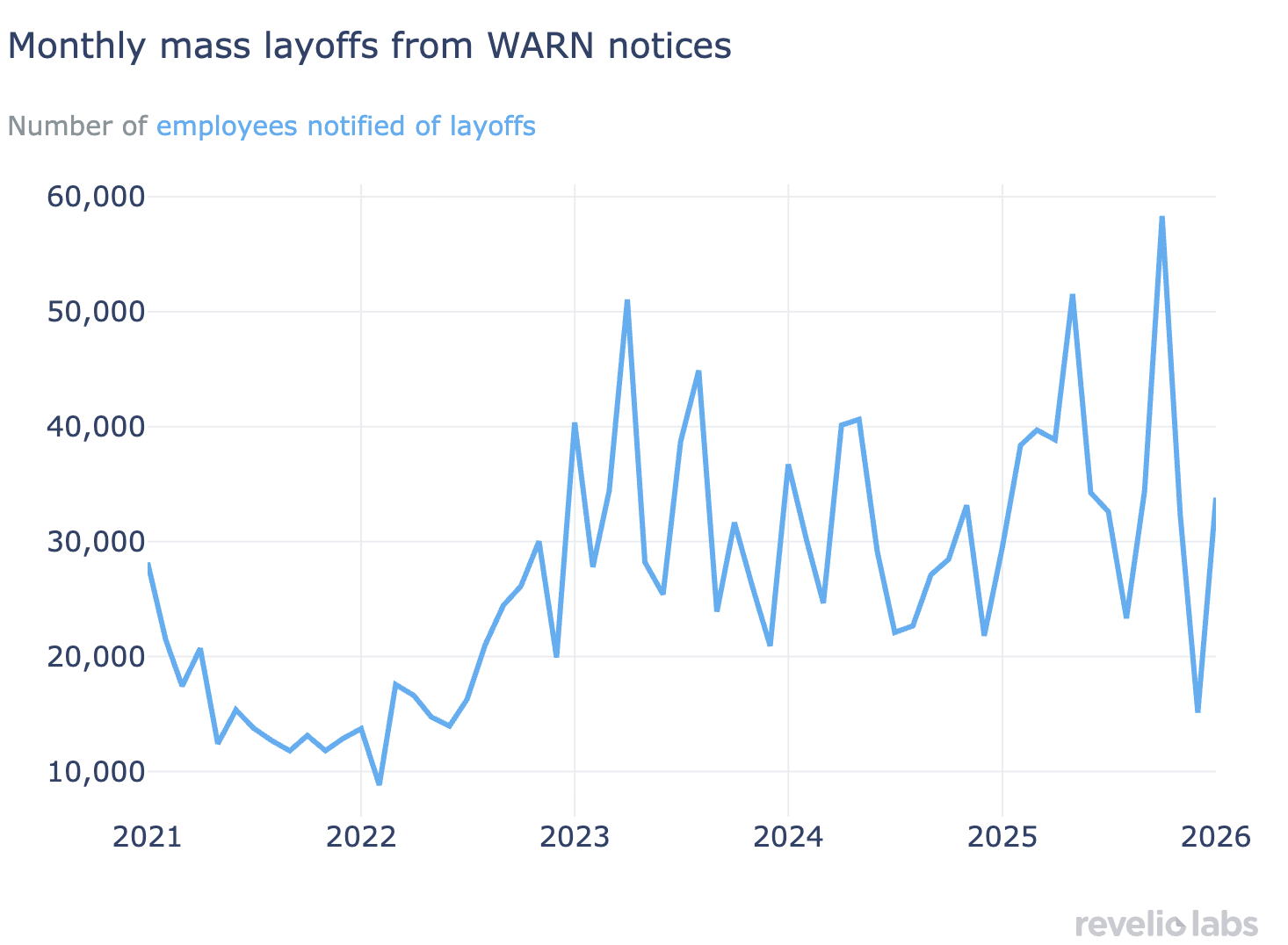
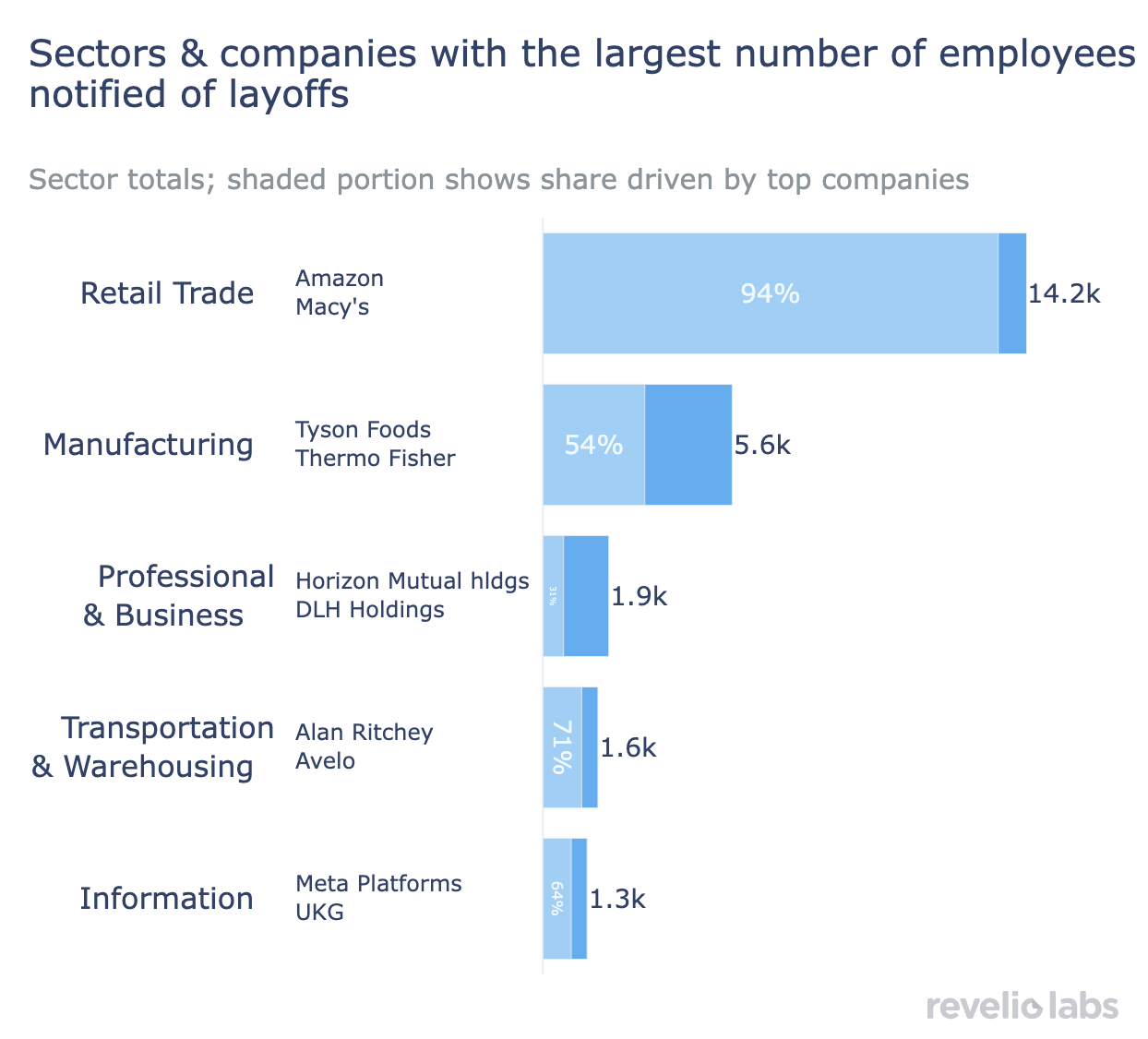
The Retail sector saw the largest number of employees notified of layoffs in January 2026, primarily due to Amazon’s layoff announcements towards the end of the month. Manufacturing had the second largest number of employees notified with layoffs in January. Within manufacturing, layoffs were concentrated in Tyson Foods and Yokohama Rubber.
Hiring and Attrition
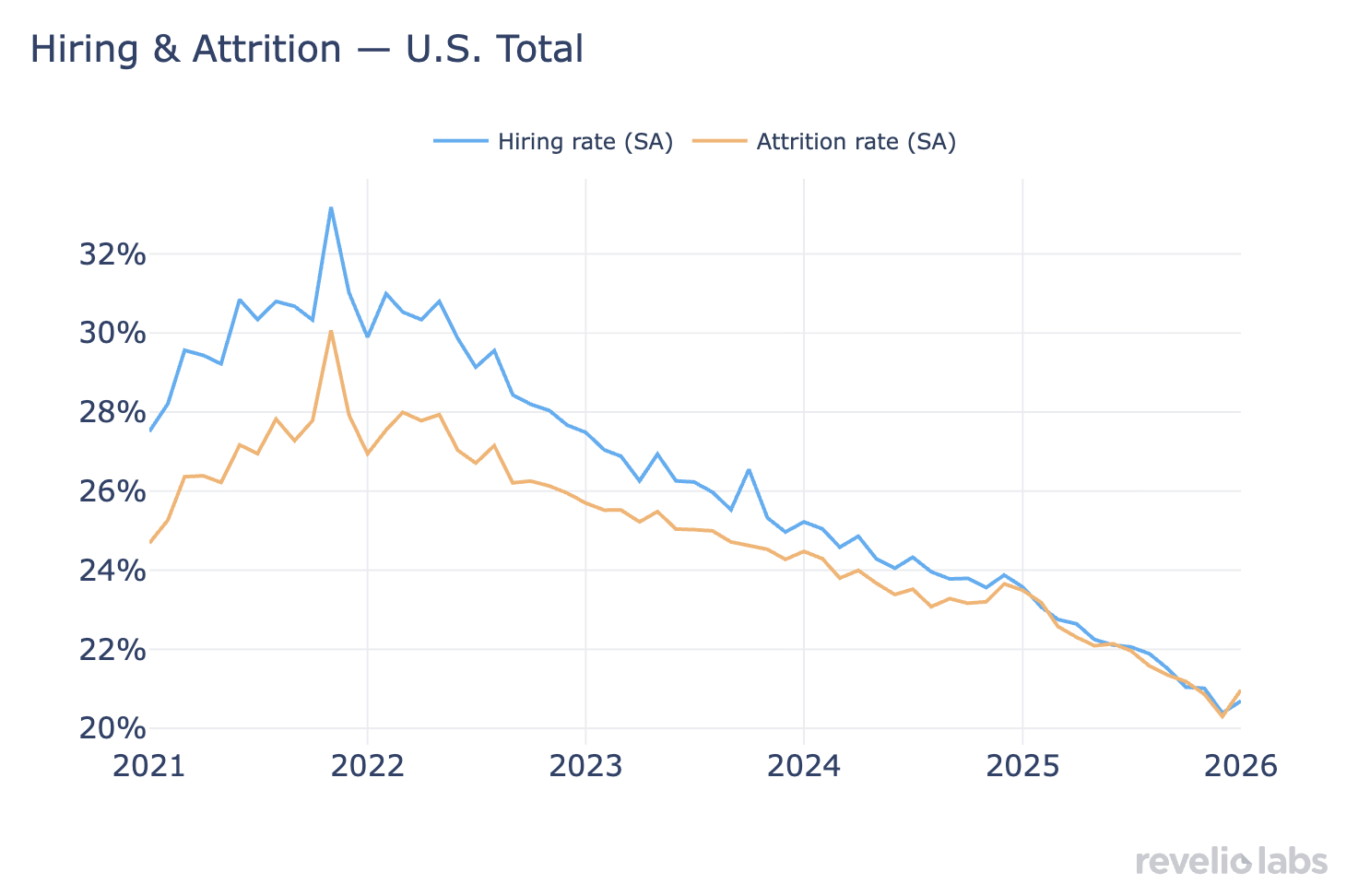
Both the hiring and attrition rates ticked upward in January. However, both remain in a downtrend as the US economy continues to be characterized by a low-hire, low-fire environment. The sluggish hiring rate has made it especially difficult for workers entering the market or looking for a new job, fueling a deterioration in labor market confidence. New entrants have had an especially difficult time in the labor market, as older workers stick around longer and employers put an emphasis on experience over long-term potential.
Job Postings
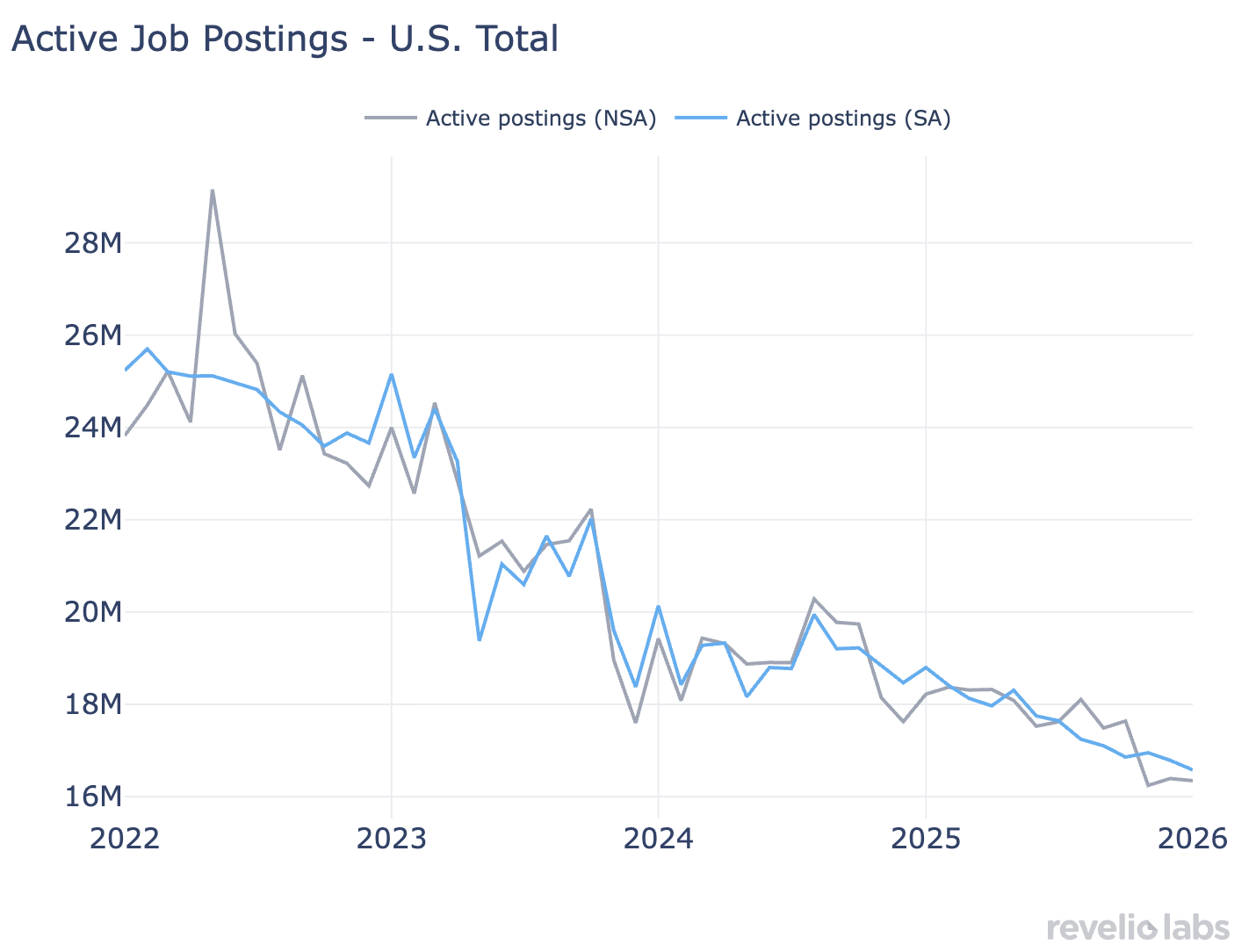
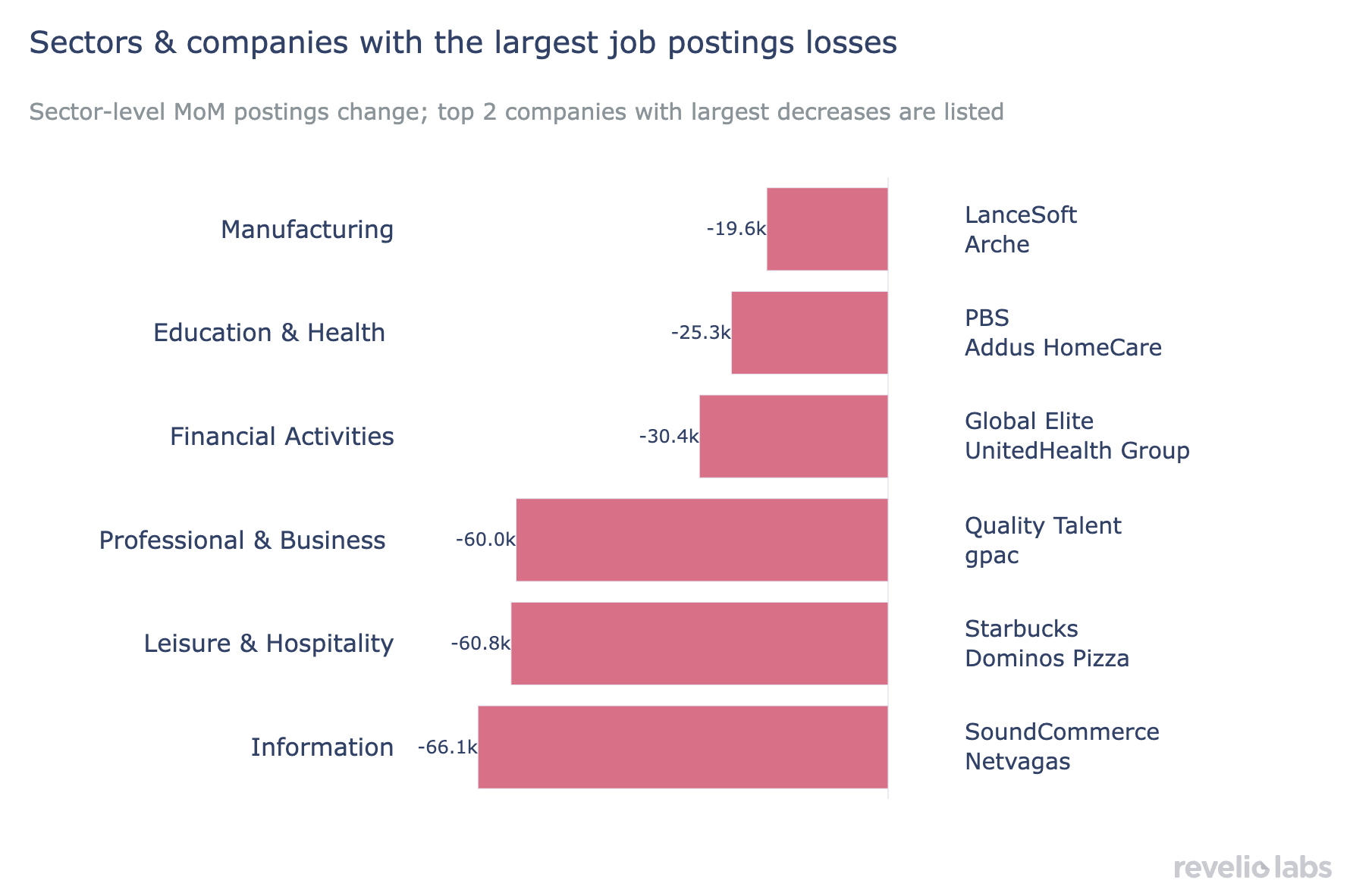
Labor demand continues to cool in the US, as the number of active job postings across the country ticked downwards again in January. Nearly all industries experienced a net decrease in job openings, with the largest declines in percentage terms occurring in the Utilities, Information, and Mining, Quarrying, and Oil and Gas Extraction sectors.
This years-long steady decline in job openings puts the United States at the forefront of cooling global labor demand, which we highlighted in a newsletter this week. Since January 2021, the total number of active postings has fallen 35%.
Looking at the total volume of job openings, the industries that were responsible for largest increases in headline labor demand from December to January were the Information, Leisure and Hospitality, and Professional and Business Services sectors. Within these sectors, major staffing firms, and retailers like Domino's Pizza and Starbucks saw some of the most significant declines.
Salaries from new job openings
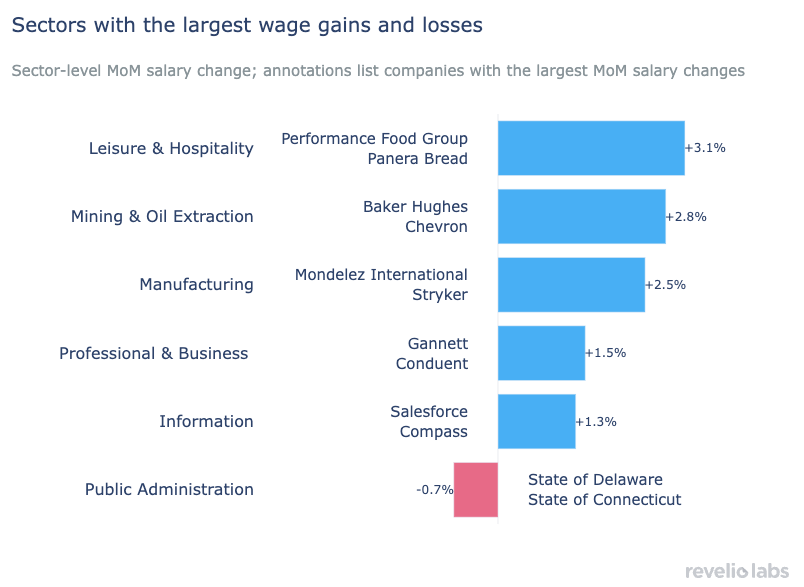
Salaries from new job postings ticked up notably in January, increasing by 2.5% from December 2025. Sectors driving the increase were Leisure and Hospitality, Mining and Oil Extraction and Manufacturing. While these industries have seen weaker job demand, the calibre of jobs open in January increased. Within these sectors, Performance Food Group and Panera Bread from Leisure and Hospitality, Baker Hughes and Chevron for Mining and Mondelez and Stryker for Manufacturing were among the companies with the largest month-over-month increases in salaries in new job postings.
- Revelio Public Labor Statistics shows the economy added approximately 71k jobs in December. The employment gains were driven by the Education and Health Services sector, which continues to add jobs every month. Meanwhile, the Retail sector lost about 11k jobs.
- Within these sectors, the employers adding the largest number of jobs were the Universities of California and Texas in Education and Health Services, PwC and KPMG in Professional Services, and JP Morgan Chase and Fidelity in Financial Services. Employers with the largest declines were Target and Walmart in Retail as well as Starbucks and Inspire Brands (Dunkin’, Baskin-Robbins, etc.) in Leisure and Hospitality.
- We are seeing a reversal in the trend for hiring this month, with hiring finally up month-over-month after a long period of decline. Job postings saw a month-over-month decline of 1.4%, which still bodes ill for labor demand moving into 2026.
- Salaries from new job postings ticked down in December, showing a -0.5% month-over-month increase, driven by salary declines in Education & Health as well as Utilities.
Employment
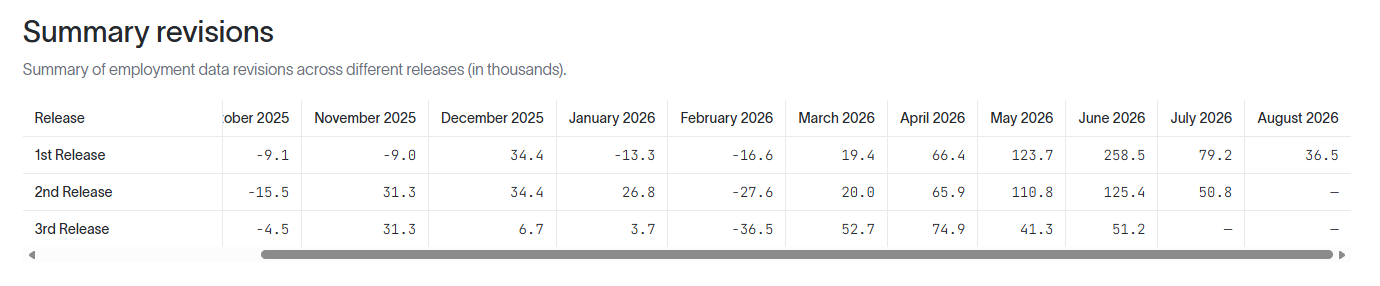
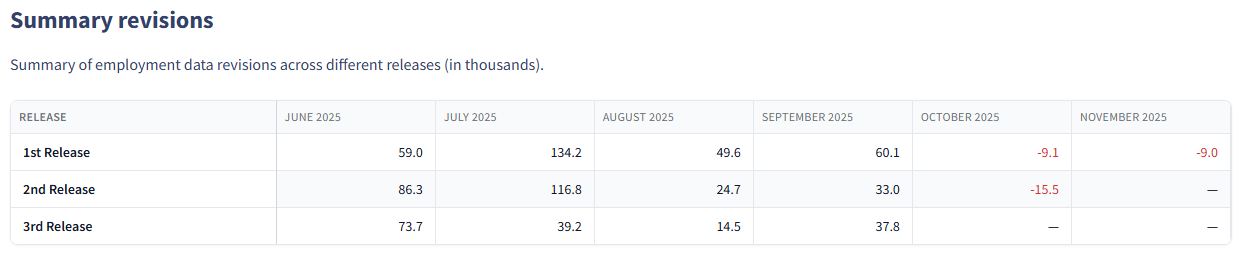
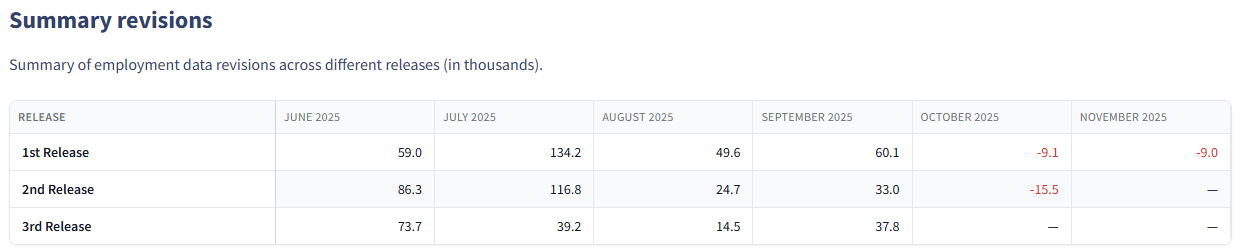
Revelio Labs Public Labor Statistics shows that the US economy added approximately 71k jobs in December. November employment growth was revised from -9k jobs to +32k. Our estimates of employment in December point to a strong holiday season. The sectors with the biggest increases and decreases in employment point to the further bifurcation of the labor market, with job creation among white-collar roles remaining relatively strong.
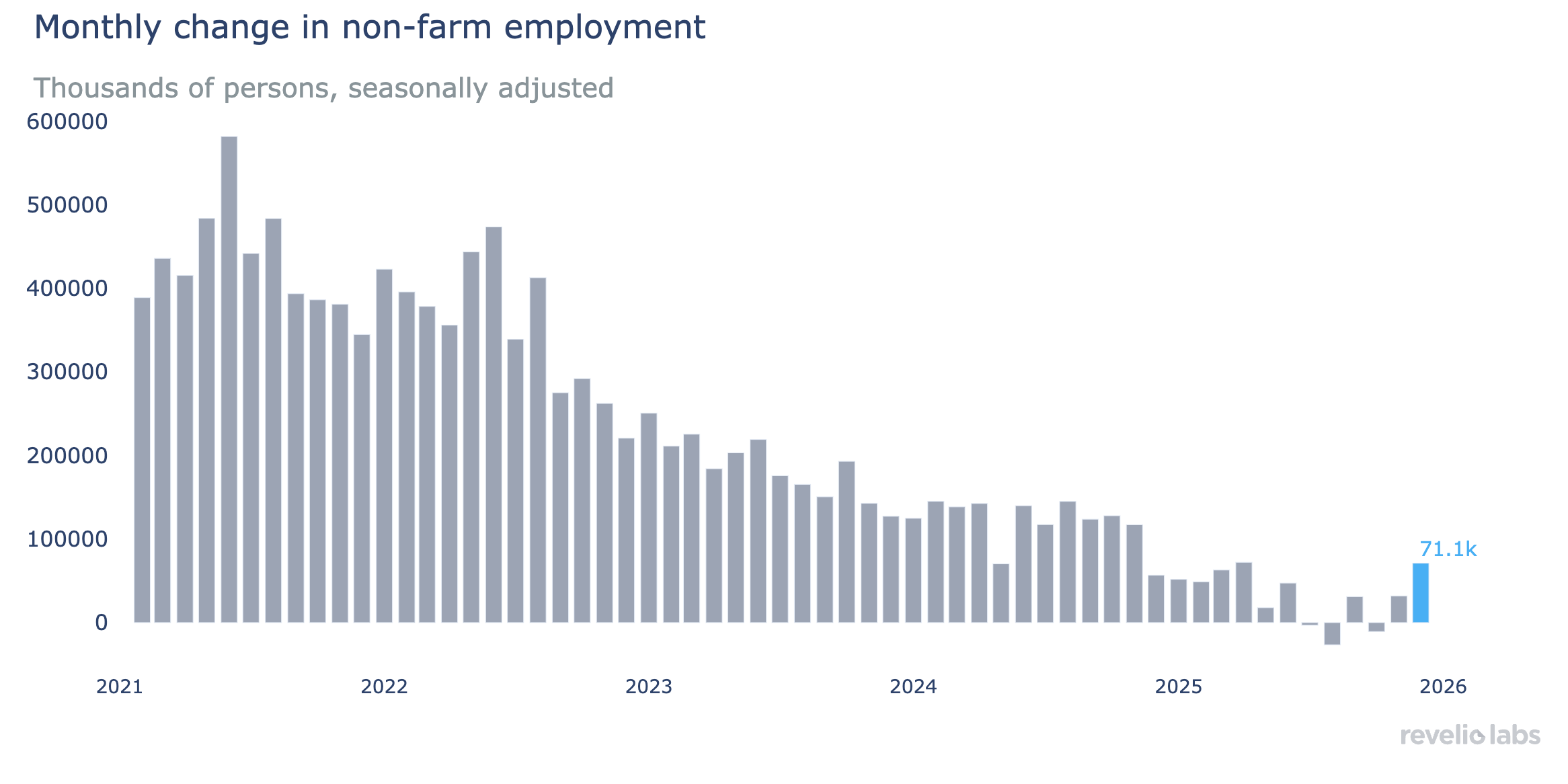
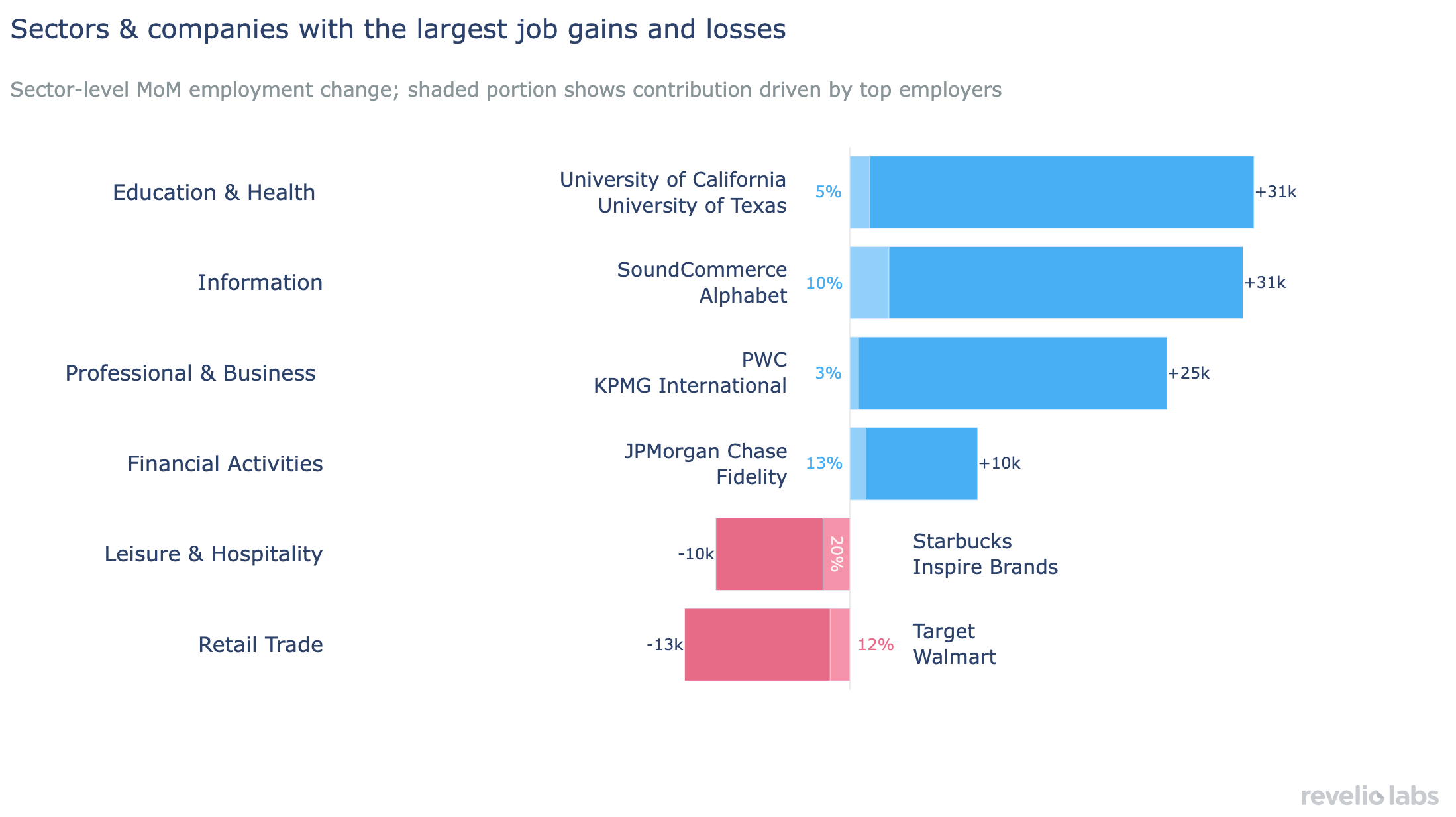
The increase in employment was driven by Health and Education, Information, and Professional and Business Services. Retail Trade and Leisure and Hospitality saw the largest declines in employment, similar to November.
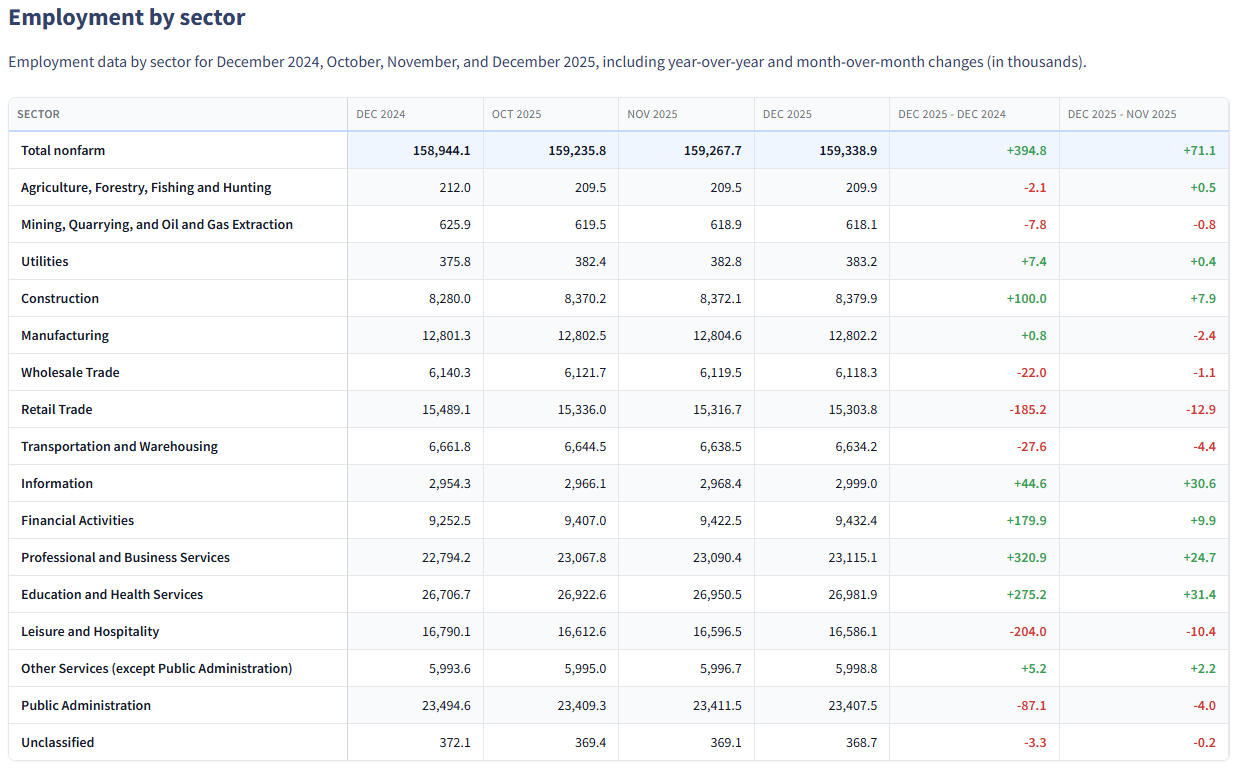
Within these sectors, the employers adding the largest number of jobs were the Universities of California and Texas in Education and Health Services, PwC and KPMG in Professional Services, and JP Morgan Chase and Fidelity in Financial Services. Employers with the largest declines were Target and Walmart in Retail as well as Starbucks and Inspire Brands (Dunkin’, Baskin-Robbins, etc.) in Leisure and Hospitality.
With the exception of the uptick in Construction, this month’s employment numbers continue the stark K-shaped trends from last month, where more white-collar industries see relative strength, while blue-collar jobs are in stark decline.
Layoff notices
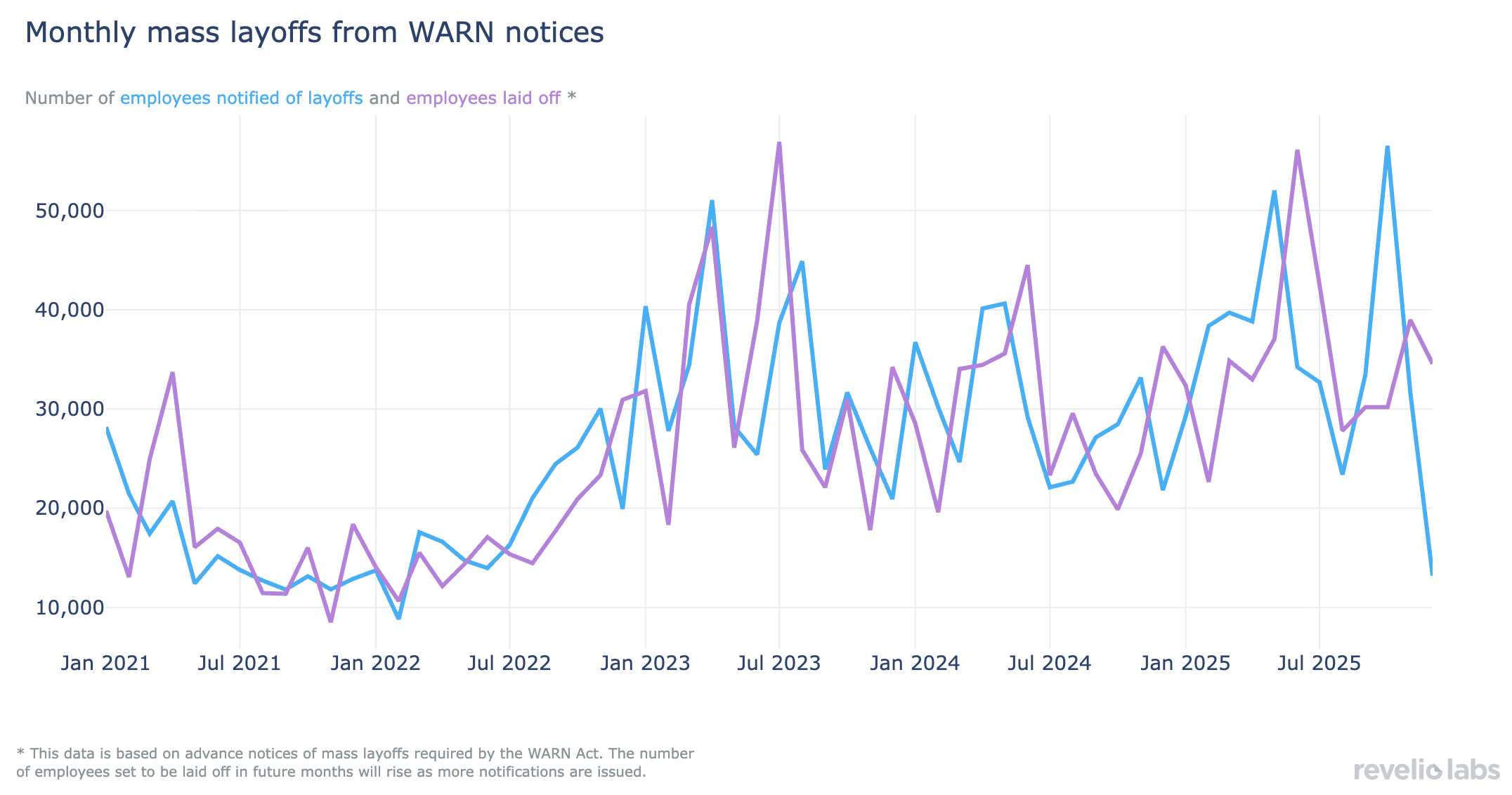
We also observe a decline in the number of employees notified with layoffs as part of WARN layoff notices. Layoff notices decreased by ~38.6% (from 306 in November to 118 in December). The number of employees notified with layoffs decreased from 31.6k employees in November to 13.2k in December, a 58% month-over-month decline.
Hiring & attrition
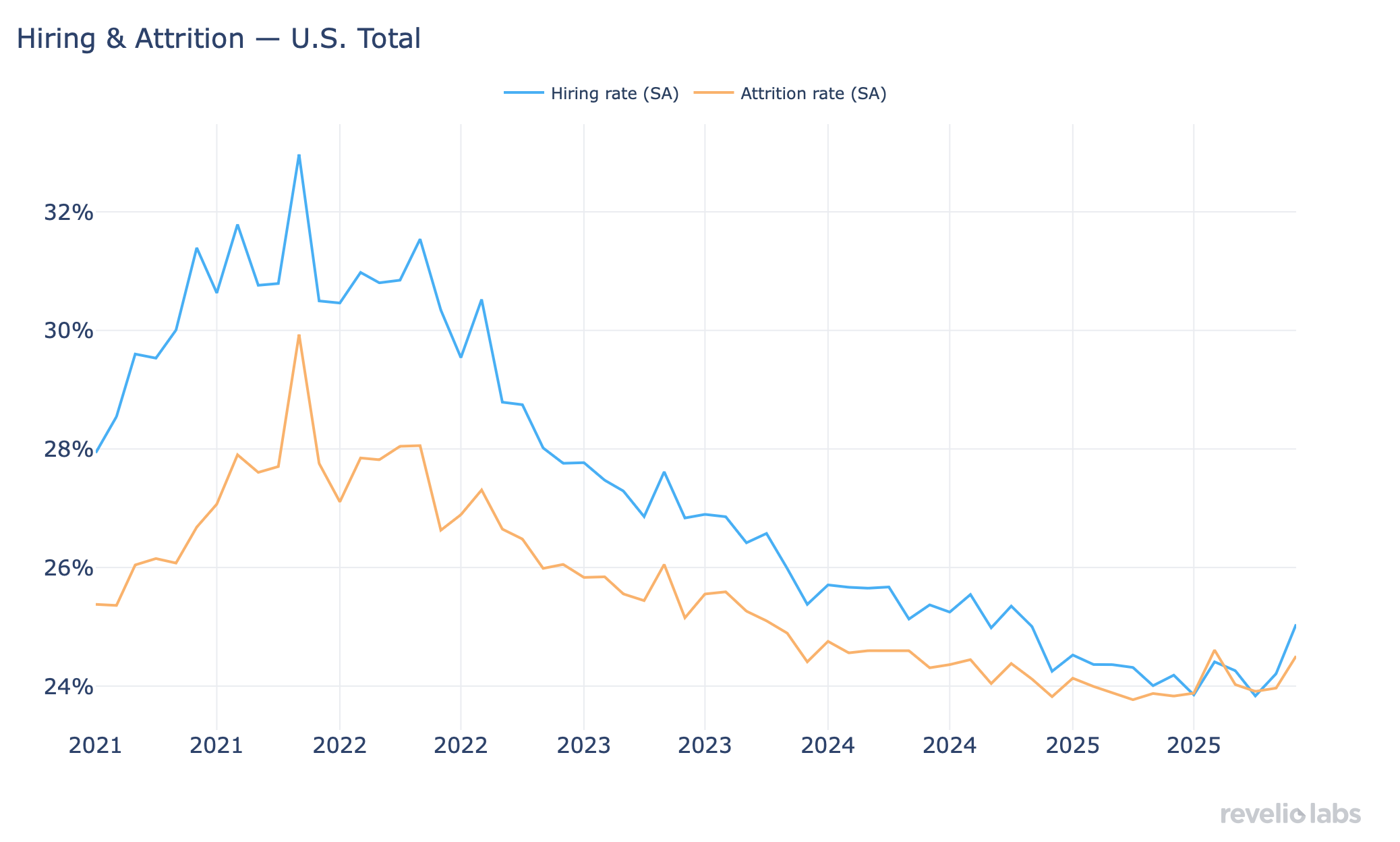
Hiring is finally showing signs of improvement after a years-long slowdown. The annualized hiring rate ticked up from 24.2% in November to 25.0% in December, giving job seekers some additional hope going into the new year. The increase in hiring was led by the Information and Financial Activities sectors.
Attrition also ticked up along with hiring, but not as much, leading to the relatively strong job gains posted in December. Overall, the increase in hiring and attrition will be a welcome sign for a labor market that was swiftly losing its dynamism.
Job postings
Job postings data continues to show weakening demand, which bodes ill for job creation moving into the new year. Active job postings ticked down 1.4% from November to December, with almost all industries showing decreases month over month and year over year. The biggest declines in labor demand in December compared to the year prior were found in Public Administration (-35.5%), Other Services (-32%), and Professional and Business Services (-30.2%).
Salaries from new job openings
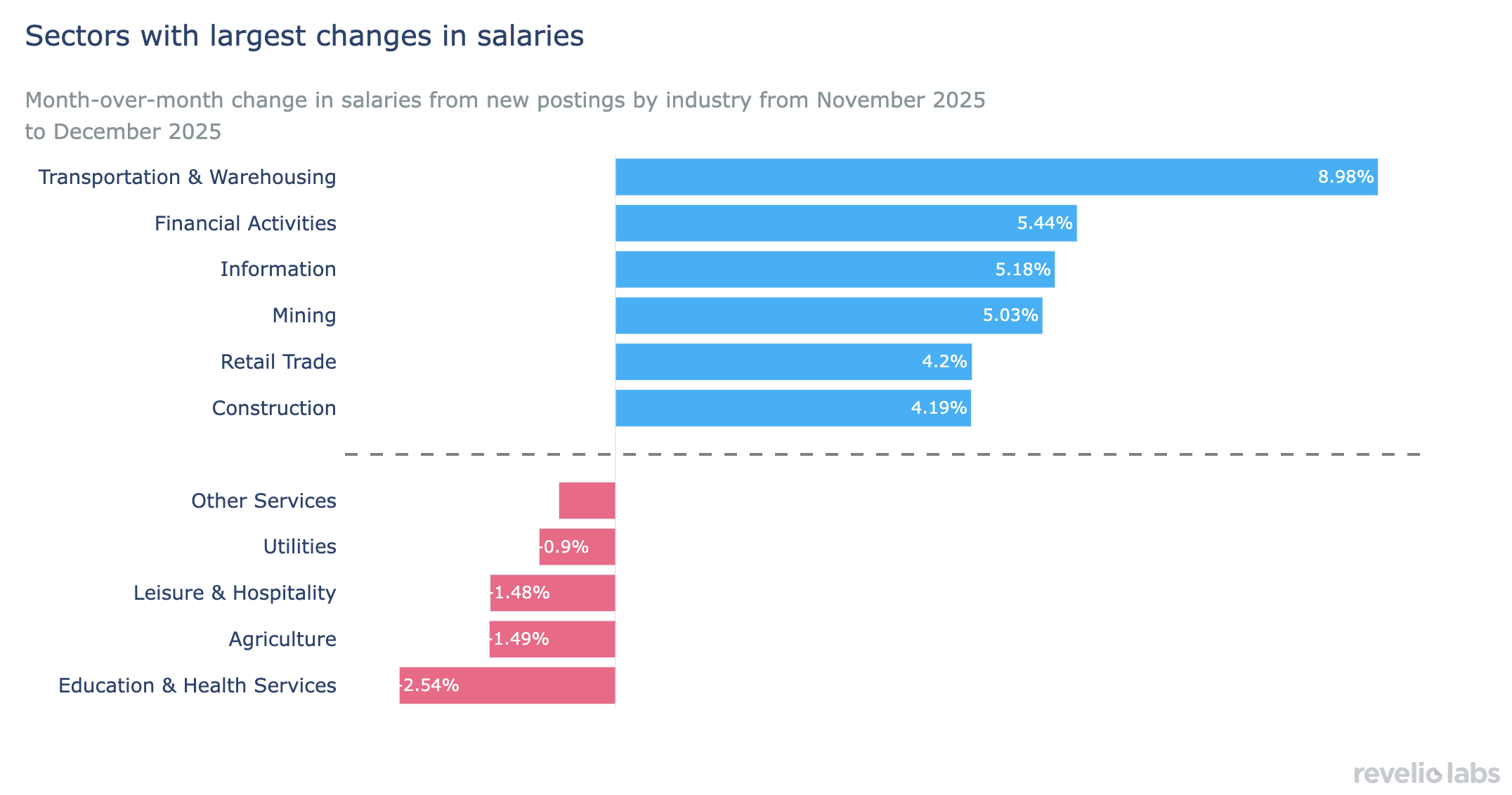
Salaries from new job postings ticked down slightly in December, falling -0.5% from November 2025. Sectors driving the decrease are Education and Health, Agriculture, and Leisure and Hospitality. Salaries increased for Transportation and Warehousing, as well as in the Financial Sector.
-
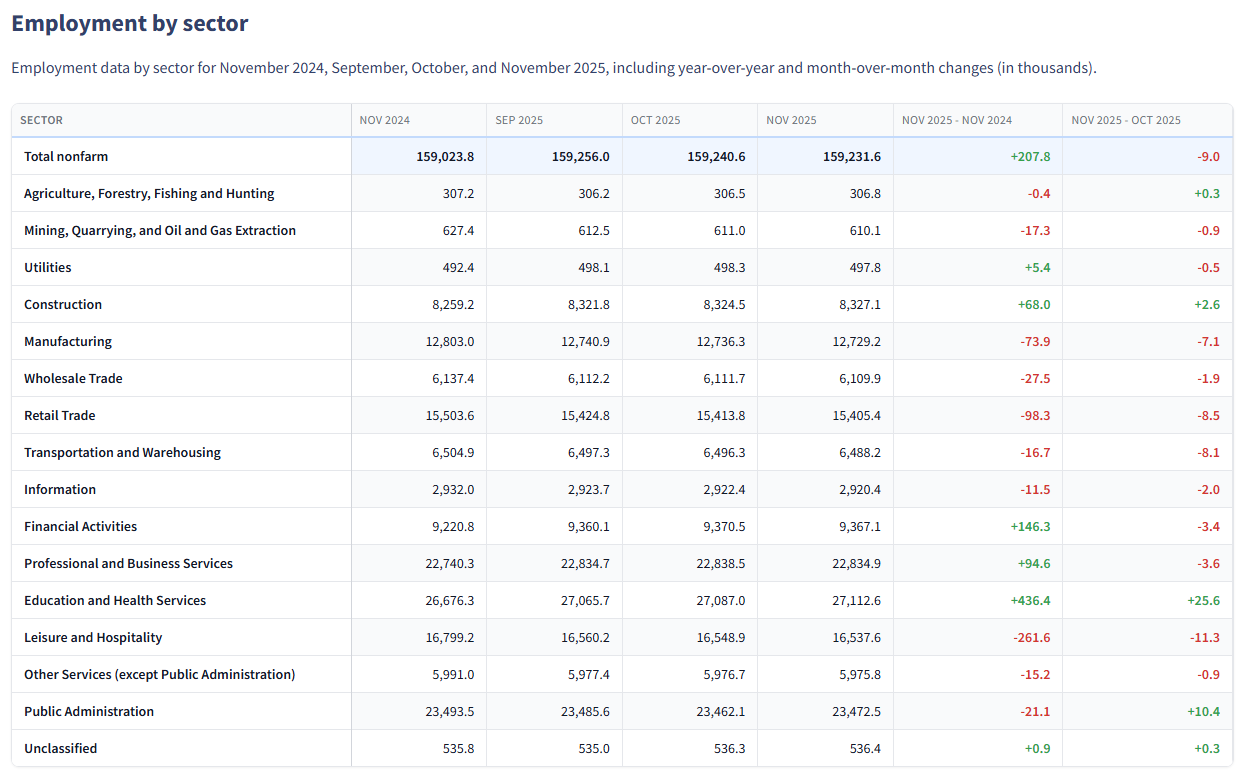
Revelio Public Labor Statistics (RPLS) shows the economy shed 9K jobs in November. The biggest declines were driven by the Leisure and Hospitality, Retail Trade, Transportation and Warehousing as well as Manufacturing sectors. Education and Health Services continued to add jobs and Public Administration saw a rebound over last month.
-
Within these sectors, Starbucks and McDonald's (in Hospitality), Target and Walmart (in Retail) as well as AstraZeneca and Intel (in Manufacturing) saw the largest declines in employment. Employers adding the largest number of jobs on the other hand included the Universities of California and Texas as well as the States of California and New York.
-
Hiring and attrition rates continued to decline. Job postings saw a further month-over-month decline of 0.3%.
-
Salaries from new job postings ticked up in November, showing a 0.9% month-over-month increase, driven by jobs in Mining and Transportation.
Employment
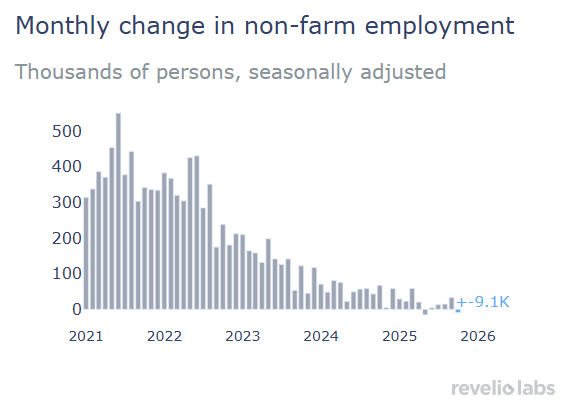
Revelio Labs Public Labor Statistics shows that the US economy lost 9K jobs in November, a similar decline as last month, pointing to continued weakening of the economy. The sectors with the biggest increases and decreases in employment point to the further bifurcation of the labor market, with more white collar jobs remaining relatively strong, and blue collar work taking the brunt of the slowdown.
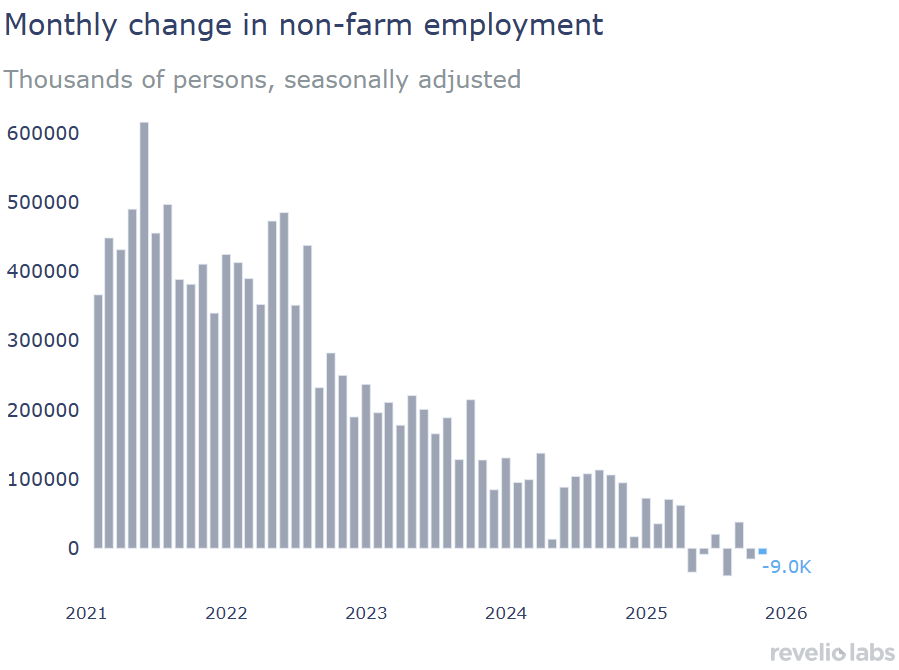
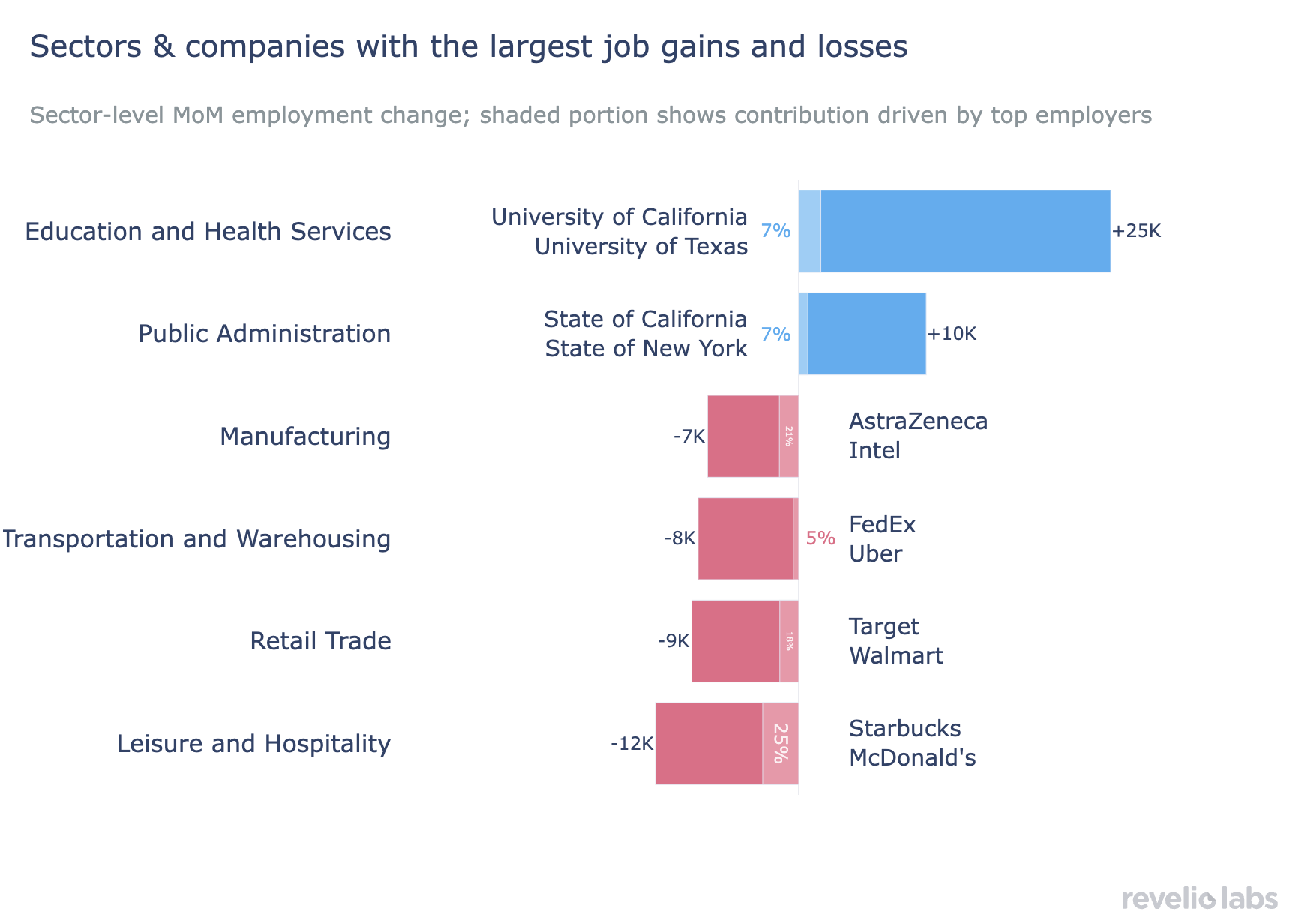
The decline in employment was driven by the Leisure and Hospitality, Retail Trade, Transportation and Warehousing as well as Manufacturing sectors. Education and Health Services continued to add jobs in the last month. Public Administration saw a rebound in November, after the sharp decline in October. Within these sectors, Starbucks and McDonald's (in Hospitality), Target and Walmart (in Retail) as well as AstraZeneca and Intel (in Manufacturing) saw the largest declines in employment. The companies driving declines in Manufacturing employment serve as a stark reminder that Manufacturing employment in the US includes production of a variety of important goods like Pharmaceuticals and Computer hardware. These companies employ a variety of workers, including high-paying white-collar jobs. Employers adding the most jobs on the other hand included the Universities of California and Texas as well as the States of California and New York.
Layoff notices
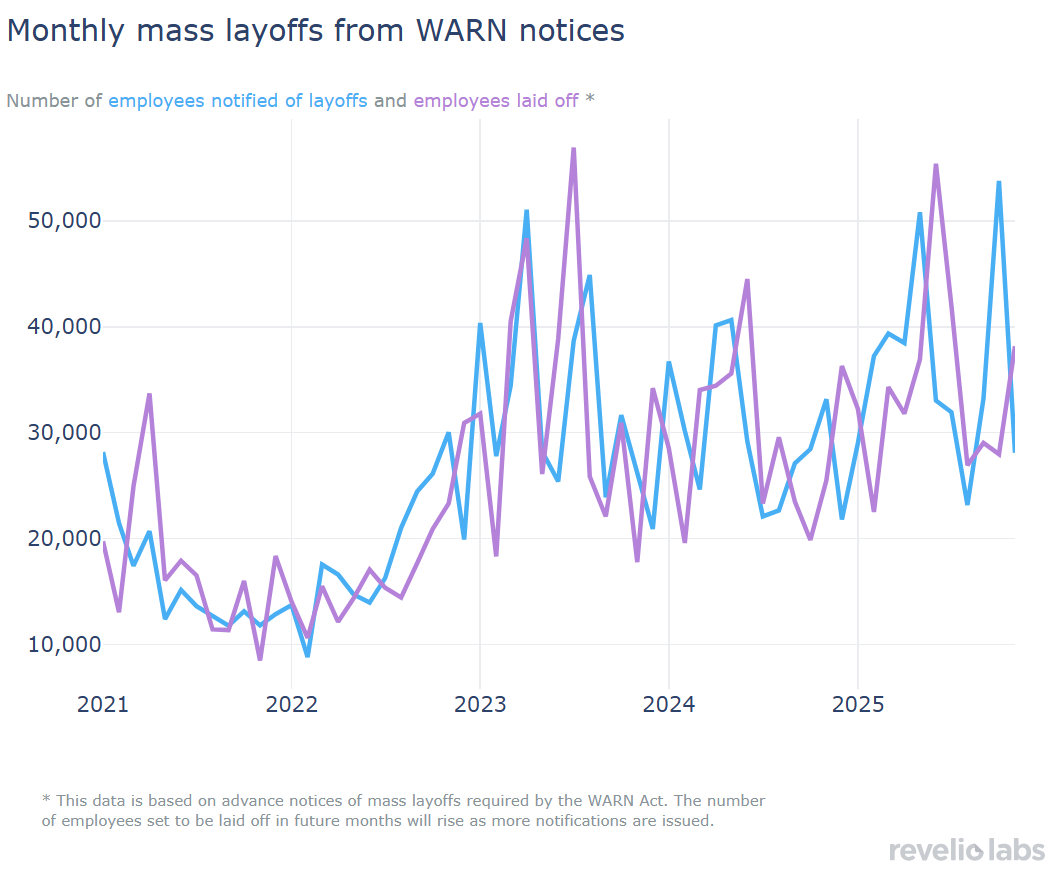
We also observe a decline in the number of employees notified with layoffs as part of the WARN layoff notices. Layoff notices decreased by ~61 % in November (from 723 in October to 281 in November). The number of employees notified with layoffs decreased from 53.8K employees in October to 28.1K in November, a 48% decline month-over-month.
Hiring & attrition
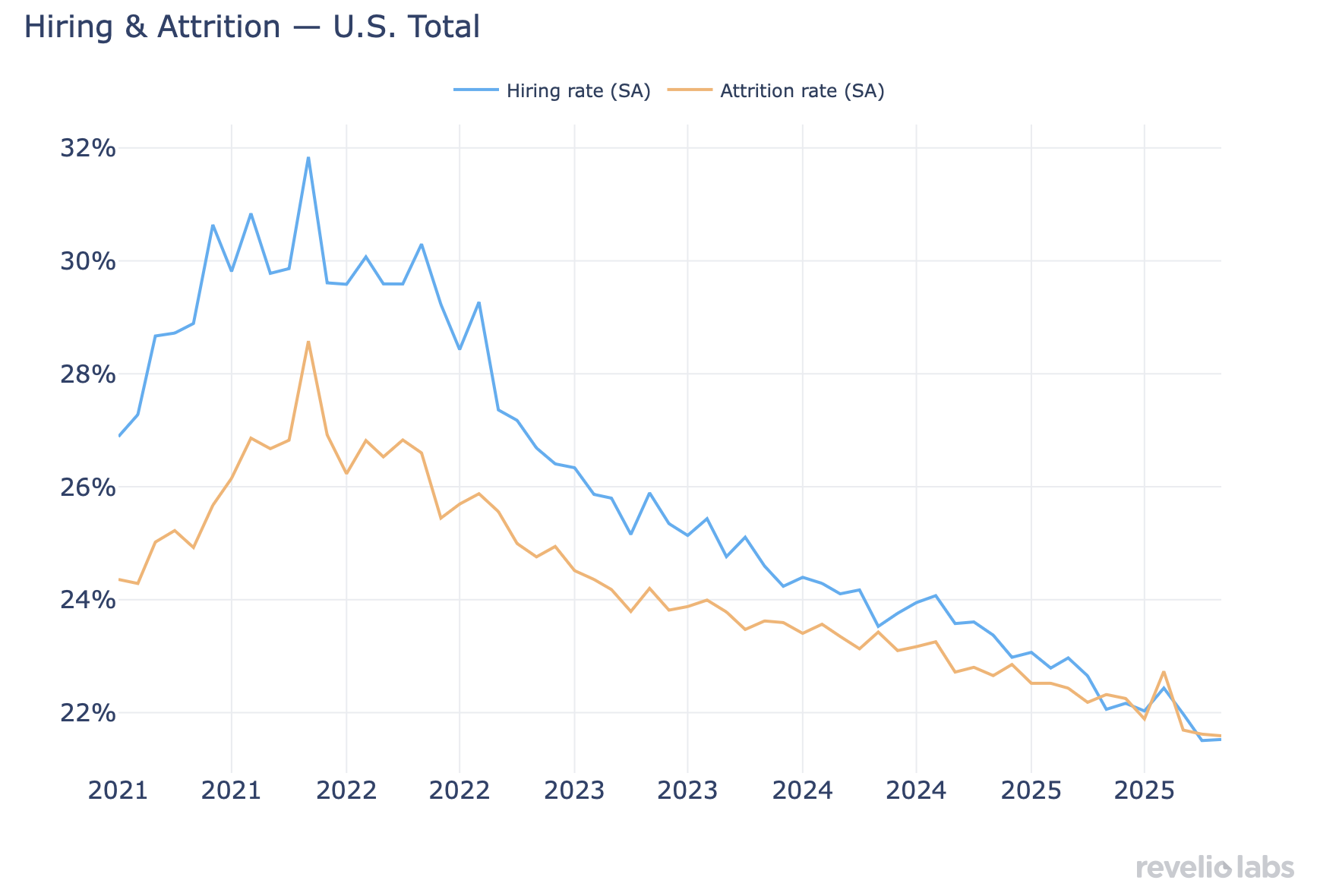
Hiring and attrition also continue to decline, though we note a slowdown in the rate of the decline over previous months. In November, the annualized hiring rate was just 21.59%, and the attrition rate stood at 21.52%. Some of the biggest declines in hiring rates can be observed in Wholesale Trade, Utilities and Professional and Business Services.
Job postings
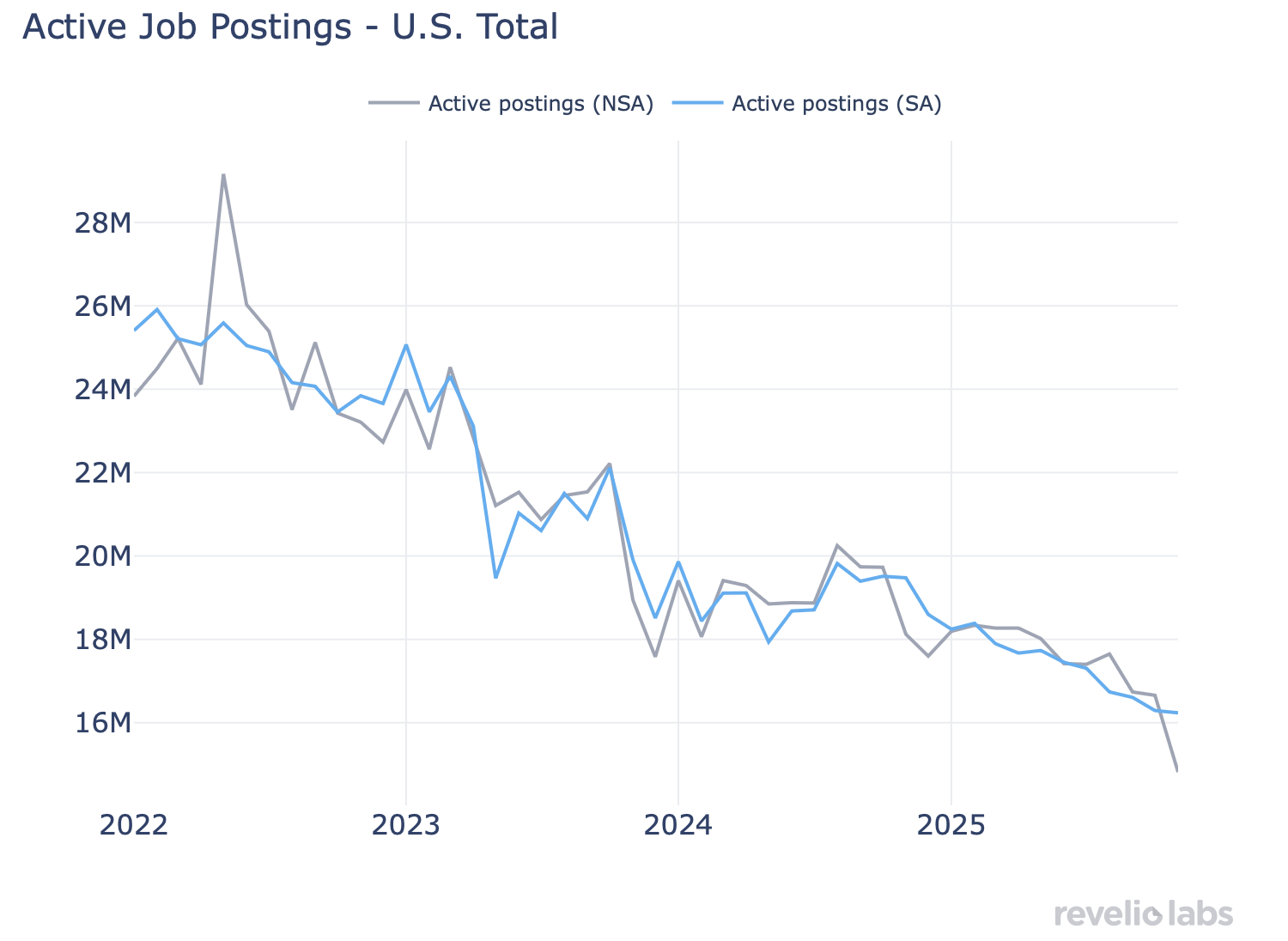
Looking ahead at demand via our job openings data, the outlook for job seekers remains grim, as active job postings continue to decline. In particular, we see declines in the Leisure and Hospitality and Public Administration sectors. Yet, some sectors saw slight increases in job openings; mainly led by the Construction sector.
Salaries from new job openings
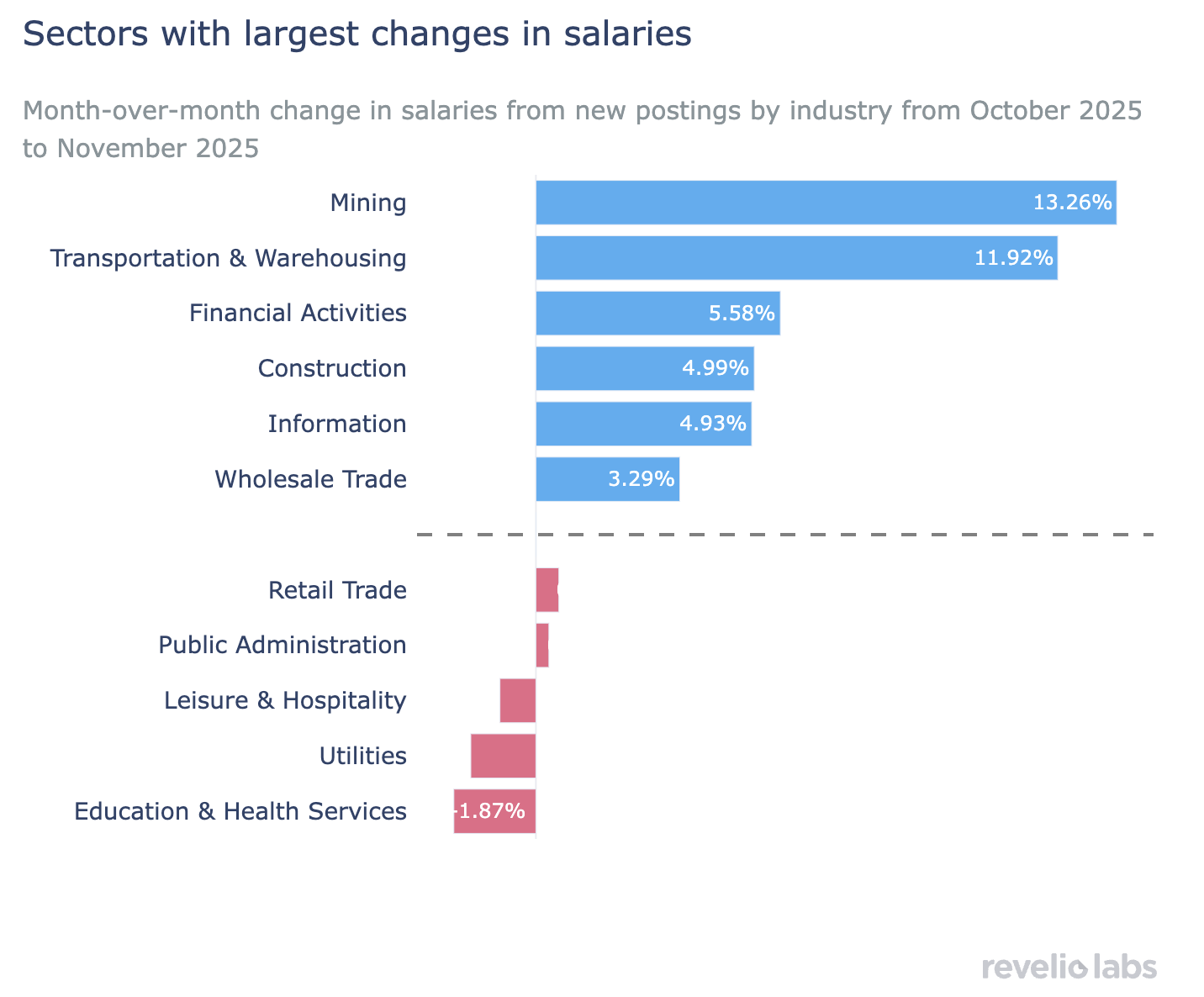
Salaries from new job postings ticked up slightly in November, by 0.9% compared to October 2025. Sectors driving the increase are Mining and Transportation and Warehousing. Salaries declined in Education and Health, as well as in Utilities and Leisure and Hospitality.
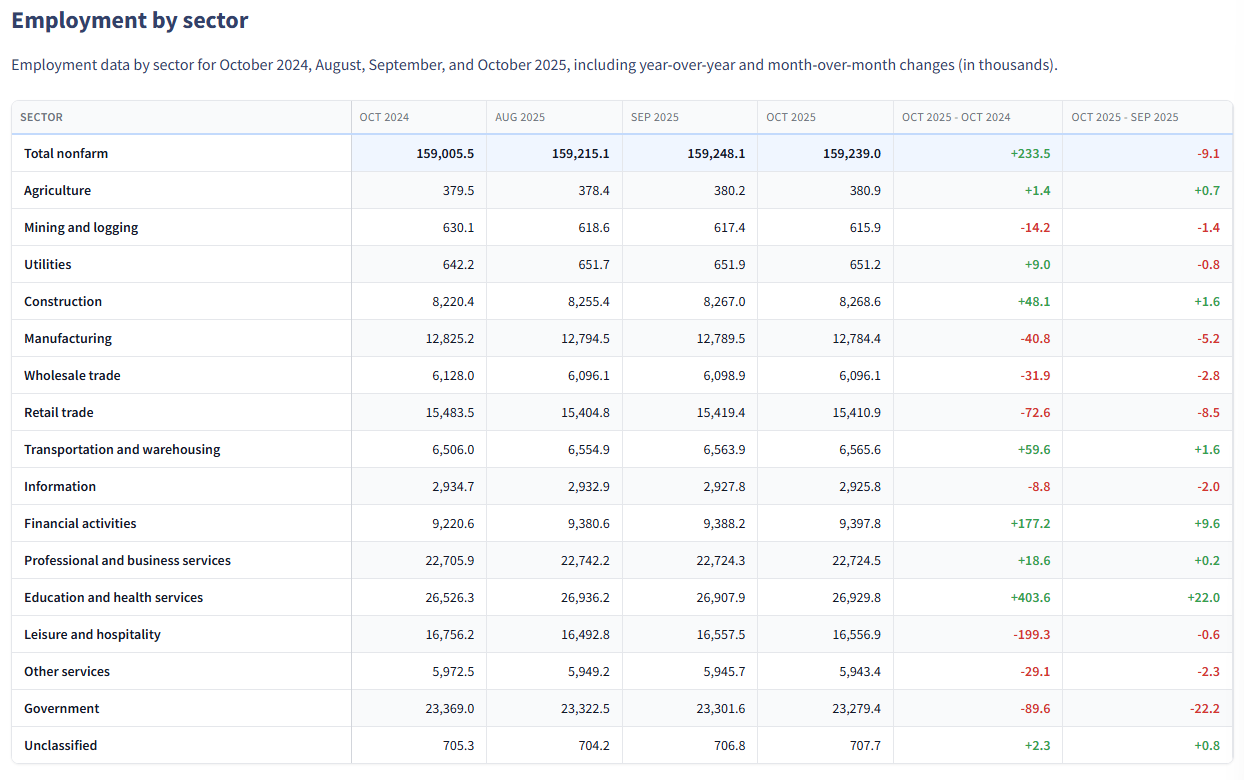
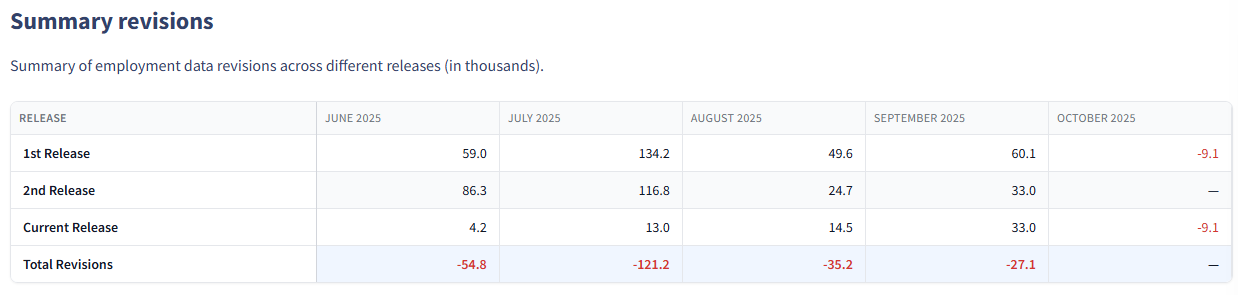
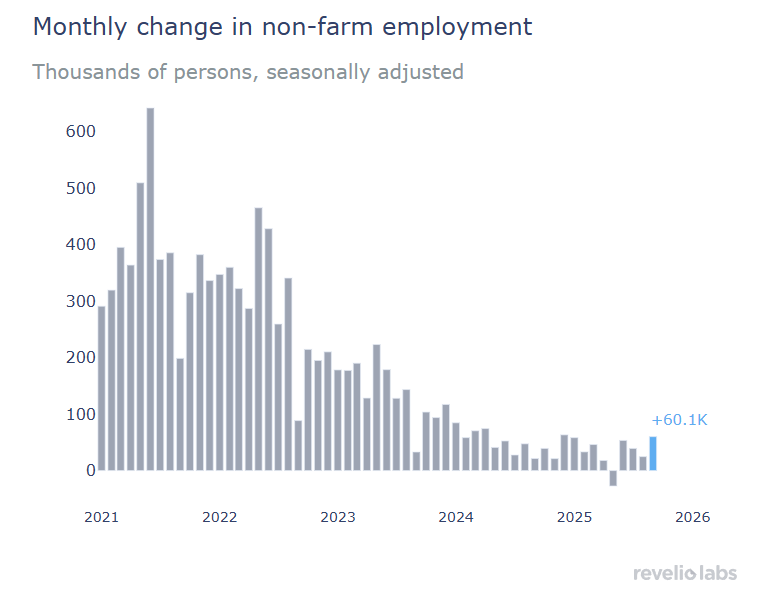
RPLS shows the US economy added 60,000 jobs in September, a reading that came in just above expectations, but continues to reflect the broad slowdown in the labor market.
-
In the absence of BLS data, RPLS can be used along with other private data from ADP to triangulate what the Employment Situation Summary for September would have been. We calculate the BLS would likely have reported approximately 38,000 jobs gained in September.
-
Both job postings and salaries from new job postings decreased in September by 0.6% and 0.3%, respectively, pointing to more softening in the labor market. Additionally, as of this month RPLS also tracks aggregate mass-layoff notices from the WARN act.