 IEA Monthly Electricity Statistics
- Source
- International Energy Agency
- Source Link
- https://www.iea.org/
- Frequency
- Monthly
- Next Release(s)
- March 16th, 2026 5:00 AM
-
April 16th, 2026 5:00 AM
-
May 18th, 2026 5:00 AM
-
June 16th, 2026 5:00 AM
-
July 20th, 2026 5:00 AM
-
August 17th, 2026 5:00 AM
-
September 16th, 2026 5:00 AM
-
October 15th, 2026 5:00 AM
-
November 17th, 2026 5:00 AM
-
December 16th, 2026 5:00 AM
Latest Updates
-
Highlight of the month
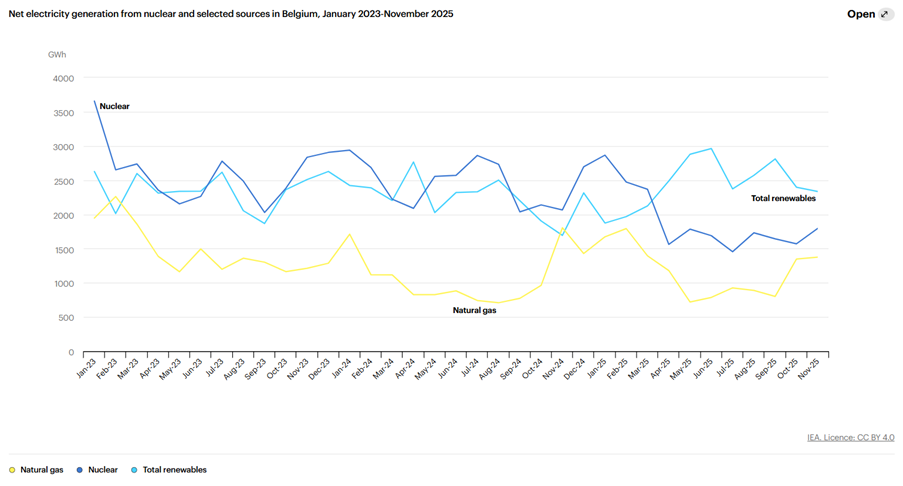
In Belgium, net electricity generation from nuclear decreased by 22.2% year-to-date (y-t-d) in November 2025. This decline reflects the permanent shutdown of several nuclear reactors during the year. Conversely, electricity generation from renewable sources and natural gas increased by 8.2% y-t-d and 12.3% y-t-d respectively, offsetting the decline in nuclear output.
-
OECD
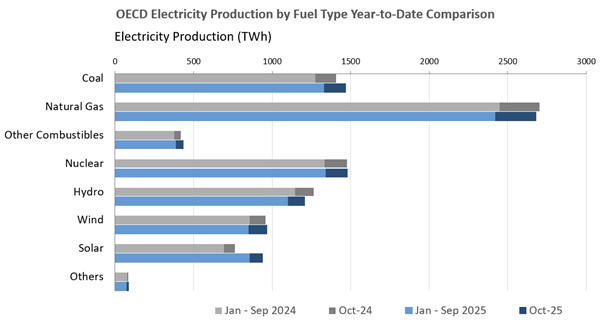
In October 2025, total net electricity generation in the OECD reached 883.8 TWh. Of this total, 411.8 TWh (46.6%) was produced from fossil fuels, 329.8 TWh (37.3%) from renewable sources and 138.0 TWh (15.6%) from nuclear power. On a year-on-year basis, total net electricity production increased by 2.5% in October 2025.
Electricity generation from fossil fuels in the OECD increased by 3.1% year-on-year in October 2025. Natural gas accounted for 29.2% of total electricity generation, coal for 15.5% and oil for 1.3%. Power generation from natural gas increased by 2.1% y-o-y (5.2 TWh), and generation from coal increased by 4.5% y-o-y (6.0 TWh). The increase in power generation from gas was mainly in OECD Europe (21.4% y-o-y, 9.2 TWh), counter-balancing decreases in the OECD Americas (-1.1% y-o-y, -1.8 TWh) and OECD Asia Oceania (-5.7% y-o-y, -2.1 TWh). Coal-fired electricity generation grew in OECD Asia Oceania (4.7% y-o-y, 2.0 TWh) and the OECD Americas (13.5% y-o-y, 7.4 TWh) but dropped in OECD Europe (-9.8% y-o-y, -3.4 TWh).
Electricity generation from renewable sources in the OECD increased by 4.7% year-on-year (+14.8 TWh) in October 2025. This trend was mainly driven by OECD Americas (6.6% y-o-y, 8.9 TWh), followed by OECD Europe (2.3% y-o-y, 3.4 TWh) and OECD Asia Oceania (7.1% y-o-y, 2.5 TWh). The output from solar generation continues to increase in the OECD (+18.2% y-o-y, +12.3 TWh). Wind generation increased year-on-year (10.1% y-o-y, 10.3 TWh) while hydro declined (-7.9% y-o-y, -9.2 TWh) in the OECD.
Nuclear power generation in the OECD declined by 4.1% year-on-year (-5.9 TWh) in October 2025. The 13% (3.0 TWh) decrease in OECD Asia Oceania was led by a drop in nuclear power generation in Korea (-19.5% y-o-y, -3.2 TWh). Nuclear power generation also went down in OECD Europe (-4.3% y-o-y, -2.3 TWh) and the OECD Americas (-0.8% y-o-y, -0.5 TWh).
Highlight of the month
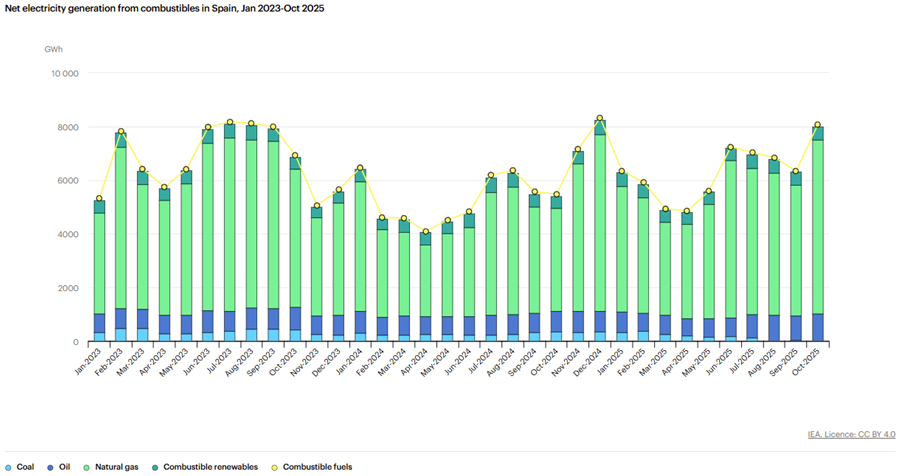
Electricity generation from oil significantly increased by 32.9% year-on-year in Spain in October 2025. At the same time, electricity generation from coal plummeted (-93.2% year-on-year). Looking at the share for electricity generation from all combustible fuels, it seems oil has replaced coal in Spain, while natural gas still is the main primary energy source among fossil fuels. In October 2025, generation from combustible fuels represented 34.3% of total electricity generation in Spain.
-
OECD
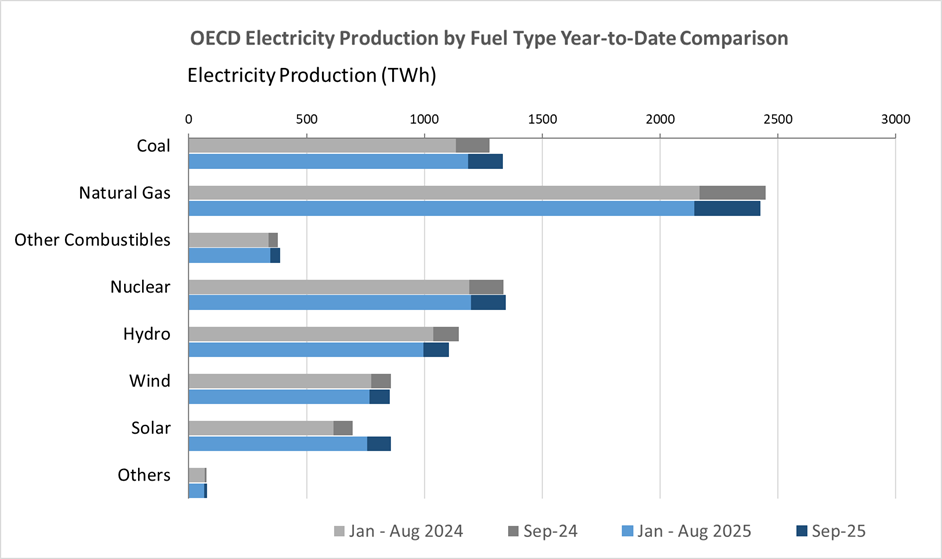
In September 2025, total net electricity generation in the OECD reached 906.0 TWh. Of this total, 438.5 TWh (48.4%) was produced from fossil fuels, 319.1 TWh (35.2%) from renewable sources and 144.4 TWh (15.9%) from nuclear power. On a year-to-date basis, total net electricity production increased by 2.0% during the first nine months of 2025.
Electricity generation from fossil fuels in the OECD remained unchanged year-on-year in September 2025. Natural gas accounted for 30.5% of total electricity generation, coal for 16.1% and oil for 1.2%. Power generation from natural gas decreased by 1.5% y-o-y (-4.3 TWh), while generation from coal increased by 2.8% y-o-y (4.0 TWh). The decline in power generation from gas was mainly in OECD Asia Oceania (-10.8% y-o-y, -4.7 TWh), and OECD Americas (-0.4% y-o-y, -0.7 TWh), while it increased in OECD Europe (2.8% y-o-y, 1.1 TWh). Coal-fired electricity generation grew in OECD Asia Oceania (6.6% y-o-y, 3.2 TWh) and OECD Americas (6.1% y-o-y, 3.8 TWh), but dropped in OECD Europe (-10.2% y-o-y, -3.1 TWh). On a year-to-date basis, electricity generation from natural gas has fallen 1.0% (-24.7 TWh) whereas coal increased by 4.3% (+54.6 TWh) across the OECD.
Electricity generation from renewable sources in the OECD increased by 5.9% year-on-year (+17.9 TWh) in September 2025. The output from solar generation continues to increase (+23.5% y-o-y, +18.8 TWh). This trend was mainly driven by OECD Americas (34.4% y-o-y, 10.6 TWh), followed by OECD Europe (21.1% y-o-y, 6.8 TWh) and OECD Asia Oceania (8.2% y-o-y, 1.4 TWh). Wind generation increased year-on-year (+3.2% y-o-y, +2.6 TWh) while hydro declined by 4.0% (-4.4 TWH) in the OECD.
Nuclear power generation in the OECD remained broadly stable in September 2025 with a slight decline of 0.2% year-on-year (-0.2 TWh). Nuclear power production fell in OECD Asia Oceania (-2.7% y-o-y, -0.6 TWh) and in OECD Europe (-3.1% y-o-y, -1.6 TWh) and increased in the OECD Americas (2.8% y-o-y, 1.9 TWh). The highest increase on a year-to-date basis across all OECD regions was in Japan ( +13.5%, +8.5 TWh), while the largest decrease occurred in Belgium (-22.6%, 5.1 TWh).
Highlight of the month
In September, Chile recorded a 19.4% drop (-388 GWh) in electricity generation from hydro. The country has seen lower hydro generation since the start of the year, with a 20.3% decline (-3,651 GWh) on a year-to-date basis. Over the same nine-month period, coal-fired power generation increased by 10.4% (+1,075 GWh), while power generation from natural gas remained relatively stable, showing a slight decrease of 0.7% (-79 GWh) year-to-date.
-
OECD
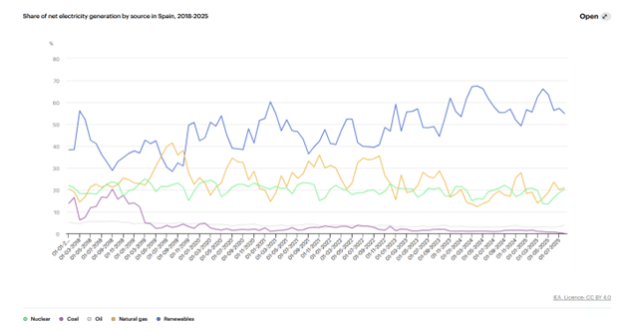
In August 2025, total net electricity generation in the OECD reached 990.5 TWh, a decrease of 0.2% compared with August 2024. Of this total, 499.1 TWh (50.4%) was produced from fossil fuels, 336.6 TWh (34.0%) from renewable sources and 150.4 TWh (15.2%) from nuclear power.
Electricity generation from fossil fuels decreased by 2.2% (-11.5 TWh) year-on-year in the OECD in August 2025, mainly due to lower electricity generation from natural gas, which fell by 3.2% year-on-year (-10.5 TWh). The shares of natural gas, coal and oil as a percentage of total electricity generation were 31.8%, 16.8% and 1.2%, respectively. The decline in electricity generation from natural gas was driven primarily by the United States (-4.9% y-o-y, -9.7 TWh), Korea (-12.0% y-o-y, -1.9 TWh) and Italy (-19.1%, -1.9TWh).
Electricity generation from renewable sources in the OECD increased by 4.3% year-on-year (+13.8 TWh) in August 2025. The highest absolute increase came from solar power, which grew by 20.1% y-o-y (+19.8 TWh), bringing total OECD solar generation to 118.2 TWh (11.6% of total generation). The strongest year-on-year growth was in the OECD Americas, where solar power generation increased by 27.6% year-on-year (+10.0 TWh) to 46.4 TWh. Conversely, hydropower generation in the OECD decreased by 5.4% year-on-year (-6.3 TWh) to 111.9 TWh (11.3% of total generation), with the OECD Americas witnessing a 5.7% year-on-year decrease (-3.5 TWh), followed by OECD Europe with a 4.5% decline (-2.1 TWh). Electricity generation from wind remained stable (+0.1% y-o-y) within the OECD in August 2025.
Nuclear power generation in the OECD declined by 2.9% year-on-year (-4.5 TWh) in August 2025. Output in the OECD Americas remained unchanged compared with the previous year, while OECD Europe and OECD Asia Oceania recorded decreases of 8.1% (-4.5 TWh) and 1.7% (-0.3 TWh) year-on-year, respectively.
Highlight of the month
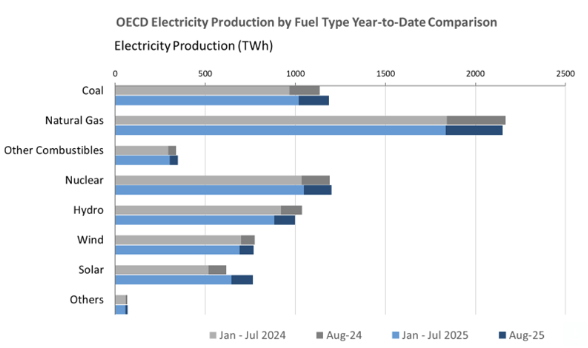
In August 2025, net electricity generation in Spain reached 25.3 TWh, an increase of 3.0% (or +0.7 TWh) compared with the same month last year. For the first time in recent history, no coal-fired electricity generation was recorded in the country. The share of coal in the electricity mix began decline significantly in 2019, recording a monthly average of 5.0%, down by 9 percentage points compared with 2018. This downward trend continued in the following years, and by 2024-2025, coal accounted for an average of 1.2% of total electricity generation.
Despite the absence of coal, the output from fossil fuels rose by 8.1% y-o-y in August 2025, with gas and oil respectively increasing by 11.1% y-o-y (or 0.5 TWh) and 28.9% y-o-y (or 0.2 TWh). Meanwhile, electricity generation from renewable sources grew by 1.9% y-o-y (or 0.3 TWh), while nuclear remained stable compared with August 2024.
-
OECD
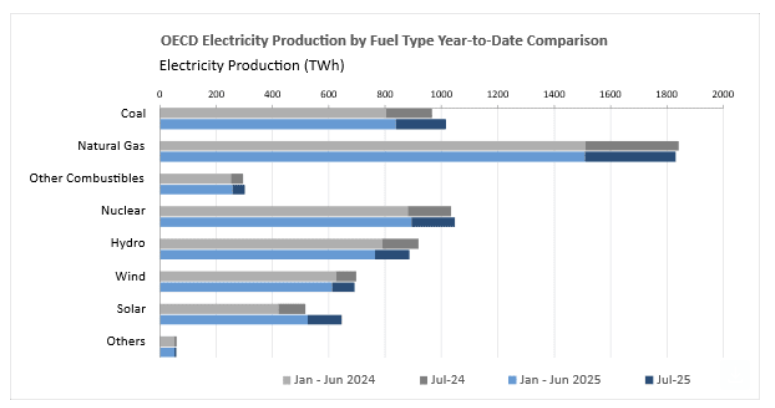
In July 2025, total net electricity generation in the OECD reached 1027.6 TWh, an increase of 2.3% compared to July 2024. Of this total, 518.8 TWh (50.5%) was produced from fossil fuels, 352.2 TWh (34.3%) from renewable sources and 152.2 TWh (14.8%) from nuclear power.
Electricity generation from fossil fuels increased by 1.1% year-on-year in the OECD in July 2025. Electricity generation from natural gas decreased by 2.0% year-on-year (-6.6 TWh), while coal-fired generation increased by 7.3% year-on-year (+12.0 TWh). The shares of natural gas, coal and oil as a percentage of total electricity generation were 31.5%, 17.3% and 1.3%, respectively. The increase in electricity generation from coal was driven primarily by the United States (+11.7% y-o-y, +8.7 TWh) and Korea (+24.5% y-o-y, +4.0 TWh).
Electricity generation from renewable sources in the OECD increased by 6.1% year-on-year (+20.3 TWh) in July 2025. The highest absolute increase came from solar power, which grew by 22.1% y-o-y (+21.6 TWh), bringing total OECD solar generation to 119.2 TWh (11.6% of total generation). The strongest year-on-year growth was in the OECD Americas, where solar power generation increased by 34.3% year-on-year (+12.3 TWh) to 48.3 TWh, driven mainly by the United States (+38.7% y-o-y, +12.0 TWh). In OECD Europe, solar power generation increased by 12.9% year-on-year (+6.0 TWh) to 52.5 TWh, with the most notable absolute increase in the Republic of Türkiye (+46.3% year-on-year, +1.7 TWh). In OECD Asia Oceania, solar power generation increased by 21.4% year-on-year (+3.3 TWh). Wind power generation in the OECD increased by 8.4% year-on-year (+6.2 TWh) reaching 79.4 TWh (7.7% of total generation). Conversely, hydropower generation in the OECD decreased by 5.9% year-on-year (-7.8 TWh) to 123.7 TWh (12.0% of total generation), with OECD Europe recording a 12.4% year-on-year decrease (-6.8 TWh).
Nuclear power generation in the OECD declined by 2.0% year-on-year (-3.1 TWh) in July 2025. Output in the OECD Americas remained unchanged compared with the previous year, while OECD Europe and OECD Asia Oceania recorded decreases of 4.4% (-2.4 TWh) and 5.2% (-1.2 TWh) year-on-year, respectively.
Highlight of the month
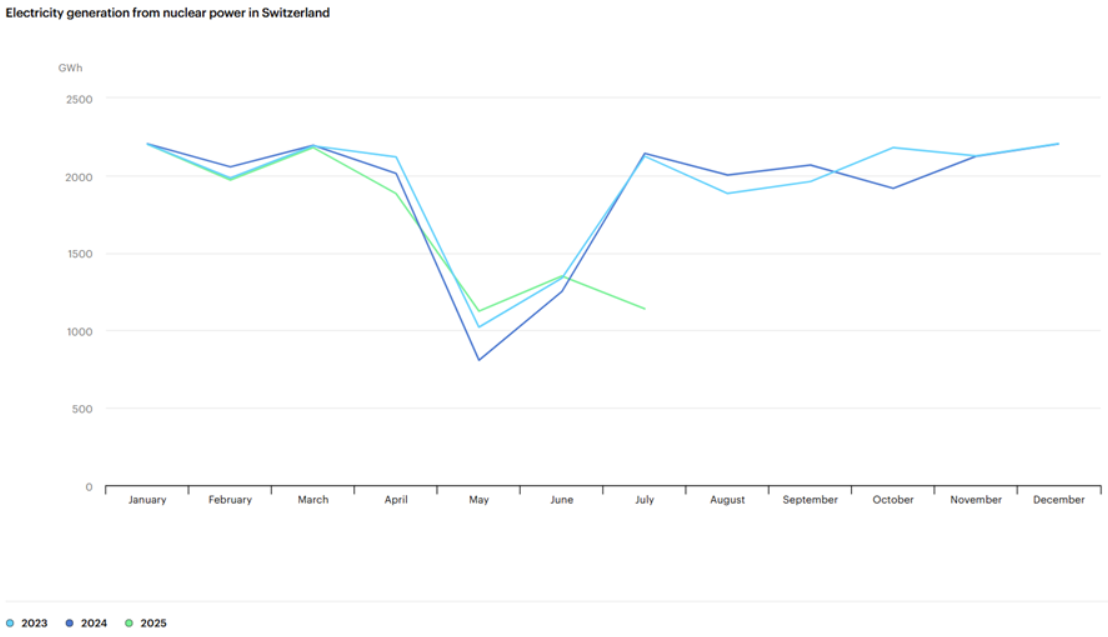
In July 2025, electricity generation from nuclear power in Switzerland nearly halved year-on-year (-46.8% y-o-y, -1.0 TWh), due to environmental constraints caused by a severe heatwave. High temperatures made river water used for cooling nuclear reactors exceed regulatory safety limits. Despite this sharp decline, nuclear power continued to represent a significant share of total electricity generation in the country, accounting for 18.1%.
-
OECD
In June 2025, total net electricity generation in the OECD reached 922.6 TWh, an increase of 1.4% compared to June 2024. Of this total, 416.8 TWh (45.2%) was produced from fossil fuels, 358.6 TWh (38.9%) from renewable sources and 143.2 TWh (15.5%) from nuclear power.
Electricity generation from fossil fuels decreased by 1.8% year-on-year in the OECD in June 2025. Electricity generation from natural gas decreased by 2.1% year-on-year (-5.5 TWh), and generation from coal decreased by 1.3% year-on-year (-1.9 TWh). The shares of natural gas, coal and oil as a percentage of total electricity generation were 28.6%, 14.9% and 1.2%, respectively. The decrease in electricity generation from natural gas was driven by OECD Asia Oceania (-8.4% y-o-y, -3.2 TWh) and OECD Americas (-1.7% y-o-y, -3.3 TWh), while generation increased in OECD Europe (3.0% y-o-y, +1.0 TWh).
Electricity generation from renewable sources increased by 7.3% year-on-year (+24.4 TWh) in the OECD in June 2025. The highest absolute increase came from solar power generation (+24.7% y-o-y, +23.5 TWh), bringing total OECD solar generation to 118.7 TWh (12.9% of total generation). The highest year-on-year increase was in the OECD Americas, where solar power generation increased by 28.6% year-on-year (+10.2 TWh) to 46.0 TWh, driven by the United States (+32.3% y-o-y, +10.0 TWh). In OECD Europe, solar power generation increased 25.0% year-on-year (+10.8 TWh) to 53.9 TWh. The notable increase was in Lithuania with 303% year-on-year (+0.4 TWh) and +288% year-to-date (+1.2 TWh). In OECD Asia Oceania solar power generation increased by 15.2% year-on-year (+2.5 TWh). Wind generation increased 8.8% year-on-year (+7.3 TWh), bringing total OECD wind power generation to 89.7 TWh (9.7% of total generation). On the other hand, hydropower generation in the OECD decreased by 2.7% year-on-year (-3.8 TWh) to 135.2 TWh (13.3% of total generation). Hydropower generation in OECD Europe decreased by 5.3% year-on-year (-6.8 TWh).
Nuclear power generation decreased 2.3% year-on-year (-3.4 TWh) in the OECD in June 2025. OECD Asia Oceania registered a constant nuclear generation year-on-year. Nuclear power production in OECD Europe and the OECD Americas decreased 2.7% (-1.4 TWh) and 2.7% (-2.0 TWh) year-on-year, respectively.
Highlight of the month
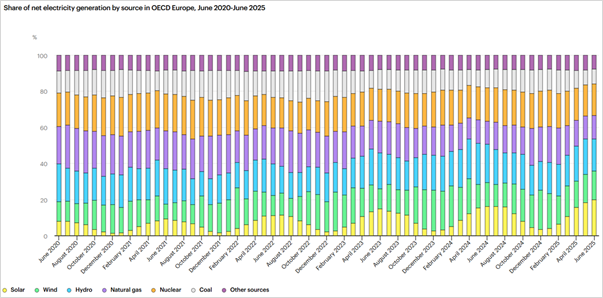
In June 2025, solar power became the leading source of electricity in OECD Europe for the first time, contributing 19.9% (53.9 TWh) of net electricity generation. Together, solar and wind reached a record share, supplying 35.8% (97.0 TWh) of total electricity production.
-
OECD
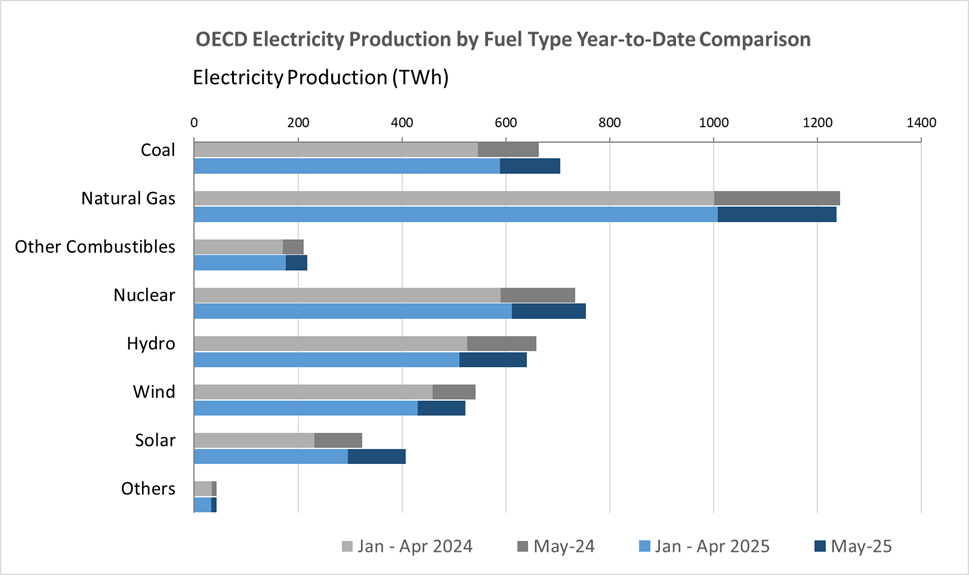
In May 2025, total net electricity generation in the OECD reached 860.6 TWh. Of this total, 356.6 TWh (41.4%) was produced from fossil fuels, 358.5 TWh (41.7%) from renewable sources and 141.6 TWh (16.5%) from nuclear power. On a year-to-date basis, total net electricity production increased by 2.3% in the first five months of 2025.
Electricity generation from fossil fuels decreased 4.8% year-on-year in the OECD in May 2025. The shares of natural gas, coal and oil as a percentage of total electricity generation were 26.4%, 13.4% and 1.1%, respectively. Generation from natural gas decreased by 6.3% y-o-y (-15.4 TWh), and generation from coal decreased by 1.3% y-o-y (-1.6 TWh). The decreased generation from natural gas year-on-year came from all OECD regions; OECD Americas -5.9% (-10.1 TWh), OECD Asia Oceania -11.0% (-4.0 TWh) and OECD Europe -3.7% (-1.3 TWh). The decrease in coal-fired electricity generation by OECD Europe (-12.0% y-o-y, -3.0 TWh) offset increased generation in the OECD Americas (+1.7% y-o-y, +1.0 TWh) and in OECD Asia Oceania (+1.2% y-o-y, +0.4 TWh). On a year-to-date basis, electricity generation from natural gas has fallen 0.6% (-7.1 TWh) whereas coal increased by 6.2% (+40.1 TWh) in the OECD.
Electricity generation from renewable sources increased by 6.0% year-on-year (+20.2 TWh) in the OECD in May 2025. The output from solar generation continues to increase (+20.7% y-o-y, +19.0 TWh). Wind generation also increased year-on- year (+8.4% y-o-y, +7.0 TWh). This trend was mainly driven by OECD Europe, where electricity generation from wind increased by 20.3% year-on-year (+7.1 TWh), driven by Germany (+1.8 TWh), the United Kingdom (+1.6 TWh) and Sweden (+1.1 TWh).
Nuclear power generation decreased 1.0% year-on-year (-1.4 TWh) in the OECD in May 2025. Nuclear power production increased in OECD Asia Oceania 6.8% year-on-year (+1.6 TWh) but decreased in OECD Europe (-4.2% y-o-y, -2.0 TWh) and the OECD Americas (-1.3% y-o-y, -1.0 TWh). Having said that, on a year-to-date basis, all OECD regions have increased nuclear production this year; OECD Asia Oceania 14.1% (+15.1 TWh), OECD Europe 1.9% (+5.1 TWh) and the OECD Americas 0.2% (+0.6 TWh).
Highlight of the month
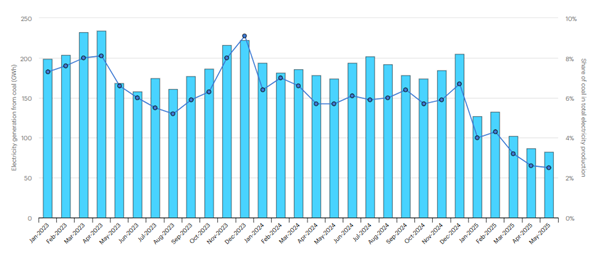
In Hungary in May 2025, electricity generation from coal reached an all-time low of 82.0 GWh. As a result, coal generation made up only 2.5% of Hungary’s total electricity generation in May 2025, also an all-time low. The share had previously been as high as 9.1% in December 2023.
-
OECD
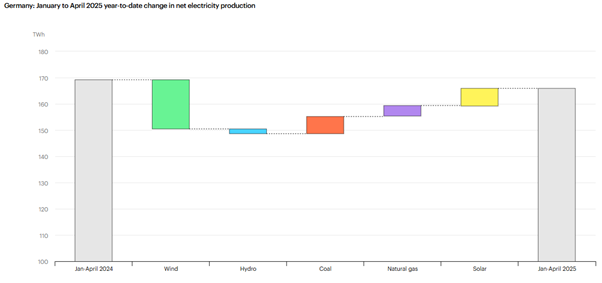
In April 2025, total net electricity generation in the OECD reached 833.8 TWh, a decrease of 7.8% compared to April 2024. Of this total, 340.8 TWh (40.9%) was produced from fossil fuels, 352.6 TWh (42.3%) from renewable sources and 136.5 TWh (16.4%) from nuclear power. On a year-to-date basis, total net electricity production increased by 3.0% in the first four months of 2025.
Electricity generation from fossil fuels increased by 1.1% year-on-year in the OECD in April 2025. Generation from natural gas decreased by 1.6% y-o-y (-3.4 TWh), and generation from coal increased by 6.8% y-o-y (+7.3 TWh). The shares of natural gas, coal and oil as a percentage of total electricity generation were 25.6%, 13.6% and 1.1%, respectively. Similar to last month, the increase in coal-fired electricity generation was driven by the OECD Americas (+16.3% y-o-y, +7.5 TWh) and OECD Europe (10.8% y-o-y, +2.6 TWh). In contrast, generation decreased in OECD Asia Oceania (-7.7% y-o-y, -2.8 TWh). A Notable increase in OECD Americas was observed in the United States (+22.1% y-o-y, +8.7 TWh) and in OECD EUROPE Germany (+29.3% y-o-y, +1.9 TWh), Türkiye (+17.2% y-o-y, +1.0 TWh) and Netherlands (+149.9% y-o-y, +0.7 TWh) had a significant increase. On a year-to-date basis, electricity generation from coal increased by 7.8% in the OECD (+42.4 TWh).
Electricity generation from renewable sources increased by 1.9% year-on-year (+6.6 TWh) in the OECD in April 2025. The output from solar generation continues to increase (+27.4% y-o-y, +21.6 TWh), counter-balancing the decrease observed in wind generation (-13.2% y-o-y, -14.8 TWh). This trend was mainly driven by OECD Europe, where electricity generation from wind dropped by 25.5% y-o-y (or -13.5 TWh), driven by Germany (-4.7 TWh), the United Kingdom (-2.9 TWh) and the Netherlands (-1.8 TWh).
Nuclear power generation increased 3.0% year-on-year (+4.0 TWh) in the OECD in April 2025. Nuclear power production increased in OECD America (3.8% y-o-y, +2.4 TWh) and OECD Asia Oceania (+13.2%, +2.7 TWh), while it decreased in the OECD Europe (-2.3% y-o-y, -1.1 TWh). On a year-to-date basis, OECD Asia Oceania saw the largest increase in nuclear production (+16.1%, +13.6 TWh) during the first four months of 2025.
Highlight of the month
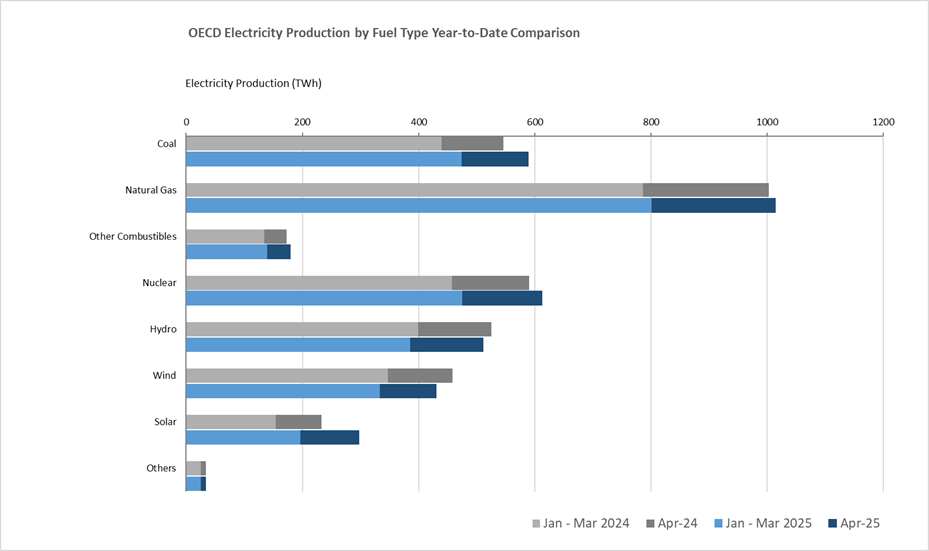
In Germany, the cumulative wind generation from January to April 2025 has decreased substantially compared to 2024 (-32.8% year-to-date, -18.8 TWh). Despite the considerable increase in solar generation compared to last year (+39.1% y-t-d, +6.7 TWh), the total renewable output is lower (-14.0% y-t-d, -13.7 TWh).
This gap has been compensated by fossil-based generation, namely coal (+18.2% y-t-d, +6.6 TWh) and natural gas (+13.6 y-t-d, +4.1 TWh).
-
OECD
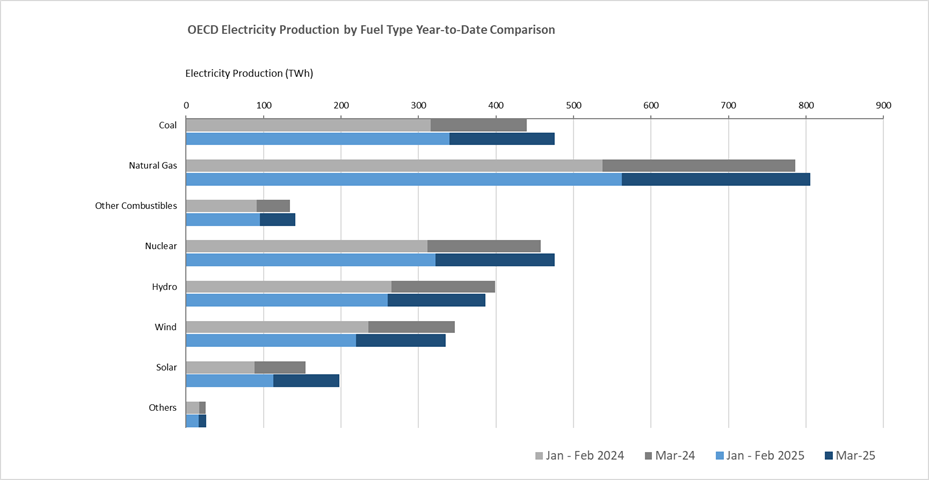
In March 2025, total net electricity generation in the OECD reached 908.7 TWh, an increase of 3.1% compared to March 2024. Of this total, 392.9 TWh (43.2%) was produced from fossil fuels, 358.7 TWh (39.5%) from renewable sources and 153.2 TWh (16.9%) from nuclear power. On a year-to-date basis, total net electricity production increased by 3.5% in the first quarter of 2025.
Electricity generation from fossil fuels increased by 1.2% year-on-year in the OECD in March 2025. Generation from natural gas decreased by 2.6% year-on-year (-6.4 TWh), and generation from coal increased by 8.7% y-o-y (+10.7 TWh). The shares of natural gas, coal and oil as a percentage of total electricity generation were 26.7%, 14.8% and 1.2%, respectively. The increase in coal-fired electricity generation was driven by the OECD Americas (+24.0% y-o-y, +11.2 TWh) and OECD Europe (5.2% y-o-y, +1.7 TWh)., whereas generation decreased in OECD Asia Oceania (-4.8% y-o-y, -2.1 TWh) Notable increases were observed in the United States (+27.3% y-o-y, +11.1 TWh) and in Germany (+16.9% y-o-y, +1.6 TWh). On a year-to-date basis, electricity generation from coal increased by 8.0% in the OECD (+35.3 TWh).
Electricity generation from renewable sources increased by 4.5% year-on-year (+15.6 TWh) in the OECD in March 2025. The output from solar generation continues to increase (+28.8% y-o-y, +18.9 TWh), counter-balancing the decrease observed in hydro generation (-6.6% y-o-y, -8.8 TWh). This trend was mainly driven by OECD Europe, where electricity generation from hydro dropped by 18.1% y-o-y (or -11.3 TWh), driven by France (-2.0 TWh), Italy (-1.4 TWh), Switzerland (-1.5 TWh) and Türkiye (-1.3 TWh). On the other hand, electricity generation from wind increased in the OECD (+3.1% y-o-y, +3.5 TWh), amounting to 115.0 TWh.
Nuclear power generation increased 4.8% year-on-year (+7.0 TWh) in the OECD in March 2025. Nuclear power production increased in OECD Europe (7.1% y-o-y, +3.8 TWh) and OECD Asia Oceania (+15.3%, +3.3TWh), while in the OECD Americas it remained stable (-0.2% y-o-y, -0.1 TWh). On a year-to-date basis, OECD Asia Oceania saw the largest increase in nuclear production (+16.5%, +10.5 TWh) in the first quarter of 2025.
Highlight of the month
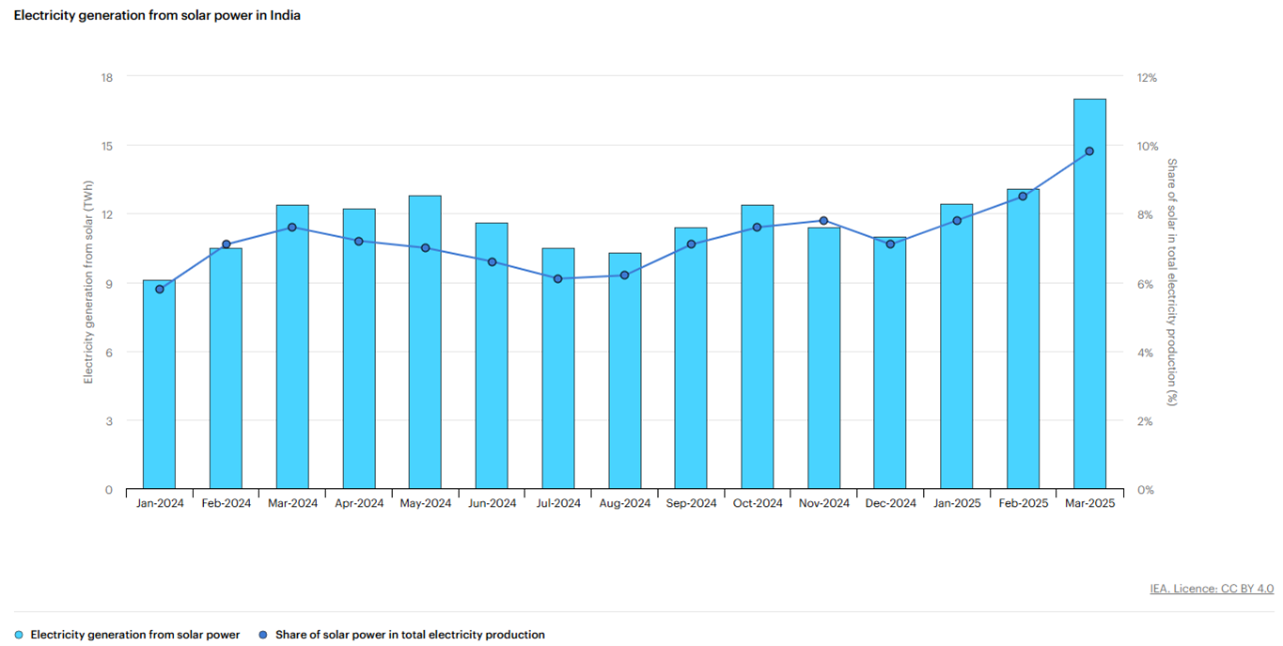
Electricity generation from solar increased drastically in India on a year-on-year basis (+37.5%, +4.7 TWh), to a share of 9.8% of total electricity generation in the country, as depicted in the graph below. Electricity generation from other low-carbon sources also increased sharply on a year-on-year basis: +17.4% (+0.6 TWh) for nuclear, +25.4% (+1.9TWh) for hydro, +12.1% (+0.6TWh) for wind. On the other hand, electricity generation from combustible renewables decreased (-12.6%, -0.6 TWh y-o-y).
-
OECD
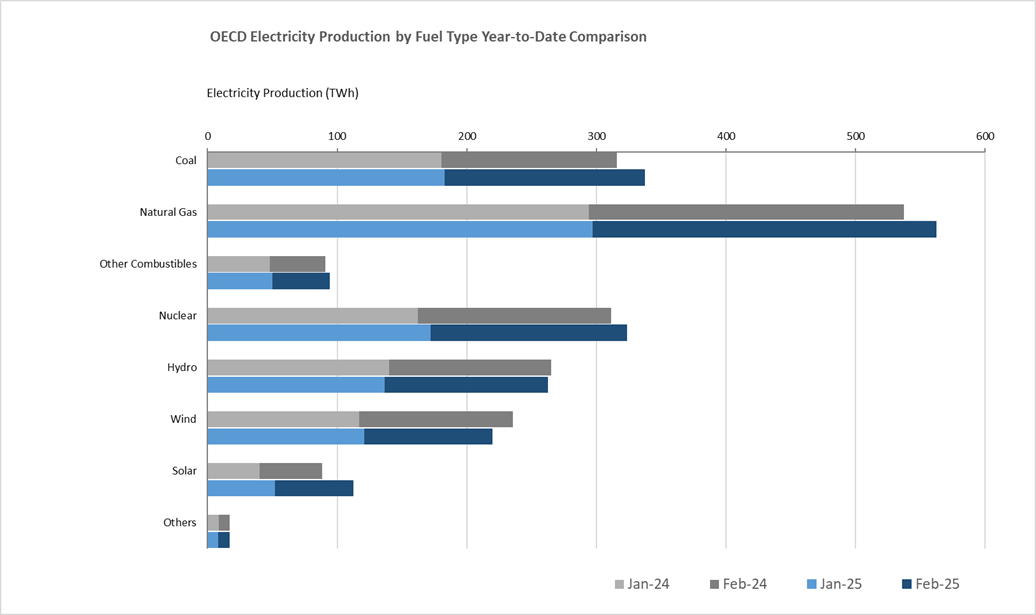
In February 2025, total net electricity generation in the OECD reached 904.8 TWh, an increase of 4.0% compared to February 2024. Of this total, 434.4 TWh (48.0%) was produced from fossil fuels, 316.0 TWh (34.9%) from renewable sources and 150.7 TWh (16.7%) from nuclear power.
Electricity generation from fossil fuels increased by 10.2% year-on-year in the OECD in February 2025. Generation from natural gas rose by 8.8% year-on-year (+21.3 TWh), and generation from coal increased by 14.0% y-o-y. The shares of natural gas, coal and oil as a percentage of total electricity generation were 29.2%, 17.0% and 1.2%, respectively. The increase in coal-fired electricity generation was driven by the OECD Americas (+36.6% y-o-y, +19.1 TWh) and OECD Europe (+17.6% y-o-y, +5.8 TWh), whereas generation decreased in OECD Asia Oceania (-12.3% y-o-y, -6.1 TWh). Notable increases were observed in the United States (+40.9% y-o-y, +18.9 TWh) and in Germany (+34.1% y-o-y, +3.1 TWh).
Electricity generation from renewable sources decreased by 2.1% year-on-year (-6.7 TWh) in the OECD in February 2025. While the output from solar generation continues to increase (+24.5% y-o-y, +11.9 TWh), that growth did not offset the decrease observed in wind generation (-17.0% y-o-y, -20.1 TWh). This trend was mainly driven by OECD Europe, where electricity generation from wind dropped by 29.4% y-o-y (or -19.4 TWh), driven by Germany (-7.3 TWh), France (-2.0 TWh) and Poland (-1.3 TWh). On the other hand, hydropower generation in the OECD remained stable (+0.3% y-o-y), amounting to 125.4 TWh.
Nuclear power generation increased 0.9% year-on-year (+1.4 TWh) in the OECD in February 2025. OECD Asia Oceania registered the highest absolute increase of 3.4 TWh year-on-year (+16.5%), driven mainly by nuclear power generation in Japan (+29.3% y-o-y, +2.0 TWh) and Korea (+10.3% y-o-y, +1.4 TWh). Nuclear power production in OECD Europe increased 2.5% y-o-y (+1.4 TWh), while in the OECD Americas it decreased 4.7% y-o-y (-3.4 TWh).
-
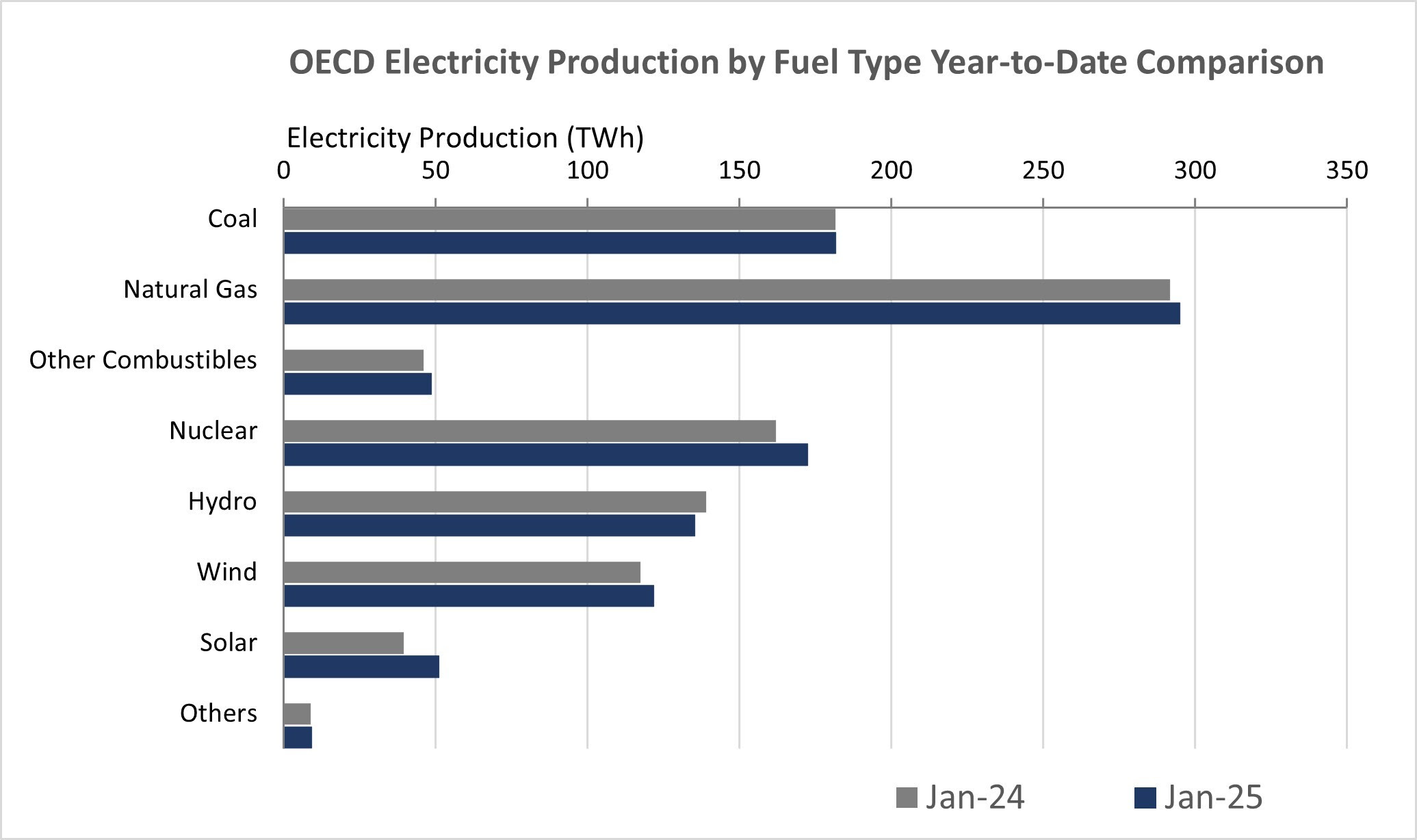
In January 2025, total net electricity generation in the OECD reached 1,015.1 TWh, an increase of 2.9% compared to January 2024. Of this total, 495.4 TWh (48.8%) was produced from fossil fuels, 342.8TWh (33.8%) from renewable sources and 172.5 TWh (17.0%) from nuclear power.
Electricity generation from fossil fuels increased by 0.9% year-on-year in the OECD in January 2025. Electricity generation from natural gas increased 1.1% year-on-year (+3.3 TWh), while generation from coal remained the same year-on-year. The shares of natural gas, coal and oil as a percentage of total electricity generation were 29.1%, 17.9% and 1.3%, respectively. The increase in electricity generation from natural gas was driven by OECD Europe (+14.5% y-o-y, +8.3 TWh), while generation decreased in the OECD Americas (-2.4% y-o-y, -4.4 TWh) and in OECD Asia Oceania (-1.4% y-o-y, -0.7 TWh).
Electricity generation from renewable sources increased by 4.2% year-on-year (+13.9 TWh) in the OECD in January 2025. The highest absolute increase came from solar generation (+29.5% y-o-y, +11.7 TWh), bringing total OECD solar generation to 51.1 TWh (5.0% of total generation). This was driven by the OECD Americas, where solar generation increased by 49.0% year-on-year (+7.9 TWh) to 23.9 TWh. In OECD Europe, solar generation increased 20.7% year-on-year (+2.1 TWh) to 12.3 TWh. Notable increases were seen in Türkiye and Spain, with solar electricity generation increasing by 0.9 TWh and 0.4 TWh year-on-year, respectively. In OECD Asia Oceania, solar generation increased 12.7% year-on-year (+1.7 TWh), driven mainly by Australia (+26.5% y-o-y, +1.3 TWh). Wind generation increased 3.8% year-on-year (+4.5 TWh), bringing total OECD wind generation to 121.9 TWh (12.0% of total generation). On the other hand, hydropower generation in the OECD decreased by 2.7% year-on-year (-3.8 TWh) to 135.2 TWh (13.3% of total generation). Hydropower generation in OECD Europe decreased 9.9% year-on-year (-6.2 TWh).
Nuclear power generation increased 6.5% year-on-year (+10.5 TWh) in the OECD in January 2025. OECD Asia Oceania registered the highest absolute increase of 4.7 TWh year-on-year (+22.7%), driven mainly by nuclear power generation in Korea increasing 2.8 TWh year-on-year (+19.6%). Nuclear power production in OECD Europe and the OECD Americas increased 4.8% (+3.0 TWh) and 3.5% (+2.7 TWh) year-on-year, respectively.
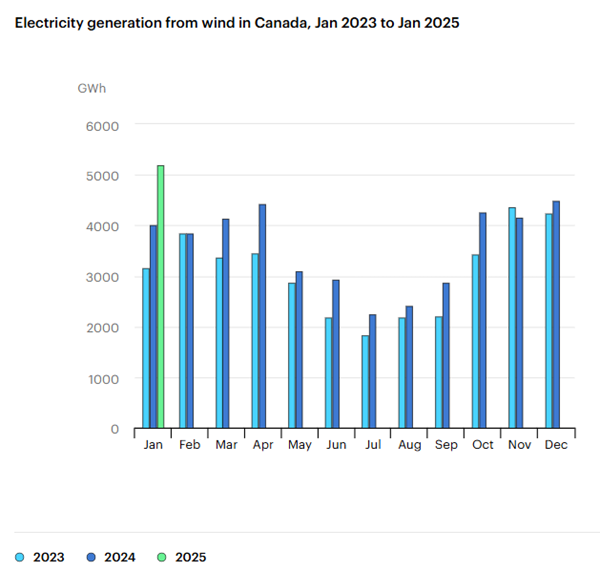
In January 2025, Canada’s electricity generation from wind increased 29.9% (+1.2 TWh) year-on-year to 5.2 TWh, 7.9% of total generation. Several projects increased Canada’s wind capacity in 2024, including the Buffalo Plains Wind Farm (494 MW) in Alberta, which began operations late last year and is now Canada’s largest onshore wind farm.