
 IATA Air Passenger Market Analysis
- Source
- IATA
- Source Link
- https://www.iata.org/
- Frequency
- Monthly
Latest Updates
-
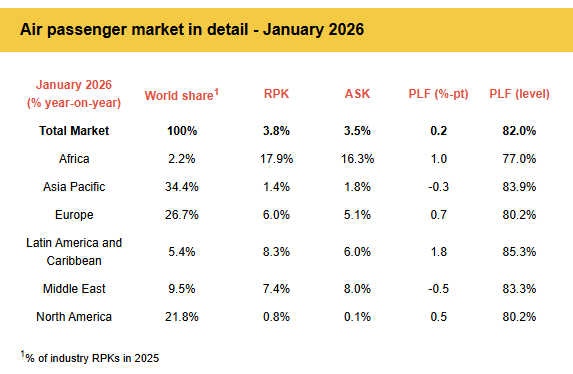
The International Air Transport Association (IATA) released data for January 2026 global passenger demand with the following highlights:
- Total demand, measured in revenue passenger kilometers (RPK), was up 3.8% compared to January 2025. Total capacity, measured in available seat kilometers (ASK), increased 3.5% year-on-year. The load factor was 82.0% (+0.2 ppt compared to January 2025), a record high for January.
- International demand rose 5.9% compared to January 2025. Capacity was up 5.8% year-on-year, and the load factor was 82.5% (+0.1 ppt compared to January 2025).
- Domestic demand increased 0.1% compared to January 2025. Capacity was down -0.4% year-on-year. The load factor was 81.2% (+0.4 ppt compared to January 2025).
January demand was skewed by a shift in the Lunar New Year from January in 2025 to February in 2026. Lunar New Year typically drives a spike in demand, as families reconnect to celebrate the holiday. The year-on-year comparison has the effect of making January 2026 demand appear slightly weaker.
“The timing of the Lunar New Year partly explains the slightly slower 3.8% expansion in January, but the fundamentals are in place for demand to continue strong growth in 2026. Schedule data, for example, indicate a 5.2% increase in global seat capacity by March, which would be the fastest expansion since April 2024. Events over the weekend have, however, introduced some uncertainty into the evolution of traffic and fuel costs. We all hope for an early peaceful resolution to the current hostilities. In the meantime, it is critical that states respect their obligation to keep civilians, and civil aviation free from harm,” said Willie Walsh, IATA’s Director General.
“Average fares are expected to fall in real terms over the course of 2026, continuing a long-established trend of ever more affordable air travel. This is despite persistent cost pressures from rising infrastructure charges, onerous regulatory burdens, and the mounting cost of the energy transition. In the face of these cost and regulatory pressures, it is notable that 2025 saw the slowest rate of new airline start-ups since 1999. Governments who value competition should consider this a canary in the coal mine. To protect and enhance the consumer benefits of connectivity, these cost and regulatory issues must be addressed,” said Walsh.
-
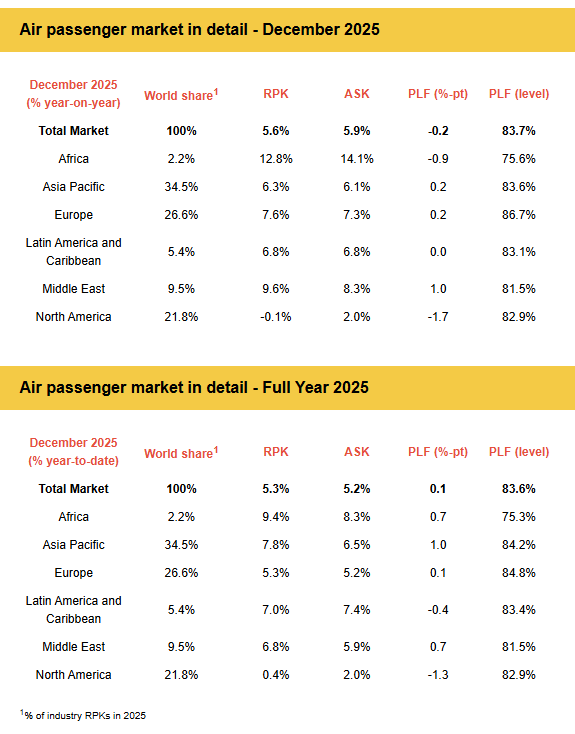
The International Air Transport Association (IATA) released 2025 full-year and December 2025 passenger market performance showing record high demand.
- Total full-year demand in 2025 (measured in revenue passenger kilometers or RPKs) rose 5.3% compared to 2024. Total capacity, measured in available seat kilometers (ASK), was up 5.2% in 2025. The overall passenger load factor (PLF) reached 83.6%, up 0.1 ppt and a record for full-year traffic.
- International full-year demand in 2025 increased 7.1% compared to 2024, and capacity rose 6.8%. The full year international load factor was 83.5%, a rise of 0.2 ppt on 2024. This was also a record high for international PLF.
- Domestic full-year demand for 2025 rose 2.4% compared to the prior year, while capacity expanded by 2.5%. The load factor for the full year averaged 83.7%, down -0.1 ppt compared to 2024.
- December 2025 was a strong finish to the year with overall demand rising 5.6% year-on-year, capacity growing by 5.9%, and a load factor of 83.7%.
“2025 saw demand for air travel grow by 5.3% with international demand growing by 7.1% and domestic by 2.4%. This returns industry growth to align with historical growth patterns after the robust post-COVID rebound. The strong and continuous increase in demand puts into sharp focus two key challenges—decarbonization and supply chain.
The first, decarbonization, will protect future long-term growth. Governments whose economies grow because of aviation and whose citizens thirst for connectivity need to provide the supportive fiscal policy framework to rapidly accelerate progress, particularly for the energy sector to grow Sustainable Aviation Fuel (SAF) production.
The second, supply chain challenges, was the biggest headache for airlines in 2025. People clearly wanted to travel more, but airlines were continually disappointed with unreliable delivery schedules for new aircraft and engines, maintenance capacity constraints, and resultant cost increases that are estimated to exceed $11 billion. Airlines scrambled to accommodate the demand by keeping aircraft in service longer and filling more seats on every flight. With load factors just shy of 84%, it’s clear that these measures were an effective band aid, but we need a real solution. It’s vital that 2025 proves to be the nadir of the supply chain crisis, and 2026 marks a rebound. Every new aircraft means a quieter, cleaner fleet, with more capacity and flight options than at any previous point in history, which is what airlines and their customers want to see,” said Willie Walsh, IATA’s Director General.
-
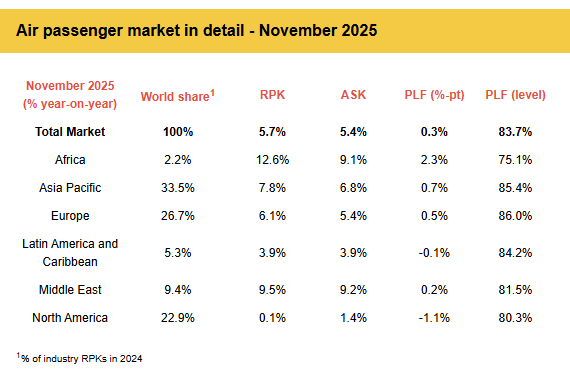
The International Air Transport Association (IATA) released data for November 2025 global passenger demand with the following highlights:
- Total demand, measured in revenue passenger kilometers (RPK), was up 5.7% compared to November 2024. Total capacity, measured in available seat kilometers (ASK), increased 5.4% year-on-year. The load factor was 83.7% (+0.3 ppt compared to November 2024), a record high for November.
- International demand rose 7.7% compared to November 2024. Capacity was up 7.1% year-on-year, and the load factor was 84.0% (+0.4 ppt compared to November 2024).
- Domestic demand increased 2.7% compared to November 2024. Capacity was up 2.7% year-on-year. The load factor was 83.2% (unchanged compared to November 2024).
“November 2025 saw continued strong demand for air travel with year-on-year growth of 5.7%. Load factors reached a new record of 83.7% for the month as airlines continued to satisfy growing passenger demand amid continuing capacity constraints stemming from challenges in the aerospace supply chain. The new year’s resolution for the manufacturing sector must be to increase production to meet the needs of their airline customers. The backlog of more than 17,000 aircraft orders that we reached in 2025 must be reduced in 2026,” said Willie Walsh, IATA’s Director General.
-
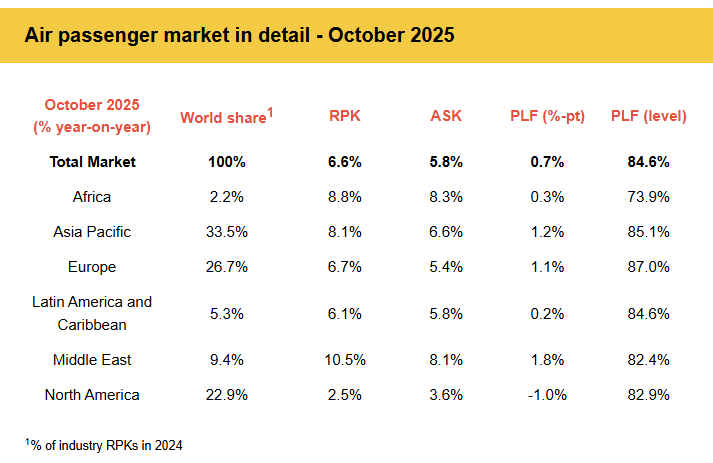
The International Air Transport Association (IATA) released data for October 2025 global passenger demand with the following highlights:
- Total demand, measured in revenue passenger kilometers (RPK), was up 6.6% compared to October 2024. Total capacity, measured in available seat kilometers (ASK), was up 5.8% year-on-year. The October load factor was 84.6% (+0.7 ppt compared to October 2024).
- International demand rose 8.5% compared to October 2024. Capacity was up 7.1% year-on-year, and the load factor was 84.6% (+1.1 ppt compared to October 2024).
- Domestic demand increased 3.4% compared to October 2024. Capacity was up 3.6% year-on-year. The load factor was 84.6% (-0.1 ppt compared to October 2024).
“October was a strong month for air travel with demand up 6.6% on the previous year. Of particular note is the 4.5% international traffic growth for carriers based in North America which comes after several months of basically flat performance. The trends for the rest of the year look encouraging: scheduled seat capacity in November is set to expand 3.6% and in December by 4.7%. This points to strong demand for holiday travel and businesses looking to complete deals by the end of the year. Considering the uncertainty in the economic outlook for 2026, the resilience of demand for air travel, with the jobs and growth it brings, is a bright spot that governments should nurture with care,” said Willie Walsh, IATA’s Director General.
-
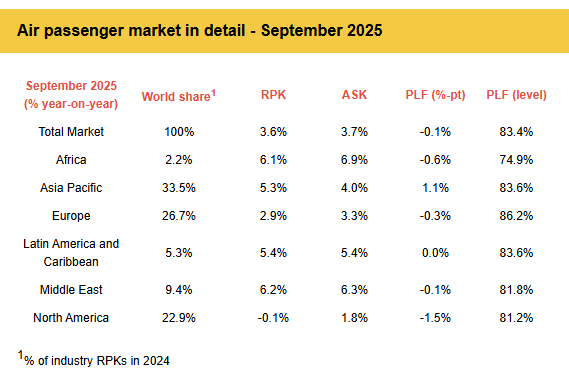
The International Air Transport Association (IATA) released data for September 2025 global passenger demand with the following highlights:
- Total demand, measured in revenue passenger kilometers (RPK), was up 3.6% compared to September 2024. Total capacity, measured in available seat kilometers (ASK), was up 3.7% year-on-year. The September load factor was 83.4% (-0.1 ppt compared to September 2024).
- International demand rose 5.1% compared to September 2024. Capacity was up 5.2% year-on-year, and the load factor was 83.6% (-0.1 ppt compared to September 2024).
- Domestic demand increased 0.9% compared to September 2024. Capacity was up 1.1% year-on-year. The load factor was 83.0% (-0.1 ppt compared to September 2024).
- “Solid international demand drove 90% of September’s 3.6% overall growth. Importantly, the capacity expansion slightly nudged ahead of demand growth at 3.7%. Load factors, nonetheless, remained very strong at 83.4%. With November flight schedules indicating a 3% expansion on the previous year, airlines are gearing up for continued growth into the year-end holiday season. This is despite the severe constraints of unresolved supply chain issues,” said Willie Walsh, IATA’s Director General.
-
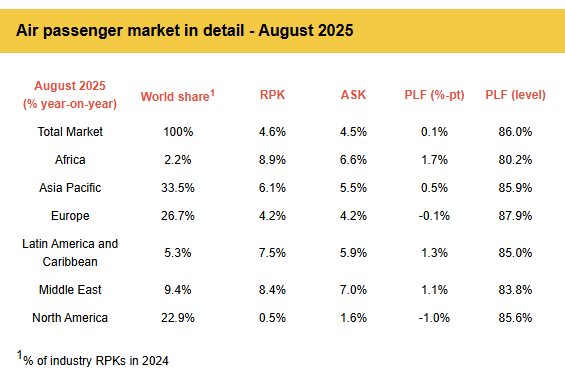
The International Air Transport Association (IATA) released data for August 2025 global passenger demand with the following highlights:
- Total demand, measured in revenue passenger kilometers (RPK), was up 4.6% compared to August 2024. Total capacity, measured in available seat kilometers (ASK), was up 4.5% year-on-year. The August load factor was 86.0% (+0.1 ppt compared to August 2024), a record high for the month.
- International demand rose 6.6% compared to August 2024. Capacity was up 6.5% year-on-year, and the load factor was 85.8% (+0.1 ppt compared to August 2024).
- Domestic demand increased 1.5% compared to August 2024. Capacity was up 1.3% year-on-year. The load factor was 86.3% (+0.1 ppt compared to August 2024).
- “August year-on-year demand growth of 4.6% confirms that the 2025 peak northern summer travel season reached a new record high. Moreover, planes were operating with more seats filled than ever with a record load factor of 86%. Despite economic uncertainties and geopolitical tensions, the global growth trend shows no signs of abating, as October schedules are showing airlines planning 3.4% more capacity. Airlines are doing their best to meet travel demand by maximizing efficiency, making it even more critical for the aerospace manufacturing sector to sort out its supply chain challenges,” said Willie Walsh, IATA’s Director General.