Freightos Weekly Update
- Source
- Freightos
- Source Link
- https://www.freightos.com/
- Frequency
-
Weekly
Tuesday
- Next Release(s)
- May 5th, 2026 12:00 PM
-
May 12th, 2026 12:00 PM
-
May 19th, 2026 12:00 PM
-
May 26th, 2026 12:00 PM
-
June 2nd, 2026 12:00 PM
-
June 9th, 2026 12:00 PM
-
June 16th, 2026 12:00 PM
-
June 23rd, 2026 12:00 PM
-
June 30th, 2026 12:00 PM
-
July 7th, 2026 12:00 PM
-
July 14th, 2026 12:00 PM
-
July 21st, 2026 12:00 PM
Latest Updates
-

AnalysisIncreased fuel costs from the Strait of Hormuz closure continues to keep container rates elevated during the post-Lunar New Year, pre-peak season, low demand season for ocean freight when prices normally reach their floor for the year.
Even with this pressure however, rates are well below spikes caused by recent disruptions like the Red Sea crisis and trade war frontloading.
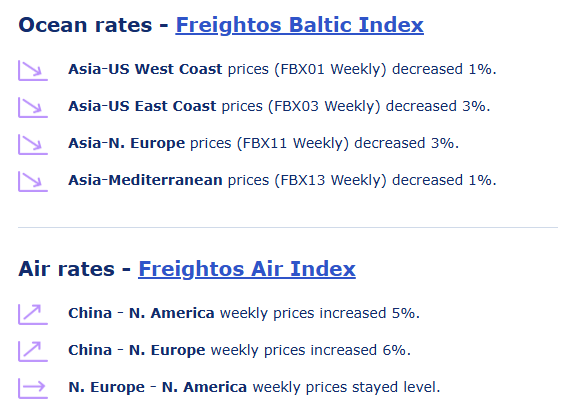
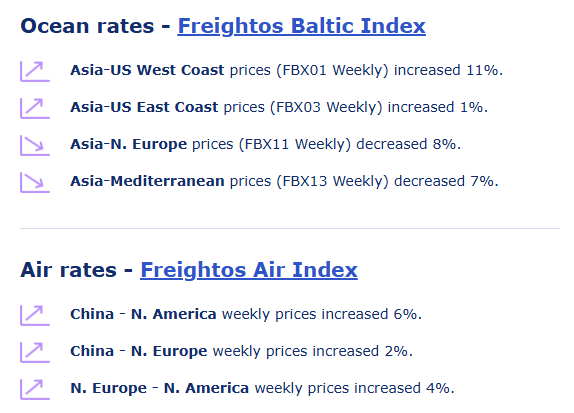
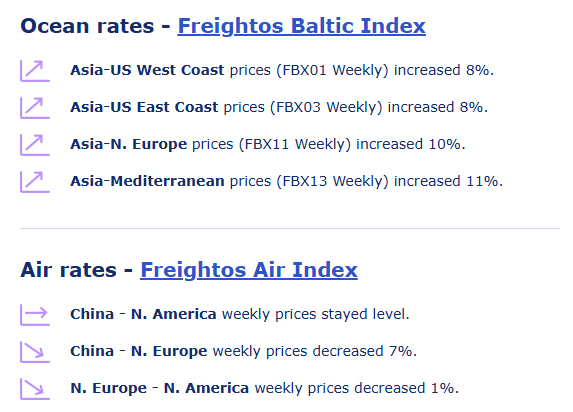
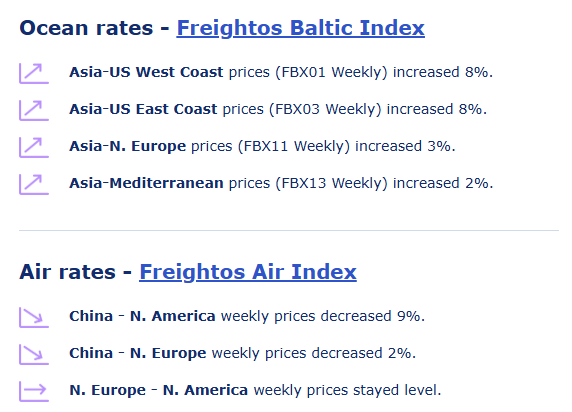
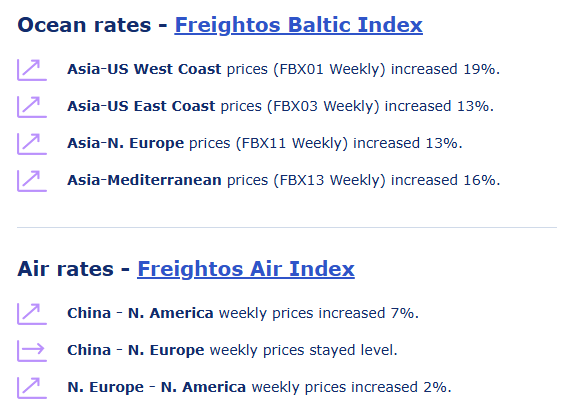
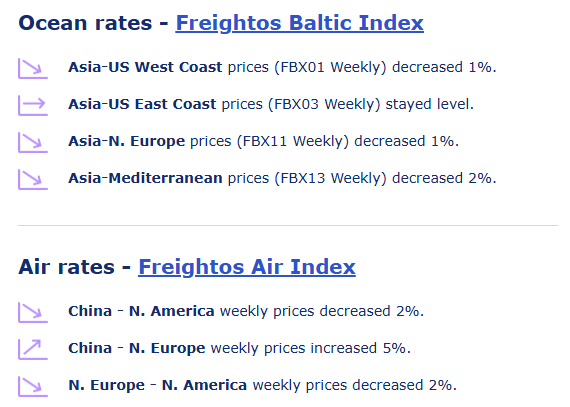
Asia - Europe rates eased 3% last week to both N. Europe and the Mediterranean. Though prices on both lanes climbed by several hundred dollars in the first weeks of the war, N. Europe rates of $2,668/FEU are just 8% higher than before the war and Mediterranean prices at $3,527/FEU are 3% lower than in late February. Maersk recently cancelled an upcoming Asia - Europe GRI, and carriers have started to announce more blanked sailings.
War-related rate increase attempts have not succeeded in keeping prices on these lanes much above their pre-war baselines, but upward pressure from the conflict is likely keeping rates higher than they otherwise would be. Asia - Europe rates are more than 15% higher year on year for both lanes, and more than 50% above rate levels in October, the other most recent low-demand period.
On the transpacific carriers have had more success steadily pushing rates up and preventing backsliding since late February. Prices ticked up slightly for both coasts last week, with West Coast rates of $2,675/FEU up 45% compared to the start of the war and almost 90% higher than post-peak season levels back in October. East Coast prices at just below $4,000/FEU are 30% higher compared to just before the war, and 30% above the previous low-demand stretch in October.
Nonetheless, even with these increases, the low demand and high capacity environment – and possibly the moderate easing of oil and bunker rates compared to earlier highs since the start of the war in Iran – has not allowed rates to rise to the full announced GRI or various surcharge levels.
The next significant rate increase across these lanes could come with the start of peak season in June or July, though some observers warn that war-related rising costs for consumers could dampen shipper expectations and depress peak season volumes.
Containers continue to move to and from the Gulf states via the alternative routes developed since the Strait of Hormuz closure. But even with significantly lower volumes booked, the network is straining, with Maersk reporting that Gulf export containers are facing particular challenges. Even as import containers also face delays and high costs, Gemini is increasing capacity to Saudi Arabia’s Jeddah Port.
In air cargo, more carriers have recently announced jet fuel cost-driven flight cancellations. In addition to Lufthansa scrapping its domestic Europe short-haul CityLine service – eliminating 20k flights through October – KLM will cancel some domestic flights, though both carriers say the cancellations represent a very small share of their overall network. United Airlines is rolling out a market disruption fee for cargo bookings.
Jet fuel supply is already getting tight in Southeast Asia, with K+N reporting it is adding fueling stops in China where supply is so far unconstrained before transiting to SEA countries. European Union officials recently met to discuss the looming prospect of jet fuel shortages, and may be considering a jet fuel sharing plan if supply gets really tight.

Despite these cancellations though, overall global air cargo capacity that had dropped sharply in March may now be at only a single digit deficit compared to before the war as Middle East carriers continue to rebound. Other global carriers have also shifted capacity to follow the war-driven shift in volumes to alternative Asia - Europe and other lanes.
These capacity additions, as well as moderate recent decreases in jet fuel prices may be contributing to the continued leveling off of rates on major lanes. The Freightos Air Index global benchmark remains 30% higher than before the war and year-on-year, but has been about level since the start of the month.
China - Europe rates at $5.07/kg and China - N. America prices of $6.40/kg both dipped slightly last week, with S. Asia - Europe rates also down 1% to $4.94/kg. SEA - Europe rates meanwhile climbed 9% to $5.24/kg, though remain a little below its year high of $5.30/kg hit earlier this month.
-

Analysis
Iran’s announcement that the Strait of Hormuz was open on Friday – followed shortly thereafter with statements that it was closed – led to a brief rush for the exit and many u-turns. Subsequent attacks on vessels in the region as well as US blockade forces taking control of an Iranian cargo ship have meant no real change in the status quo, with the ceasefire expiration approaching and US-Iran negotiations uncertain.
For the container market in the region, operations to and from the Gulf via alternative ocean-landbridge routes remain challenging: Maersk suspending landside bookings for some cross border services to the UAE and out of Salalah. But while some accessible ports like UAE’s Khor Fakkan are congested and some carriers increase surcharges for Mideast feeder services out of India, other ports like Fujairah and Sohar are reportedly operating more smoothly.
The broader container market remains unaffected operationally though fuel costs are still the main concern.
But while carriers could face significant bunker shortages in the next two or three months if the strait doesn’t reopen; and while there is tight supply, especially for low sulfur fuel, in some important Asian hubs including Singapore; early reports of real shortages in places like Singapore may have been overstated, and in general terms there is still enough bunker fuel supply in the Far East – for now.
Bunker fuel prices are 55% higher than before the war, but are down 15% from their peak a month ago and have eased 9% since the start of the month. This correction in fuel prices, together with the current seasonally low demand and continued high capacity levels may be combining to limit the overall impact of the crisis on container rates.
During the March - April stretch when freight rates typically ease until the summer peak season demand picks up, fuel surcharges and other price increases this year have indeed put upward pressure on rates. And prices are up year on year for most of the major trades. But carriers have so far mostly not succeeded in pushing rates up to the full announced surcharge or GRI levels.
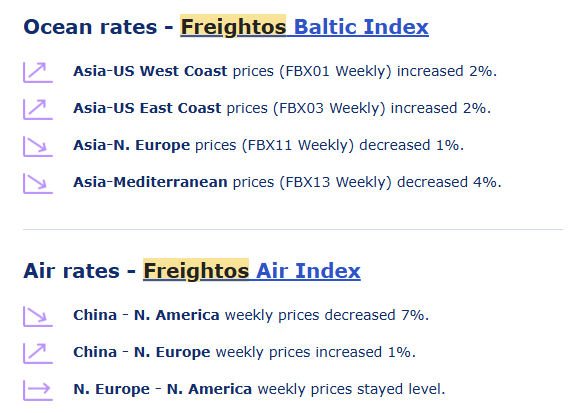
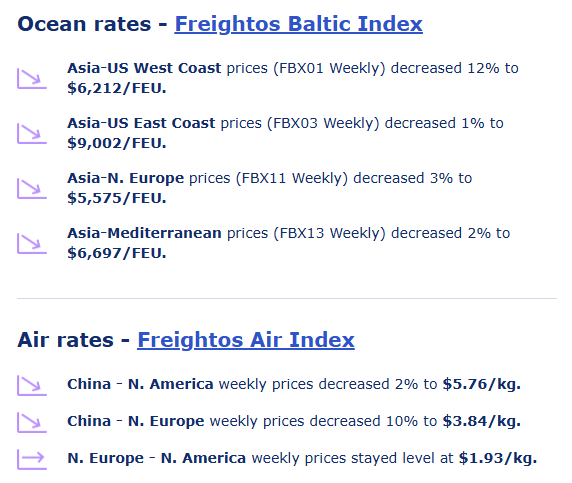
Transpacific rates ticked up again last week, and are about $800/FEU higher than before the war for both coasts, but nonetheless remain below their levels reached ahead of Lunar New Year. Rates from Asia - N. Europe of about $2,700/FEU are just 9% higher than at the end of February, and Asia - Mediterranean prices that climbed in March are now 5% lower than before the war. Rates on both lanes are down more than 11% so far in April amid reports of ongoing discounting, though some carriers are nonetheless announcing additional GRIs for May.
Barring a significant spike in fuel prices or an actual shortage in fuel supply and availability, rate behavior since the start of the war may indicate that the chances of significant spot rate increases are slim until peak season. And in the background is the possibility that the war and its impact on inflation rates could subdue consumer demand and peak season container volumes with it.
Jet fuel prices remain double their pre-war level, but have eased 12% since the start of the month. Nonetheless, the high carrier costs of flying has led almost all of the top 20 airlines to cancel at least some flights. Real concerns remain around fuel availability as well, with reports of short supply already in some parts of Asia, and estimates that Europe may have only six weeks of jet fuel stock left.
Capacity out of the Middle East – mostly from Gulf carriers – continues to recover with Iraq and Bahrain now reopening their airspace as well. DHL estimates that Emirates SkyCargo is back to 80% capacity, but puts the overall recovery level out of Dubai at only 40%.
Capacity recovery, easing fuel prices, reports of drooping volumes, and carriers adding capacity to lanes with high yields, may account for more examples of rates leveling off or easing on some major lanes. The latest S. Asia - Europe price of just below $5.00/kg is down 3% from a week ago, with SEA - Europe rates of $4.80/kg 9% lower, though these prices are still 93% and 43% higher than before the war, respectively.
China - Europe rates of $5.12/kg last week were up 2% week on week and are 50% higher than the $3.50/kg level at the end of February. China - N. America prices were also up 2% to $6.41/kg last week, but are just 7% higher compared to before the start of the war.
-

Analysis
Ceasefire talks that potentially could have yielded at least a partial reopening of the Strait of Hormuz quickly collapsed late last week and moved in the opposite direction, with a US naval blockade of Iran-linked traffic now in place. The few container vessels that have moved through – and any other that might manage to exit the Persian Gulf during the fragile pause – are probably unlikely to return to Gulf ports until carriers are confident the waterway is stable.
The Iranian closure has reduced global oil supply by 10% – with the added US blockade set to reduce energy flows further – and some countries are already taking measures to conserve stocks.
For the container market too, the biggest impact of the war has been on fuel costs and accessibility. Dwindling supply of bunker fuel in some Asian hubs is leading to reports of some ships switching to alternative ports, ironically using more fuel in the process.
Rising fuel costs have impacted container rates across the market, even for lanes where fuel availability is not yet a factor.
Emergency Fuel Surcharges and PSSs of between $500 - $1,000/FEU announced back in March for transatlantic shipments recently went into effect. Freightos Baltic Index transatlantic rates spiked 50% last week, climbing from $1,400/FEU to more than $2,100/FEU. Some carriers have scheduled more Europe - N. America rate increases for later this month or early May ranging from $1,000/FEU - $2,000/FEU.
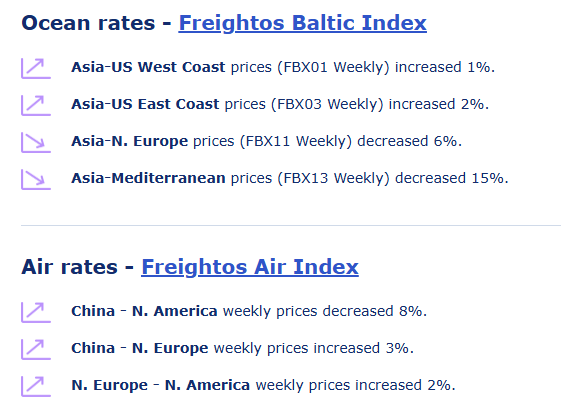
Transpacific rates to the West Coast climbed a more modest 3% last week to about $2,500/FEU and East Coast prices increased 10% to $3,678/FEU, both about $700/FEU higher than before the war. Some carriers are aiming for additional price hikes ranging from $500 - $2,000/FEU for these lanes in early May, though carriers may face a challenge sustaining those prices if rate behavior since late February, including for Asia - Europe prices, is a guide.
Asia-Europe rates have increased relatively modestly since the start of the war – albeit during the typical low demand, low rate period across these east-west lanes – climbing $200 - $400/FEU. Prices to N. Europe dipped 4% to $2,800/FEU last week and Mediterranean rates were level at $3,800/FEU – but both are around $1,000/FEU or more below GRIs that were set for March and again for early April.
The National Retail Federation projects level US ocean import volumes through June, before a 5% increase on peak season demand starting in July. Estimated year to date volumes through August however, would be 3% lower than the same period last year.
That the latest NRF volume projections for the coming months have not deviated significantly from those made in early February – just before the Supreme Court invalidated IEEPA tariffs and the White House introduced a global 10% tariff based on Section 122 as a temporary measure until July – suggests that most shippers are not frontloading ahead of the July deadline when tariffs may climb again.
In the meantime, multiple parties are challenging the Trump administration’s current use of Section 122 – a law designed to address international balance of payment issue back when the US was still on the gold standard – in the same court that first struck down IEEPA just as the refund process for IEEPA tariffs is about to get underway.
In air cargo the war continues to impact fuel costs and availability, in addition to driving volume shifts and a capacity crunch.
The Middle East supplies about a fifth of the world’s jet fuel and prices have more than doubled since the Strait of Hormuz closure. Countries especially dependent on Gulf jet fuel or on refineries in China - which has stopped exporting jet fuel - are already taking steps to conserve.
Vietnam and Myanmar are running low, with Vietnam Airlines reportedly canceling 20% of its flights as a result and foreign airlines refueling elsewhere before landing. Cathay Pacific will cancel 2% of its flights starting in mid-May to conserve fuel and reduce costs. Europe could face similar shortages by as soon as May, and though N. America is less exposed to supply issues, carriers like Delta and United are also canceling a number of unprofitable flights due to higher costs.
The fragile ceasefire is not enough to entice non-Gulf carriers to resume Middle East flights, and even as Gulf carriers continue their gradual recovery, the total number of flights in and out of the region are an estimated 60% lower than before the war. A good share of Gulf carrier cargo capacity is via passenger flights, so a full recovery could be difficult as long as visitors stay away.
This capacity strain, climbing fuel prices, as well as a shift of volumes to alternative Asia - Europe routes continue to put upward pressure on rates across most lanes though the rate of ascent has slowed on some routes and prices on other lanes are past their peak for now as capacity follows volumes.
Freightos Air Index S. Asia - Europe rates of $5.15/kg are double their pre-war level and SEA - Europe prices are 60% higher at $5.30/kg with both continuing to climb last week. China - N. America rates meanwhile were level at $6.30/kg and only 7% higher than late February after climbing to a peak of more than $7.50/kg in late March.
-

AnalysisWe are approaching six weeks since Iran closed the Strait of Hormuz, and only a few vessels per day are being allowed through. Ships that are transiting are doing so via coordination with Iran and possibly payments ahead of time, which this week included a CMA CGM container vessel, the first from one of the major European carriers.
Besides containers moving to or from the Gulf states, ocean operations remain stable across the market, with rising fuel costs and availability the main factors impacting other lanes.
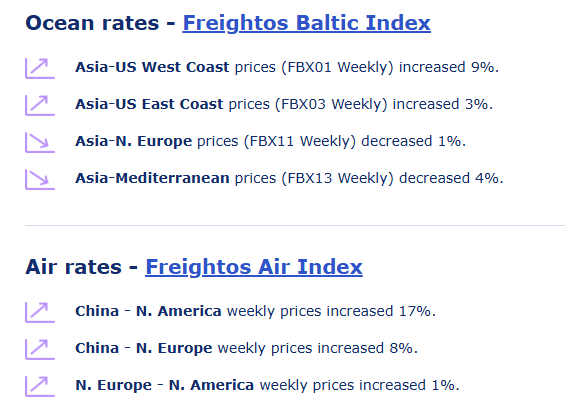
Ocean rates would typically be flat or easing this time of year in the soft demand period between Lunar New Year and peak season. But despite weak demand, transpacific container rates to the West Coast have climbed $700/FEU and nearly 40% since just before the war to more than $2,400/FEU, with Asia - N. Europe rates up 20% and $500/FEU to $2,900/FEU.
Earlier in the year, expectations were that carriers – facing a growing fleet and overcapacity – would face a significant challenge in keeping rates above last year’s levels. Indeed, up until the start of the war in Iran average transpacific spot prices were more than 50% lower than in January and February 2025, and Asia - Europe rates were 30% down year on year.

But that margin has steadily narrowed since the end of February, with rates surpassing last year’s prices in the last couple weeks, and current levels 8% stronger than a year ago for Asia - US West Coast and 22% higher for Asia - Europe.
At the same time, the downward pressure on rates from current supply-demand dynamics may be limiting the degree to which fuel surcharges and various other fees and GRIs are succeeding to push rates up, with reports of carrier discounts as well as benchmark levels well below announced FAKs.
Asia - Mediterranean prices of $3,800/FEU are up more than 7% and $260/FEU compared to the end of February, but have retreated from a high of $4,300/FEU in mid-March. Carriers nonetheless continue to announce upcoming price hikes, though the US FMC continues to deny carrier requests to waive the waiting period for new fees.
In addition to the cost of fuel, bunker availability is also a challenge. Only a month’s worth of fuel stocks remain in Singapore – the industry’s largest refueling hub – though Rotterdam, the second largest, remains supplied. If the war stretches on, carriers could start to slow steam or blank sailings to reduce fuel consumption, which could put additional upward pressure on rates.
Fuel availability is also becoming an issue in some regions for air cargo. Vietnam has canceled some domestic flights to conserve jet fuel, with reports of refueling restrictions in S. Korea and the Philippines as well.
Gulf carriers continue their capacity recoveries – with DHL estimating Emirates SkyCargo is back to 60% of its normal schedule, Etihad Airways up to 40% and Qatar Airways Cargo at 20% – but the remaining supply deficit, the volume shifts to alternate East-West routes, and rising jet fuel costs are keeping rates elevated.
Freightos Air Index data show S. Asia - Europe rates 62% higher than before the war at $4.17/kg, SEA - Europe prices up 33% to $4.50/kg and Europe - Middle East rates doubled to $3.67/kg. Even so, rates have mostly leveled off or even eased slightly on most of these lanes following initial weeks of sharp climbs, with China - Europe prices of $4.67/kg 7% lower than two weeks ago, SEA - Europe rates down 10% and S. Asia - Europe prices about even – possibly reflecting the gradual capacity shifts and recovery.
-

Analysis
Iran has continued to allow some vessels to transit the otherwise closed Strait of Hormuz for countries coordinating with and possibly paying a toll to Iran. This development includes two 19,000 TEU COSCO container vessels which had been stuck in the Persian Gulf since the end of February. COSCO – possibly not coincidentally – also just restarted accepting bookings to Gulf ports.
The Houthis fired missiles at Israel over the weekend, marking their first attacks since the start of the war in Iran, but so far have not targeted vessels in the Red Sea. The Strait of Hormuz transits take place alongside continuing attacks even on anchored ships in nearby waters, and on ports in the region – including some being used as alternatives to inaccessible container hubs in the Gulf. Maersk reports that a drone strike on the Omani port of Salalah on Saturday has meant suspended operations there, with service set to resume partially today.
Gulf-bound containers using these alternative ports also continue to face long delays from vessel bunching and from endemic challenges to the new landbridges in the form of trucking capacity shortages, insufficient road infrastructure, and border-crossing complications. And while these new routes are enabling critical goods to move to and from the Gulf states, their limitations make them more an emergency stopgap than a viable full alternative.
Beyond Gulf volumes, the broader container market continues to be unaffected operationally from the Strait of Hormuz closure. But the rising price of oil and the challenges to fuel availability mean higher costs for carriers – which Hapag-Lloyd estimates at $40 - $50 million a week – and have triggered a wave of emergency fuel surcharge, PSS and GRI announcements.
Many of these aren’t set to take effect until April, but some fuel surcharges ranging from $300 - $500/FEU from several carriers were scheduled to start from mid-month and through last week, as were some GRIs.
Transpacific container rates have increased only $200/FEU since the start of the war, with Asia - Europe prices up $500/FEU to $2,900/FEU to N. Europe. To the Mediterranean, the current rate of $3,800/FEU is just $100 higher than before the war, though prices had climbed to about $4,300/FEU earlier in the month. These Asia-Europe levels are both about $2k - $3k/FEU lower than GRIs set for last week by some carriers.
Taken together, container rates have not spiked yet on the Strait of Hormuz disruption, and mostly have not climbed fully in line with announced increases so far. The container market is now in its slow season, and all things being equal, rates would typically ease this time of year. That these price increase attempts are being made during a low demand period, and with capacity levels still high across the market, may mean that the upward pressure on prices is more keeping spot rates from falling than pushing them up very much. The coming weeks will reveal whether carriers choose to introduce – or whether the market accepts – the additional planned price hikes.
In trade war news, ahead of the May US-China summit China has initiated probes into US trade practices – possibly repeating its October playbook of creating leverage by mirroring US moves, as the US administration recently announced Section 301 investigations on countries including China. Meanwhile, there were more signs of progress – combined with confusion and frustration – around IEEPA tariff refunds.
In air cargo, the Gulf carriers continue to restore flights and freighter capacity to the market, with Emirates SkyCargo now describing its operations as stabilizing, and Qatar Airways Cargo gradually continuing its rebound, which had a much later start.
Even so, global capacity remains constrained and a good share of Asian export volumes are still rerouting via the Far East instead of through the Gulf-carrier hubs. Taken together, even though demand is lower than last year, rates are higher because of constrained capacity, volume shifts and fuel surcharges as high as $2.00/kg on some lanes.

The Freightos Air Index global benchmark is 22% higher than a year ago, and rates on key lanes remain elevated compared to before the start of the war in Iran. But as European and Far East carriers add direct Asia - Europe flights, and as Gulf carriers recover schedules, prices are stabilizing, or even easing on some lanes:
Freightos Air Index S. Asia - Europe rates are 65% higher than at the end of February, but have dipped 1% since last week, with SEA-Europe prices 26% higher than before the war, but 6% lower than a week ago.
-

AnalysisThe number of vessels transiting the Strait of Hormuz remains minimal, though it has increased in the last week as Iran announced it is allowing non-enemy vessels to pass.
Container traffic to the Gulf States has found alternate but ultimately insufficient routes. Most carriers are relying on ports on the west coast of India as tranship hubs and shuttle services to accessible ports in Oman and the UAE – with some also using north Red Sea transits to Jeddah, especially for volumes out of Europe – and road transport on to the final destinations.
But these port and road alternatives are not designed to handle these types of volumes, and in addition to the expense – Freightos Terminal shows Shanghai - Jebel Ali rates are now above $7,000/FEU – the routes are being plagued with delays and congestion. Vessels arriving at the UAE’s Khor Fakkan port are reportedly facing more than week-long waits for a berth with some being turned away, and truck shortages are delaying road transport as well.
But even as we approach a month since the start of the war, the container market beyond the Gulf region has not faced operational disruptions. And so far, container rates on the major lanes haven’t increased much either, with transpacific prices up just 3% last week to $2,100/FEU to the West Coast and 4% to $3,100/FEU to the East Coast. Asia - Europe rates were unchanged at $2,870/FEU to N. Europe and $4,264/FEU to the Mediterranean.
Carries have announced emergency fuel surcharges across lanes ranging from $200 to $500/FEU most of which will only go into effect in the coming days. They have also announced a long list of PSSs and GRIs – most set for early April – for non-Gulf lanes, including about $2,000/FEU rate increases for Asia - Europe lanes, though CMA CGM recently reduced its increase by about $700/FEU.
So container rates may be set to climb on across the board fuel surcharges soon, and possibly spike more significantly via other rate increases on some lanes to start April too. But there are some signs of pushback against the Strait of Hormuz closure driving rates up too far on non-impacted lanes.
Besides shipper concerns that contracted BCOs who pay the emergency fuel surcharges may be double charged when BAFs are updated for Q3, the US FMC just rejected an early-March request by some carriers to waive the 30-day notice period for fuel surcharges because carriers did not provide data showing that the rate increases were reasonably related to cost increases. Indian authorities have also opened a streamlined channel to hear complaints of predatory logistics pricing.
Carriers – after a tepid post-Lunar New Year period from a volume perspective – are also facing the challenge of slumping demand as slow season begins. Rate behavior in the next few weeks then, should reflect which rate increases carriers try to introduce, and their degrees of success.
In air cargo, Gulf carriers continue their gradual schedule recovery. Qatar Airways – whose Doha operations were largely suspended since the start of the war as airspace was closed – started a partial reopening this week including about forty five weekly freighter flights, alongside many passenger services as Qatari airspace starts to reopen. The UAE began reopening its airspace soon after the war began, with Emirates Skycargo announcing more than 150 scheduled freighters for this week.
But despite the continued Gulf carrier capacity recovery and European and Asian carriers adding Asia - Europe flights, capacity out of the Middle East, and Asia - Europe tonnage are still much lower than a year ago.
Air rates which had spiked on many Middle East lanes, and Asia - Europe routes early in the war – as capacity out of the Gulf dropped and volumes shifted to direct Asia - Europe services – had leveled off last week. This week though, rates on some lanes have started climbing again, possibly reflecting the first reports of backlogs developing across major hubs, and updated fuel surcharges as fuel costs continue to rise. South East Asia - Europe prices up 17% since last week to more than $5.00/kg, China - Europe rates up 23% to $5.00/kg too, China - US prices up 9% to $7.43/kg and Europe - Middle East rates up 14% to $3.18/kg.
-

Analysis
Iran has kept up its attacks on vessels attempting to transit the Strait of Hormuz this week. In recent days though, those strikes broadened to include even non-transiting vessels in the Persian Gulf or Gulf of Oman as well as a broader selection of ports in the region. Iran is allowing a small number of select vessels – from Iran and from countries like China, Pakistan and India – to transit, suggesting a verification process is now in place.
President Trump is lobbying the international community to help secure the passage via naval escorts, though there is broad skepticism that military protection would be effective or be able to move more than 10% of typical traffic. In any case, he is finding very few takers, and, from a container perspective, even if the plan moves forward, these resources would be deployed for oil and LNG tankers.
For the container market, operational disruptions continue to be limited to Gulf-bound or originating cargo, with some knock-on congestion elsewhere. As in previous disruptions like the Red Sea closure, carriers are now adjusting to the new reality and freight is finding its way.
After initially suspending bookings to the Persian Gulf, carriers like CMA CGM and Maersk are now accepting new bookings by diverting volumes to alternative accessible ports in the region – including ports in Oman, UAE, and Saudi Arabia – with containers moving on by landbridge. Carriers are also relying heavily on ports in India with new shuttle services ferrying containers to those accessible Mideast ports – though even some of these, like UAE’s Fujairah are now being directly targeted by Iran.
Congestion is already building at these alternative ports as well as in India, with reports that the Port of Colombo in Sri Lanka is declining to absorb Gulf-bound volumes because of pre-existing congestion.
For the rest of the container market, while operations are unaffected by the war, container rates are not likely to be spared.
Carriers have announced flat-rate global emergency fuel surcharges of several hundred dollars per FEU that will go into effect early next week. Ocean expert Lars Jensen observes that prolonged fuel fees like these would push rates up, but they would not represent unprecedented fuel pass throughs, and would be “expensive, but not destructive” to the market, possibly pushing rates back up to 2024 levels.
But while initially it seemed non-Gulf lanes would only be impacted by fuel surcharges, by mid-last week carriers announced a flurry of significant emergency surcharges, PSSs and GRIs across a range of lanes, including Asia - Europe and the transatlantic, some representing thousands of dollars in increases per container. Carriers like Maersk report facing additional costs not just in the price of oil, but in disruptions to fuel supply access, which may be a culprit in carriers looking to increase rates across lanes not directly impacted by the Strait of Hormuz closure.
As fuel surcharges and the other rate increases will not go into effect for a few more days, container rates have so far not risen too notably, and likely just reflect carrier hopes for a post-Lunar New Year bump. Transpacific rates increased 1% to about $2,000/FEU to the West Coast, and 9% to about $3,000/FEU to the East Coast last week, and have been about level so far this week. Asia - Europe prices climbed 10% to $2,900/FEU to N. Europe and 15% to $4,300/FEU to the Mediterranean and likewise have been stable since.
Even if rates do rise sharply on surcharges and GRIs next week, there is some skepticism that market dynamics will see these increases succeed fully. Similarly, there are reports that BCOs in the midst of annual ocean contract negotiations are pushing back against carrier fees associated with Iran war disruptions that do not directly impact these shippers’ volumes.
In some overlap between the trade war and the war in the Middle East, President Trump – who had said he would postpone his end of March summit with China if China refused to help secure the Strait of Hormuz – announced he has asked to delay the meeting for a month in order to focus on the war with Iran.
At the same time, US steps to restore IEEPA tariffs by other means continue – even as the IEEPA refund process gains steam – with China, Singapore and Thailand mentioned as subjects of Section 301 excess manufacturing capacity probes which reportedly will be completed before the Section 122 tariffs expire in July. And while it seems many US trading partners are pushing the US to stick to the agreed upon IEEPA tariff levels even if installed by other laws, they are at the same time objecting to the accusations of excess capacity abuses.
In air cargo, disruptions to a broad swath of the market continued this week as Iran persists in its attacks on regional airports which serve as hubs for major cargo players like Emirates Skycargo and Qatar Airways Cargo, and as a crucial global connection point, especially for Asia - Europe lanes.
While Qatari airspace remains closed, and Qatar Airways’ Mideast operations along with it, the UAE has gradually restored flight schedules after being closed completely during the first few days of the war and despite ongoing drone and missile attacks. Just this past week the airport in Dubai faced multiple attacks, some of which closed the airport for several hours.
With the drop in available capacity out of these Gulf hubs and the increase in Asia volumes looking for alternate routes to Europe, Freightos Air Index rates have spiked on many of these lanes. South Asia - Europe prices climbed to $4.72/kg as of today, 84% higher than just before the war began, with South East Asia - Europe rates up 26% to $4.23/kg and Europe - Middle East prices up 57% to $2.82/kg, with some of these increases likely partially due to fuel surcharges being rolled out by some carriers.

That being said, while rates had climbed sharply for the first week or so following the airspace closures, in the last few days prices have leveled off or even cooled slightly on many of these lanes. This shift may reflect some capacity recovery by Emirates, as well as Etihad, or the addition of direct Asia - Europe capacity by European airlines and carriers from the Far East.
But as Qatar Airways remains mostly grounded for services in and out of Doha, about 5% of global capacity is still absent from the market and is likely still an important factor to capacity and rate levels.
-

Analysis
Very few vessels have passed through the Strait of Hormuz since the start of the war in Iran a week and a half ago. The closure is of global concern due to its stifling of oil tanker movements which is already slowing production and pushing oil prices up.
The US International Development Finance Corporation announced a plan to insure vessel transits despite the security risk, though few carriers will likely take up the offer without naval protection as well. And the government is much more likely to devote these resources to oil tankers than to container flows.
For the container market, disruptions from the strait’s closure are so far limited to containers already en route to (or stuck in) the Gulf ports, with some knock-on congestion elsewhere. Ports in countries like India and Bangladesh – significant exporters to the Gulf states – are reporting backlogs. And yard utilization levels are increasing at transhipment hubs in the Far East where some Gulf-bound containers are now being diverted. Yard density at those ports could increase somewhat in the coming days as shippers who so far decided to wait and see may choose to divert Gulf-bound containers there as the Strait remains closed.
Carriers are rolling out contingency plans for Gulf volumes via alternative ports in the region, with shipments then moving on to their destinations by road. Carriers are applying significant surcharges for those containers already in transit on these lanes, and offering alternatives like storage, return to origin and change of destination, which will also incur additional costs.
For the broader container market though, Iran’s closure of the Strait of Hormuz has not caused disruptions or price increases yet. And while congestion at Far East tranship hubs could cause delays for non-Gulf volumes in the near term, these backlogs should be much less significant than those seen at the outset of the Red Sea crisis, since the volumes involved are much lower and since carriers have already suspended new bookings to those destinations.
But one way global container shipping could be impacted is by rising fuel costs. The climbing price of oil has already led some carriers like CMA CGM and Hapag-Lloyd to announce emergency fuel surcharges for all lanes at $70-75/TEU for regional transits and $150/TEU for long haul voyages starting March 23rd, with others announcing fuel increases only on certain lanes for now. If oil prices remain elevated, more carriers are likely to introduce emergency surcharges, though standard fuel rates – adjusted on a quarterly basis and already set for Q2 – could only increase to start Q3.
Freightos Baltic Index transpacific container rates increased about $200 or 10% to $2,022/FEU last week, with daily rates to the East Coast showing a similar climb to about $3,000/FEU so far this week. Asia-Europe rates increased 6% last week to about $2,600/FEU and 2% to $3,700/FEU to the Mediterranean, with prices continuing to climb so far this week.
These rate increases are not likely related to the war in Iran, and instead reflect attempts by carriers to bump prices up now that we’re in the post-Chinese New Year period when it is not uncommon for demand to increase for a couple weeks. Emergency fuel surcharges, though, could start showing up as a component of rate levels once implemented.
In air cargo, a more broad range of lanes have been impacted by airspace closures in the Gulf, with rates climbing significantly on a list of lanes.
Gulf carriers Qatar Airways and Emirates Skycargo are two of the top three largest cargo carriers by capacity, and together with Etihad make up about 13% of global capacity. Their hubs serve as a major east-west connection point, including providing a significant share of South Asia and South East Asia capacity to Europe and N. America.

As a result, Freightos Air Index data show air cargo rates have increased by about 50% since the start of the war from South Asia to N. America and Europe, with rates now at about $6.00/kg and $4.00/kg respectively. SEA - Europe prices are up 20% to more than $4.00/kg. China - US rates have climbed 20% to more than $7.00/kg too, though this increase may be mostly due to post-LNY demand. That these disruptions are coinciding with the post-LNY rush could be adding some upward pressure to ex-China rates as volumes that normally would go via the Gulf compete for long haul space.
Most Gulf airports closed completely for several days at the start of the war, but over the last few days some started to reopen partially. The UAE has reportedly opened safe air corridors enabling 48 flights per hour to depart. Emirates Airways reports it is now operating a reduced but stable flight schedule, and are now estimated to be flying more than 50% of their scheduled flights. Etihad has also resumed some flights, though Qatar Airways Cargo operations through Doha remain suspended. With these flights and capacity returning to the cargo market, we may see pressure on rates ease somewhat in the coming days. Like in ocean, some forwarders are working to fly cargo with final destinations in the Gulf to alternate airports in the region, especially Saudi Arabia, and move goods on by road.
In trade war developments, following the Supreme Court’s decision invalidating President Trump’s IEEPA-based tariffs, the US Court of International Trade ordered the government to start refunding the billions of dollars in IEEPA tariffs paid over the past year.
Some experts were surprised by the speed at which this ruling was issued, and that it relies on a single case to resolve refunds for everyone even as more than 2,000 individual suits had been filed. Customs and Border Protection responded that these hundreds of thousands of payments can’t be made immediately and asked for 45 days to set up an automated system. There are still a lot of questions as to when refunds will actually start going out and who will receive them, but these developments are a big step forward.
In the meantime, the administration has put 10% global tariffs into place relying on Section 122 – even as two dozen states are challenging the administration’s use of this law – and the USTR says Section 301 investigations that will be used as the basis for country-specific tariffs replacing EEPA duties are underway and will be concluded before the Section 122 tariffs expire in late July. The president has said that an additional executive order will introduce Section 122 tariffs at 15% for some countries, though so far no such order has been issued.
The current Section 122 tariffs mean lower-than-IEEPA duty levels for some companies, leading to reports of some companies starting to frontload before the July deadline, while others are not taking action just yet. The latest National Retail Federation US ocean import volume projections through June are about even with those from just before the SCOTUS decision, suggesting that most companies are remaining cautious, and not pulling volumes forward. The report expects H1 volumes to be 2.5% lower than in 2025.
-

Analysis
The US-Israel strikes on Iran and subsequent Iranian retaliation targeting multiple countries in the area since the weekend are driving significant logistics disruptions in the region which could start to be felt more broadly if the conflict stretches on.
Six tanker vessels in or near the Strait of Hormuz came under attack early this week. The strikes de facto closed the waterway by Sunday, though the IRGC only made an official announcement on Monday. President Trump – who also said the US will cut off trade with Spain in response to being denied access to military bases there – stated on social media that the US would facilitate insurance and naval escorts to keep oil tankers moving through the strait, though experts are skeptical of the feasibility of and speed at which these could be provided.
In terms of container shipping, DP World suspended operations at the major container port of Jebel Ali in Dubai, the largest port in the Middle East, after an aerial interception caused a fire there Saturday night but reopened on Monday. Otherwise, ports remain operational, but with the strait closed and the security risks in the region, the major container carriers are diverting vessels away, cancelling sailings and suspending new bookings.
Hapag-Lloyd and MSC suspended bookings out of Persian Gulf ports and from all origins to these ports – including Oman and UAE ports on the Gulf of Oman side of the strait because of their proximity. CMA-CGM stopped accepting all bookings to and from Persian Gulf ports only. Maersk suspended all new reefer bookings to the entire region, and bookings out of India to the gulf because of the short lead time. But for now Maersk is still accepting general bookings from the Far East, possibly reflecting optimism that the Strait of Hormuz could reopen relatively soon.
These moves mean delays of uncertain duration for shippers to and from the gulf area. The canceled sailings mean gulf-bound containers are already starting to pile up and threaten container yard congestion in India. They could likewise lead to some backlogs at Far East origins that may start to be felt by other shippers out of those ports if the shutdown lengthens.
Carriers still sailing to the region are diverting containers already in-transit to alternatives in the area with most volumes likely to be offloaded at the major Far East transhipment hubs in Singapore, Malaysia and Sri Lanka. A similar shift to transshipment in the early months of the Red Sea crisis led to significant congestion at these ports in 2024, but with lower volumes and more port capacity this time, congestion should not be as severe.
So for now, the war’s impacts on the container market are mostly local, with Hapag-Lloyd reporting that elsewhere operations continue as normal. But the longer the conflict continues the more disruptive it will be and the more broadly it will be felt.
The Strait of Hormuz handles about 2% or 3% of global container volumes, and estimates of the amount of container capacity from the around 100 container vessels now stranded in the Persian Gulf range from less than or around 1% to as much as 10% of effective capacity. Analysts agree though, that the longer these vessels and equipment are out of circulation, the more likely that reduction will be felt in terms of available capacity and equipment out of the Far East. When traffic through the strait resumes, there will likely be some vessel bunching at these ports too, as ships arrive off schedule. Taken together with climbing fuel costs, these factors could start pushing rates up on non-gulf lanes.
So far rates are only going up for containers directly impacted by the closure. CMA CGM introduced a $3,000/FEU emergency surcharge for containers heading to the gulf, and other carriers are also applying fees for diverted bookings. Freightos Terminal container rates for Shanghai to Jebel Ali in Dubai spiked from $1,800 per 40' container on Saturday to more than $4,000/FEU by Tuesday likely reflecting these surcharges. On the main east-west trades though, rates were stable last week as the Lunar New Year holiday period is still approaching its end, and prices have remained level so far this week too.
War impacts are also reaching the Red Sea. The Houthis – who’ve paused attacks on Red Sea vessels since October – have threatened to resume strikes, though none have been reported yet. In response, the few carriers who had resumed some Red Sea sailings have diverted these vessels back around the Cape of Good Hope until further notice, possibly pushing a full Red Sea return farther off once again.
The crisis may have bigger and more immediate impacts for air cargo. The IRGC has targeted airports in Abu Dhabi, Bahrain, Kuwait and Dubai, with airports and airspace still closed. These closures are directly impacting shippers of volumes to and from the region.
But gulf carriers Qatar Airways and Emirates Skycargo are two of the top three largest cargo carriers by capacity, and together with Etihad make up about 13% of global capacity. Their hubs serve as a major east-west connection point, making up, for example, about a quarter of all China - Europe capacity according to Aevean.
With these carriers’ flights cancelled, many of their aircraft grounded and their hubs inaccessible, global capacity has dipped over the last few days, though there are also signs that direct Asia - Europe capacity has increased in response. South and South East Asian air exports are also heavily dependent on transit through the Middle East for movements west and there are already reports of shippers on these lanes facing disruptions, delays and scrambling for alternatives.

Kuehne + Nagel says forwarders are starting to charter direct Far East - West flights to make up for the missing capacity and that it expect backlogs of Europe and US-bound cargo in Asia to begin stacking up by the end of the week, creating a backlog that could cause delays and push up prices.
Climbing rates on some lanes may already reflect the war disruptions and blow to available capacity. Freightos Air Index data show rates from South East Asia to Europe have climbed more than 6% to $3.82/kg since Friday, with South Asia rates up 3% to Europe and 5% to the US. Middle East - Europe prices are up 8% to $1.62/kg and China -US prices are up 15% to $6.90/kg, though rates had begun increasing before the start of the war, possibly due to the start of some post-LNY bump.
-

Analysis
The much-anticipated US Supreme Court decision arrived on Friday, striking down the Trump administration’s use of the International Emergency Economic Powers Act to enact tariffs. The president relied on IEEPA for most of last year’s tariffs, including all the country-specific tariffs and the fentanyl-related duties imposed on China, Mexico and Canada.
The move triggered a rapid response from the White House, making good on promises to reinstate IEEPA tariffs by other means in the event of a loss. Trump signed an executive order later that day introducing a 10% global tariff based on Section 122 of the Trade Act of 1974, reframing the duty as addressing a balance of payments problem. The president said on social media that he will raise the tariff to 15%, and the administration is reportedly working on an amended order, but the law went into effect Tuesday at 10%, and is valid until late July.
The ruling keeps de minimis suspended, and leaves Section 232 sectoral tariffs, and Section 301 tariffs on specific trading partners – used in 2018 for duties specific to China – intact too, but along with the long list of previous exemptions to the IEEPA tariffs. The president and other officials stated this week that they will use other means – like 232 and 301 – to restore tariffs before Section 122 expires, though these channels typically take months as they require federal agency investigations before the president can introduce duties.
The White House already has several Section 232 probes underway and is now reportedly considering opening more. And in addition to reviewing China’s compliance to the terms of its deal with the US during Trump’s first administration, it may also have opened additional China-focused 301 investigations.
The US based the many trade agreements it negotiated in the past year largely on IEEPA tariffs, raising questions as to the deals’ validity and how various trade partners will react. The administration says the US intends to honor these agreements and Trump has threatened counterparts who do otherwise. And while some countries have so far said they will stick to the deals, some high profile partners like the European Union see a 15% blanket duty as a breach of agreed tariff levels for some goods, and have paused steps to implement the agreement until they can receive clarity.
All-in-all the shift to a global 15% tariff mostly preserves the IEEPA trade barriers: Yale's Budget Lab estimates the change reduces the overall effective US tariff rate by only two percentage points, with impacts varying by country – a five percentage point reduction for China and Vietnam, no change for the EU baseline, a five-point increase for the UK, and the most significant reduction for Brazil (down from 40%). Overall effective tariffs on China remain around 40% due to pre-existing Section 301 duties.
So while in terms of tariff levels not too much has changed for the near term – and as of now the US appears intent on restoring and maintaining tariffs after Section 122 expires too – the more significant implication may be geopolitical.
Trump relied on IEEPA during this administration because of its speed — it allowed him to credibly threaten immediate tariffs across a wide range of, often non-trade-related, issues, including the recent Greenland drama. With that leverage gone, though we’re still likely to see Trump threaten tariffs that could ultimately materialize, the pace of US trade policy changes, and the frequency of disruptions Trump has caused for freight markets over the past year, could slow significantly.
For US shippers, the immediate question – in addition to the many questions around potential refunds – is whether or not these developments justify frontloading before the July deadline.
Where the 15% rate represents a meaningful reduction — like for Brazil — we may see a quick increase in volumes. And a five-percentage point reduction for tariffs on goods out of China and Vietnam may be enough to spur frontloading by some shippers, meaning we may see some signs of increased demand as soon as manufacturing restarts post-Lunar New Year in a week or so.
But, for many shippers, the relatively modest tariff reduction for most countries including China and Vietnam may not be enough to trigger a significant pull forward. And with the White House under cost of living political pressure; facing some open Republican opposition to tariffs; and considering expanding its list of tariff exceptions – some importers may suspect that Trump will hesitate to extend tariffs at the end of July as midterm elections loom. These factors could also keep many importers from frontloading in hopes that the tariff landscape shifts in their favor.
So, we’ll probably see somewhat stronger US import volumes in the coming months, and possibly an earlier start to peak season, than we otherwise would have, but we may not see the levels of frontloading that tariff threats spurred last year.
As container rates won’t reflect any, or even a surge of, potential frontloading until after the LNY period, transpacific rates – along with Asia - Europe prices for the same reason – were about stable last week and down from their pre-LNY highs. As rates are likely to rebound on the typical post-LNY backlog bump for all these lanes, it may initially not be possible to attribute rate increases solely to trade war developments.
Carriers have prevented rates from sliding too far over the past weeks by increasing blanked sailings on these lanes, though they will restore capacity if demand materializes post the holiday. With the current demand lull, the stop and start weather disruptions in N. Europe and the resulting congestion has not pushed rates up. This week’s major blizzard in the northeastern US also shut ports, roads and airports temporarily, but may likewise not be felt in rate levels despite likely delays and congestion.
In other ocean news, some ZIM vessels in Israel are facing port labor disruptions from union workers opposed to the planned sale to Hapag-Lloyd. And Maersk and MSC have officially taken over operations at the Panama Canal ports previously run by HK Hutchinson, despite Hutchinson’s opposition.
Finally, for air cargo, the tariff turmoil could, like for ocean freight, be reflected in some increase in US bound volumes in the coming months. But with de minimis still suspended, we’re unlikely to see a big or sudden volume surge for air cargo either. As ex-Asia freight is in its LNY lull, China - US rates dipped by 15% and prices to Europe eased almost 10% last week.
-

Analysis
US steps toward maritime protectionism aimed at reviving the US shipbuilding industry resurfaced this week for the first time since the suspension of proposed port call fees on Chinese vessels late last year.
The administration’s Maritime Action Plan – which does not give a timeline for implementation – features a long list of possible steps including a proposal for port fees of between one and twenty five cents per kilo of freight arriving on foreign-buillt vessels. Ocean expert Lars Jensen estimates these fees would range from about $150/FEU for a one cent per kilo charge to a maximum of a prohibitive $3,750/FEU.
Other recent US trade-related developments include the White House considering lowering steel and aluminum tariffs for consumer goods, a – symbolic, but partially Republican-backed – House of Representatives bill passed last week invalidating tariffs imposed on Canada last year, marking the highest profile challenge yet by Republicans to Trump’s tariffs, and rising tensions in the Panama Canal port operations dispute, with Hutchinson Ports threatening legal action against Maersk’s terminal operator if it takes steps to take over the disputed ports.
One impact of the US trade war has been a diversification of trade partners and increase of commerce between non-US economies, with several long-running negotiations being spurred to completion as a result, including a EU - Australia trade agreement which is nearing completion. Likewise, this trend of exporting countries seeking alternative sources for growth is also being reflected in ocean freight flows, with carriers shifting some capacity and resources to Far East - W. Africa lanes as demand increases. This shift may also be a factor in recent service reductions on the transatlantic.
Hapag-Lloyd has agreed to acquire ZIM, marking the most significant acquisition in the container market in quite some time. The deal requires shareholder and various regulatory approval and if approved won’t be completed until late this year.
With the purchase Hapag-Lloyd will remain the fifth largest carrier by capacity, but adding ZIM – currently the tenth largest carrier with more than 700k TEU according to Alphaliner – would push it closer to the number four spot with more than three million TEU combined. That capacity will help Hapag-Lloyd, whose Gemini Cooperation partner Maersk was also a bidder, increase its overall market share, particularly on the Far East - N. America and transatlantic lanes.
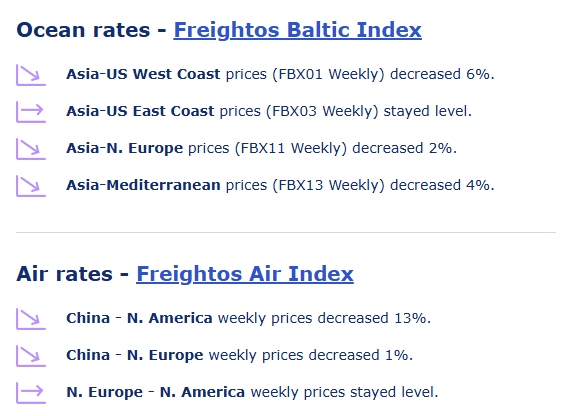
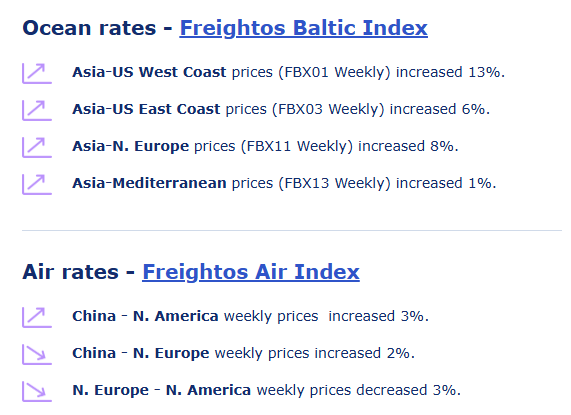
Container rates continued to ease on east-west lanes last week as the Lunar New Year holiday period got underway. Asia - US East Coast prices fell 12% to about $3,000/FEU and back to early December levels before pre-LNY demand picked up. Asia - N. Europe rates dipped 5% to about $2,400/FEU, also back to December levels while prices to Mediterranean ports fell 4% to $3,600/FEU but remain several hundred dollars above its level in December.
The end of pre-LNY demand is letting rates slide on Asia - Europe lanes even as weather disruptions continue to cause significant delays and backlogs at many Western Med and N. Europe ports and carriers introduce disruption surcharges on some lanes. Strong winds and high waves which have come and gone several times over the last few weeks made N. Atlantic transits difficult again mid-last week. Conditions improved and operations resumed over the weekend and carriers don’t expect additional weather disruptions this week.
Carriers will blank a significant number of sailings across these lanes over the holiday period, which should slow the rate decline. The FBX Global benchmark rate is 44% lower than it was last year, pointing to the impact of a growing fleet, which is also starting to be reflected in falling carrier revenue.
Air cargo rates from China to the US remained elevated last week at $7.40/kg and prices to Europe increased 8% to $3.60/kg, possibly reflecting some last minute pre-LNY push, though pre-holiday demand was reportedly subdued compared to typical volume increases this time of year.
-

AnalysisThe transpacific container market is firmly post the pre-Lunar New Year rush this year, with reports that demand increase that did materialize was muted. And while ocean rates typically ease as the holiday approaches, they normally remain elevated relative to levels before the rush until after the post-holiday backlog is cleared.
This year, however, Asia - US West Coast rates that slipped more than 20% last week to about $1,900/FEU are all the way back to early December levels, suggesting that prices are already entering the post-LNY, pre-peak season lull. The latest National Retail Federation US ocean import report projects March volumes will dip 5% month-on-month, with Q1 demand expected to be down 7% year on year as retailers exercise caution and as totals are compared to volumes frontloaded in Q1 last year.
US container ports and air hubs have mostly recovered from the recent winter storm, though backlogs at inland rail terminals continue to cause delays for shippers. Bad weather in Europe closed ports in the Western Mediterranean and disrupted transits in the Bay of Biscay for a second time towards the end of last week. As conditions have improved this week operations and transits have resumed, though carriers warn of congestion and delays due to disrupted schedules.
Despite the congestion, easing pre-LNY demand means cooling rates on these lanes as well, with Asia - N. Europe and Mediterranean prices both down more than 8% last week, and daily rates so far this week slipping further to $2,700/FEU to Europe and $3,700/FEU to the Med. Though prices to Europe are about down to pre-LNY rush levels, those December rates were supported by strict capacity reduction, and expectations for a post-LNY bump on these lanes are reflected in GRIs of several hundred dollars per FEU planned for March.
Record global container volumes last year weren’t enough to keep carrier revenue growing as the global fleet continues to expand – likely a sign of things to come. Hapag-Lloyd and Maersk both reported drops in earnings last year, with Maersk among carriers reporting losses for the first time in a long time in Q4 despite volume growth. And as a clear indication of the current uncertainty in the market, even with projections for demand growth again this year, Maersk forecasts either a profit or loss of around $1B for 2026, mostly hinging on whether or not container traffic returns to the Red Sea.
In trade war developments, President Trump signed executive orders codifying tariff reductions for India, and empowering the departments of commerce and state with the discretion to impose tariffs on countries trading with Iran or selling oil to Cuba – examples of a new kind of authority-backed tariff threat as compared to declarations on social media. Hutchinson Ports is seeking arbitration with Panama over the recent invalidation of their port operation concessions there, with China reportedly asking state companies to pause any development plans in Panama in retaliation.
Global air cargo volumes are projected to increase this year, though not as quickly as last year and at a big step down from the rapid e-comm driven rise in 2024. There are indications that China-US e-commerce volumes have contracted since the de minimis closure last year, and signs that e-comm growth to Europe is slowing. The EU is set to change their de minimis rules by 2028, and will assign a handling fee to low-value imports starting in July. But some EU countries are already charging for parcel imports – with reports of falling e-comm air volumes as a result – and opposition to de minimis from domestic retailers continues to grow, with objections by businesses in Poland the latest example.
Freightos Air Index data show China - N. America rates continued to climb last week, up 9% to more than $7.30/kg possibly reflecting some pre-LNY bump. And the pre-Valentine’s Day surge of S. American flower exports has prices to N. America at $2.10/kg and to Europe at $1.95/kg up 8% and 17% respectively compared to the end of January.