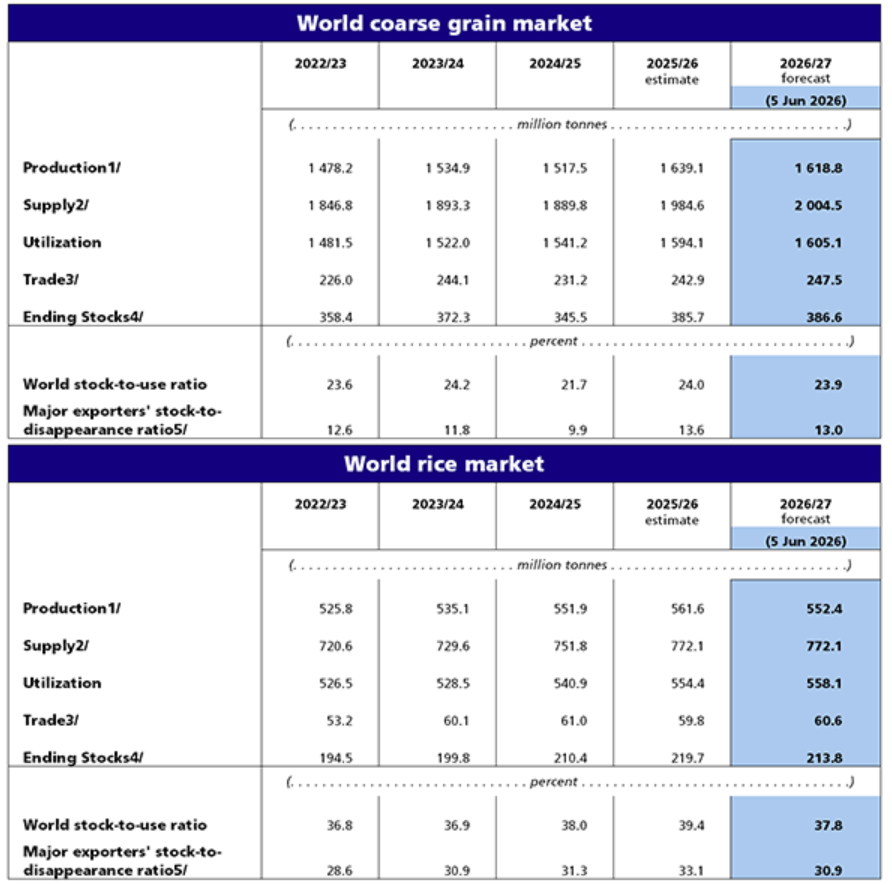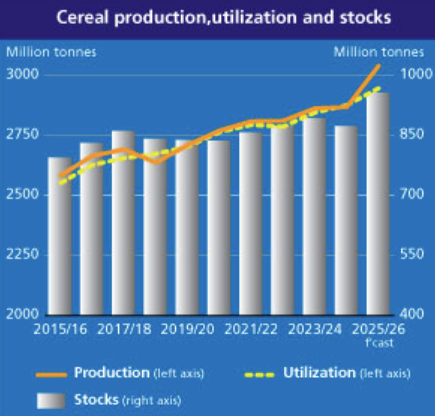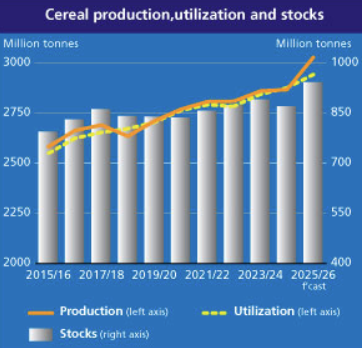
FAO Cereal Supply and Demand Brief
- Source
- United Nations
- Source Link
- https://www.fao.org/
- Frequency
- Monthly
- Next Release(s)
- May 8th, 2026 4:00 AM
-
June 5th, 2026 4:00 AM
-
July 3rd, 2026 4:00 AM
-
August 7th, 2026 4:00 AM
-
September 4th, 2026 4:00 AM
-
October 2nd, 2026 4:00 AM
-
November 6th, 2026 4:00 AM
-
December 4th, 2026 4:00 AM
Latest Updates
-
Cereal production prospects remain positive, but rising input costs add uncertainty ahead of sowing
Release date: 03/04/2026

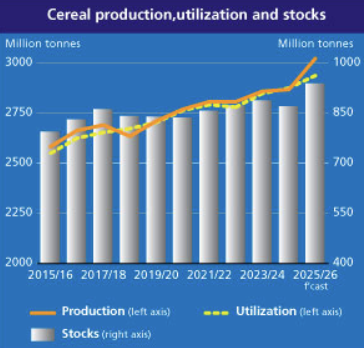
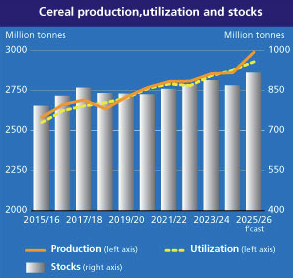
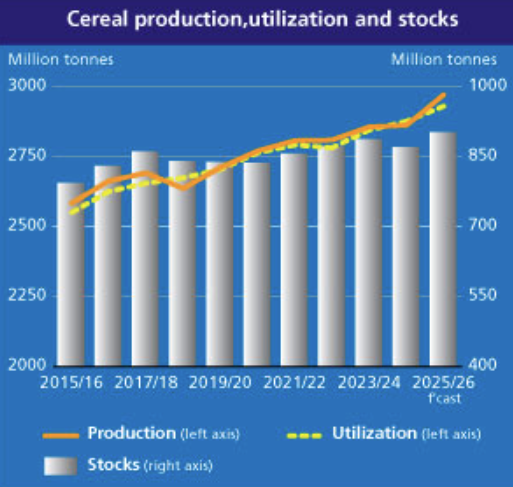
FAO’s latest forecast for global cereal production in 2025 is raised by 0.2 percent this month to 3 036 million tonnes. At this level, world production is 5.8 percent higher year on year, with upward revisions largely reflecting recently released official data for wheat production in Central Asia and maize production in India. As for rice, FAO’s global production outlook has changed only marginally since March, as a yield-based upgrade to Egypt’s production estimate is largely offset by an output downgrade for the United Republic of Tanzania, where official assessments indicate that weather setbacks caused a more pronounced contraction than previously envisaged. As a result, world rice production remains forecast to expand by 2.0 percent in 2025/26 to reach a record high of 563.3 million tonnes (milled basis). Bangladesh, Brazil, China, India, and Indonesia remain forecast to drive this annual production growth, more than compensating for contractions namely in Madagascar, Pakistan, Thailand, the United Republic of Tanzania, and the United States of America.
World cereal utilization in 2025/26 is forecast at 2 945 million tonnes, marginally higher than last month and 2.4 percent above the 2024/25 level. A downward revision to wheat use is more than offset by increased utilization of coarse grains, particularly maize. In Argentina, strong export demand for wheat has prompted its substitution by maize and sorghum in feed rations while in Mexico upward revisions to production estimates have resulted in additional maize being channeled into animal feed. World rice utilization is anticipated to reach a fresh peak of 555.6 million tonnes in 2025/26, up 2.7 percent from 2024/25 and essentially unchanged from March expectations. Food use remains forecast to spearhead this expansion, although ample supplies are also seen underpinning growth in non-food uses of rice, including use of rice for ethanol production in India.
World cereal stocks by the close of the 2026 seasons are raised once more and are now seen at a record level of 951.5 million tonnes, 9.2 percent higher than the previous year. The latest forecast reflects upward revisions to wheat stocks in the European Union, owing to a slower pace of exports, and in the Islamic Republic of Iran, following a faster-than-expected pace of imports. Wheat stocks are also revised upward in Uzbekistan on improved harvest estimates and in India, where maize ending stocks have been raised after confirmation of a higher-than-anticipated output. The world cereal stocks-to-use ratio at the end of seasons in 2025/26 is forecast to stand at 32.2 percent, further underlining the overall comfortable supply situation. World rice stocks at the close of 2025/26 marketing seasons are forecast to expand by 4.2 percent to an all-time high of 219.3 million tonnes, owing to expected accumulations among exporting countries (particularly India, but also Brazil, Thailand, and Viet Nam) and among rice importing countries (namely China, but also Bangladesh, and Indonesia).
FAO’s forecast for world trade in cereals in 2025/26 is raised this month by 3.6 million tonnes to 505.3 million tonnes. Recent trade data point to substantial purchases of barley and wheat by the Islamic Republic of Iran earlier in the 2025/26 season. In the case of wheat, increased shipments from Argentina and Kazakhstan outweigh a downgrade to the export forecast for the European Union, where sales have slowed since the turn of the year, while purchases by Türkiye have also been at levels lower than previously expected. World trade in maize in 2025/26 is little changed this month at 192.9 million tonnes as major exporters Brazil and the United States of America each continue to sell at a record pace. FAO’s forecast of international rice trade in 2026 (January-December) now stands at 60.0 million tonnes, down 1.6 percent from the 2025 record high and fractionally below March expectations as slight downward revisions to expected shipments by Cambodia and Thailand were partly offset by improved export prospects for Egypt.
Global wheat production prospects for 2026 remain favourable, although Near East conflict escalation is raising input costs and planting uncertainty
With the bulk of the 2026 global wheat crop already in the ground and to be harvested in the coming months, FAO’s forecast has remained mostly stable this month. At 820 million tonnes, production is foreseen to decline by 1.7 percent in 2026 yet still exceed the five-year average. However, conflict escalation in the Near East - and the resulting pressures from higher energy and fertilizer prices on production costs and disruptions to supply chain routes - has introduced additional uncertainty into the outlook, particularly for 2026 wheat crops yet to be planted in southern hemisphere countries and for spring wheat crops in countries north of the equator. Tightening margins, reflecting higher input costs alongside flat or weaker crop prices, could also influence planting decisions for 2026 maize crops in northern hemisphere countries, as farmers consider shifting towards less fertilizer-intensive crops, although the extent of the effect remains uncertain.
In the European Union, recently released official data confirm expectations of slightly smaller wheat production of about 137 million tonnes, reflecting a cutback in winter crop plantings due to weaker prices and an anticipated return to more average yields from the elevated levels of last year. However, broadly favourable weather conditions continue to support prospects for solid crop productivity. Similarly favourable crop conditions prevail in the United Kingdom of Great Britain and Northern Ireland, where wheat production is seen surpassing 13 million tonnes, higher year on year, reflecting larger sowings and an anticipated improvement in yields. The wheat production outlook remains unchanged in the Russian Federation, where lower plantings are expected to result in a smaller harvest amid generally conducive weather conditions. In Ukraine, notwithstanding a cold spell in February that raised concerns over potential winterkill damage to wheat crops, overall wheat production is forecast at 23 million tonnes, broadly stable year on year but still well below pre-war levels. In the United States of America, a price-driven reduction in plantings and an expected modest decline in yields from the previous year’s elevated levels — with a larger share of the wheat crop located in drought-affected areas compared to 2025 — are supporting expectations of a decline in production to about 51 million tonnes, albeit still above the five-year average. In Canada, latest official data indicate that wheat plantings, mostly consisting of spring crops, are expected to remain comparable to last year and, assuming a return to near-average yields, production is forecast to decline moderately to about 35 million tonnes. In India, wheat production prospects point to a likely record output of 120 million tonnes, supported by all-time high sowings, while favourable early weather conditions and sufficient irrigation water supplies are underpinning good yield prospects, alleviating earlier concerns about elevated temperatures in parts of the country. Production forecasts for Pakistan and China (mainland) are kept unchanged in March compared to the previous month, with outputs anticipated to marginally exceed the five-year averages. In Near East Asia, following improved rainfall during the winter period in the Islamic Republic of Iran, overall crop conditions are favourable despite some localized dryness; however, if the conflict persists it may pose risks to harvesting operations expected to begin in May. In Türkiye, ample winter rainfall increased soil moisture levels and supported early crop development, while snow cover in central and eastern areas provided protection against frost, underpinning favourable yield and production prospects. In North Africa, following two consecutive years of region-wide rainfall deficits, a return to wetter conditions is bolstering wheat yield prospects and production upturns are consequently expected in 2026.
Regarding 2026 maize crops, harvesting is already underway in countries south of the equator, while plantings will soon commence in northern hemisphere countries. In Brazil, maize production is forecast to remain above average in 2026, supported by generally favourable weather conditions in key producing areas and a slight expansion in planted area encouraged by robust export demand; however, the output is likely to be below the record level achieved in the previous year. In Argentina, above-average maize plantings, together with expectations of near-normal rainfall in the latter half of the season following earlier dryness, are anticipated to underpin an above-average harvest in 2026. Weather conditions in South Africa continue to be largely beneficial, supporting good yield prospects and combined with large plantings, production in 2026 is expected to exceed the five-year average but decline modestly year on year.
-
Early wheat production prospects for 2026 point to potential decrease as lower prices curb sown area
Release date: 06/03/2026

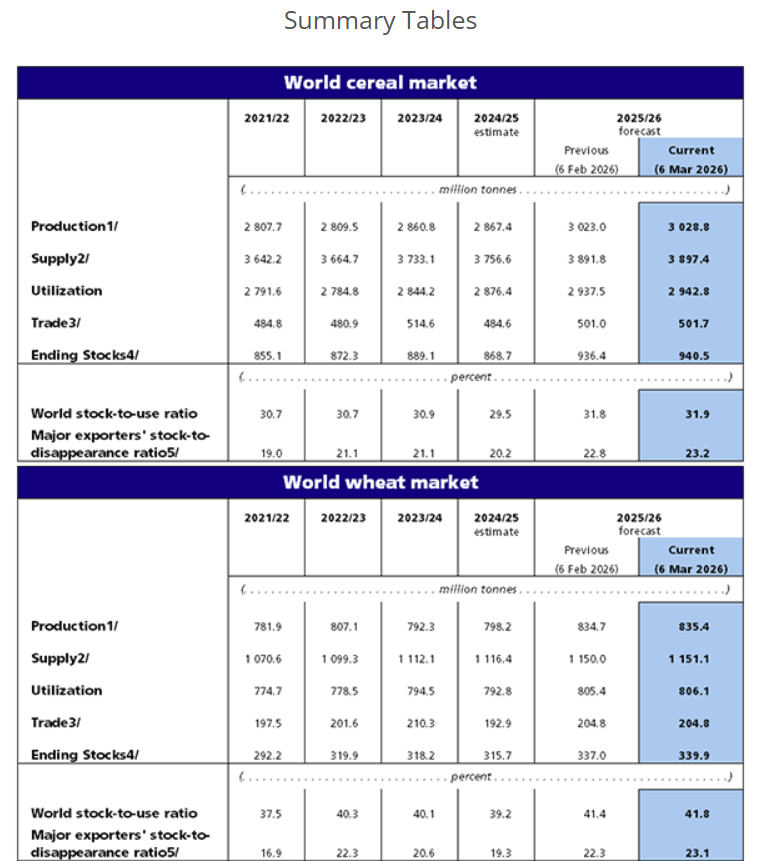
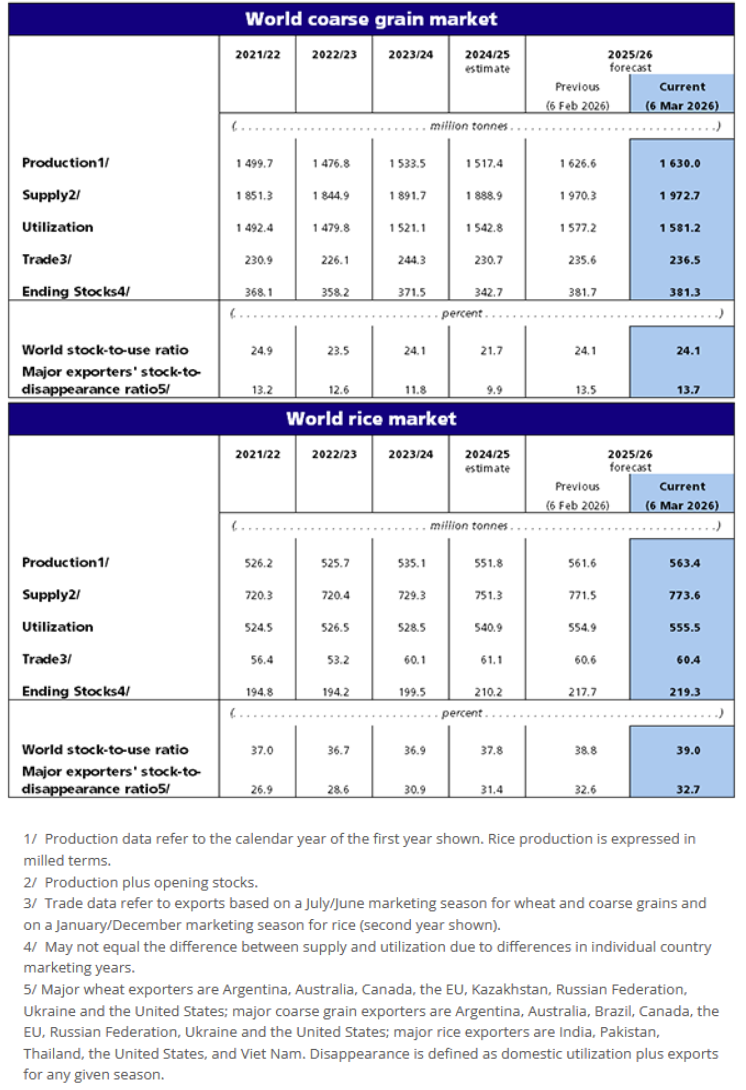
Global cereal production for 2025 has been raised marginally this month to 3 029 million tonnes, reflecting minor adjustments, mainly to maize and rice estimates. At this level, the world cereal outturn is 5.6 percent higher year on year, reinforcing the record level. The recent upward revisions were largely driven by updated maize yield estimates for Paraguay, putting the harvest at a record level. As for rice, FAO has raised its production estimate for Indonesia since February, as final government assessments indicate that a pronounced area expansion raised Indonesian production to a decade high. Output figures were also upgraded for Thailand, following revisions to 2024/25 estimates, but also because sowing pace in the country suggests a less pronounced area reduction of the 2025/26 offseason crop than previously envisaged. Combined with smaller adjustments for various other countries, these amendments raised FAO’s forecast of world rice production in 2025/26 by 1.7 million tonnes to 563.4 million tonnes (milled basis), up 2.1 percent year-on-year and a record high. Bangladesh, Brazil, China, India, and Indonesia remain forecast to spearhead the season’s annual production growth, outweighing contractions namely in Madagascar, Pakistan, Thailand, and the United States of America.
World cereal utilization in 2025/26 is forecast to reach a record of 2 943 million tonnes, up 5.2 million tonnes (0.2 percent) from the February projection. Utilization of wheat is nudged up slightly while coarse grains account for most of the upward revision. Feed use of maize and barley is higher than previously expected, particularly in South America where supplies are plentiful. In the European Union, the latest official forecasts indicate a downward adjustment to feed use of maize, offset by upward revisions to feed use of wheat, barley and sorghum. Against a backdrop of large global supplies from successive bumper harvests, world rice utilization is forecast to expand at an upbeat pace of 2.7 percent in 2025/26 to reach a fresh peak of 555.5 million tonnes.
FAO’s forecast for world cereal stocks by the close of the seasons in 2026 has been raised this month by 4.1 million tonnes to 940.5 million tonnes, keeping the global cereals stocks-to-use ratio at a comfortable level of 31.9 percent. At 339.9 million tonnes, global wheat inventories increased by 3.0 million tonnes (0.9 percent) this month, reflecting upward revisions for the European Union and Ukraine. Compared to their opening levels, global wheat stocks are forecast to rise by 24.2 million tonnes (7.7 percent), on anticipated large buildups in major producers including Argentina, China, the European Union, India and Ukraine. Global stocks of coarse grains are also projected to grow in 2026 by as much as 38.5 million tonnes (11.2 percent). However, this month’s forecast for barley stocks has been revised downwards, especially for the European Union, where supplies are expected to be directed towards feed use and exports. FAO has raised its forecast of world rice stocks at the close of 2025/26 marketing seasons by 1.6 million tonnes to a high of 219.3 million tonnes. The revision largely reflects upward adjustments to expected reserves in Bangladesh, Indonesia, and Thailand due to higher supply prospects, although for Bangladesh and Indonesia, it also mirrors upgrades to government reserves owing to a strong pace of public domestic procurement. These amendments outweighed downgrades to reserves namely in Japan and Nigeria.
FAO’s latest forecast for world trade in cereals in 2025/26 (July/June) stands at 501.7 million tonnes, representing a rebound of 17.1 million tonnes (3.5 percent) from 2024/25 and the second highest level on record. The forecast for wheat trade remains unchanged this month, still pointing to an increase of 11.9 million tonnes from the previous season to 204.8 million tonnes with a return to average levels of imports expected in Türkiye after an import ban constrained purchases in the previous season. Trade in coarse grains remains broadly stable this month, up by less than 1.0 million tonnes from the previous forecast on small adjustments to trade in maize and barley. FAO’s forecast of international rice trade in 2026 (January-December) has changed little since February, continuing to point to 1.1 percent trade decline from the 2025 all-time high to 60.4 million tonnes.
Wheat production to decline in 2026 as softer prices curb sowings
Reflecting moderate area cutbacks in response to softer crop prices and an expected return to average yields after the previous year’s highs, global wheat production is anticipated to decline by nearly 3 percent to 810 million tonnes in 2026, though remaining above the five-year average.
In the European Union, weaker wheat prices contributed to an estimated scale-back in winter wheat sowings. Although eastern and northern parts suffered from cold spells, elsewhere mostly mild and generally favourable weather, which is forecast to continue for the coming months, is likely to keep yields above average. Total wheat production is nonetheless forecast to decline modestly in 2026, remaining close to the five-year average. In the United Kingdom of Great Britain and Northern Ireland, a shift away from barley and conditions that have been broadly supportive of planting underpin expectations of a modest expansion in the wheat area. Together with a foreseen recovery in yields after dry weather curbed levels in 2025, this is anticipated to lift production towards a near-average level. In the Russian Federation, the total wheat acreage, largely comprising the winter crop, is expected to continue trending downward, as relatively stronger returns for oilseeds shift farmers’ incentives away from wheat. Persistent dryness across key regions during the planting period compounded the decline. As a result, wheat production is expected to decrease moderately from the previous year. In Ukraine, wheat production is expected to remain broadly steady year on year, supported by a relatively stable planted area and yield prospects that do not currently indicate major deviations from last year’s levels. Nevertheless, the wheat output is forecast to remain well below pre-conflict levels. In the United States of America, wheat production is forecast to remain above the five-year average but to decline year on year, reflecting reduced plantings amid softer prices during the sowing period, as well as an expected modest drop in yields from the previous year’s elevated levels. In Canada, wheat plantings are expected to edge up, driven by larger soft wheat plantings. However, assuming a return to near-average yields, wheat production is forecast to decline from the previous year’s strong outturn. In India, 2026 wheat production prospects are generally favourable, supported by record sowings encouraged by government incentives. Although crop development has been partially impaired by dryness and elevated temperatures in parts of the northern states, the overall outlook still points to an output on par with last year’s all-time high. Production prospects for Pakistan’s 2026 wheat crop are also beneficial, with above‑average vegetation conditions in major producing areas owing to ample irrigation supplies. In China (mainland), mid-February field assessments indicate broadly favourable wheat crop conditions, and production is expected to remain stable year-on-year. In Near East Asia, early-season dry conditions followed by beneficial rains have resulted in a mixed yield outlook for wheat crops in the Islamic Republic of Iran, where the planted area is also expected to contract owing to increased production costs. In Türkiye, by contrast, an expansion in planted area and a projected recovery in yields from weather-reduced levels in the previous year are expected to support a modest increase in 2026 production.
South of the equator, maize production in Brazil is expected to remain above average in 2026, supported by favourable weather conditions and an expansion in the planted area driven by strong export prospects, despite downward price pressure stemming from abundant 2025 supplies. In Argentina, above-average maize plantings combined with forecasts for normal rainfall amounts for the latter part of the season are expected to result in an above-average output in 2026. South Africa is expected to harvest a second consecutive bumper maize crop in 2026, underpinned by large plantings. However, the output is forecast to be marginally below the previous year’s level, reflecting likely lower yields due to irregular weather in some provinces.


-
Ample cereal production sustains stock recovery
Release date: 06/02/2026

FAO’s latest forecast for global cereal production in 2025 has been raised this month by 0.7 percent (19.9 million tonnes) to 3 023 million tonnes, reinforcing the already anticipated record level. The upward revision mainly reflects higher-than-foreseen wheat yields in Argentina, Canada and the European Union, which have lifted the world wheat outturn to a new all-time high. Similarly, the global coarse grain estimate has been marginally revised upward, placing production at a new peak. The adjustment reflects updated data from China and the United States of America indicating higher maize acreage and better-than-expected yields, while upward revisions to barley outputs in Australia and Canada further strengthen this month’s record outlook. For rice, FAO has increased its global production forecast for 2025/26 by 2.9 million tonnes since December. India accounts for much of this revision, consistent with higher official assessments of the 2024/25 harvest in the country, and with the strong pace of Rabi crop plantings registered during the ongoing season. Coupled with smaller upward adjustments to production in Nepal, Nigeria, and various other countries, this revision more than compensates for downgrades for the Philippines, due to yield depressions caused by storm strikes, and for the Bolivarian Republic of Venezuela, following historical output revisions for the country. As a result, world rice production in 2025/26 is now forecast at 561.6 million tonnes (milled basis), up 2.0 percent year-on-year and an all-time high. Bangladesh, Brazil, China, India, and Indonesia remain forecast to drive this growth, outweighing contractions namely in Madagascar, Pakistan, Thailand, and the United States of America.
Turning to the 2026 crops, the main planting period for winter wheat in northern hemisphere countries concluded in January. In the European Union, early indications point to a likely small increase in 2026 sowings compared to the previous year. Against this backdrop, favourable weather conditions and near-average rainfall forecasts for February-April suggest that yields could remain above the five-year average, albeit below last year’s exceptional levels. In the United Kingdom of Great Britain and Northern Ireland, planting intentions indicated that the wheat area is likely to edge up, supported by favourable sowing conditions and more attractive prices relative to other winter crops, such as barley and oats. In the Russian Federation, the wheat planted area is estimated to be marginally lower year-on-year, while limited soil moisture and unusual temperature volatility are weighing on yield prospects. In India, where plantings are forecast to reach a record level due to high domestic prices, the overall outlook for the 2026 wheat crop remains positive, bolstered by continued favourable weather conditions across key northern producing regions. By contrast, low prices have contributed to a slight reduction in winter wheat plantings in the United States of America, where crop conditions have deteriorated over the last two months as drier than normal conditions affected parts of key producing areas.
In the main coarse grain-producing countries of the southern hemisphere, the 2026 harvest is expected to begin in the second quarter of the year. In Argentina, despite forecasts of dry conditions in pockets of the central producing regions in February, maize production is projected to increase year-on-year, driven by a sharp rebound in the planted area from last year’s low and generally favorable crop conditions. In Brazil, robust domestic and international demand could encourage a slight expansion in total plantings, potentially reaching a new high. However, lingering concerns remain over the delays in soybean sowing, which could in turn postpone the planting of the main safrinha maize crop. In South Africa, amid broadly favourable weather conditions and firm demand, the maize area for 2026 is estimated to have increased by 3 percent year on year. Average to above-average rainfall expected in the next months is supporting overall favourable yield prospects.
World cereal utilization in 2025/26 is forecast to rise by 61.8 million tonnes (2.2 percent) from the 2024/25 level, reaching 2 938 million tonnes. The revision is driven primarily by a 3.0 percent increase in the use of maize while utilization of wheat, sorghum and barley is also expected to rise. Global cereal utilization is revised upwards marginally since the December report. Among coarse grains, maize use has been raised, most notably for Egypt due to rapid expansion in the poultry sector and growth in cattle and aquaculture operations, and for the United States of America, where demand for maize in ethanol production has strengthened. These increases are partly offset by downward revisions to the use of barley and sorghum. The forecast for global wheat utilization in 2025/26 has been raised marginally (0.8 million tonnes) since December but is still projected to rise 1.5 percent year-on-year, reflecting anticipated growth in both food and feed use of wheat. As for rice, largely reflecting upgrades to non-food use expectations for India, Pakistan and Viet Nam, FAO now anticipates world rice utilization to reach a record high of 554.9 million tonnes in 2025/26, up 2.7 percent year-over-year and 2.1 million tonnes more than predicted in December.
FAO’s latest forecast for world cereal stocks by the close of seasons in 2026 has been revised upwards by 10.9 million tonnes, now indicating an increase of 67.6 million tonnes (7.8 percent) from opening levels. Stocks of all major cereals are expected to grow – particularly in the major producing and exporting countries – where record harvests are contributing to ample inventories despite robust export activity. The largest volume increase is projected for maize, up 28.7 million tonnes (10.0 percent) over the previous season’s level with Brazil and the United States of America accounting for most of the expansion. Barley stocks are expected to rise by 4.6 million tonnes (16.8 percent), driven mainly by substantial accumulation in the European Union. Global reserves of wheat are projected to grow by 21.7 million tonnes (6.9 percent) by the end of seasons in 2026 with notable build-ups in major exporters Argentina, Canada and the European Union while accumulations are also expected in China and India. Alongside these increases, the global cereal stocks-to-use ratio in 2025/26 is anticipated to rise to 31.8 percent, its highest level since 2001. World rice stocks at the close of 2025/26 marketing years are now anticipated to rise 3.8 percent above their opening level to a fresh peak of 217.7 million tonnes. At that level, stockpiles would stand 900 000 tonnes above December expectations, mainly mirroring an upgrade to reserve expectations for India.
Rising only slightly since the previous forecast to 501.0 million tonnes, world trade in cereals in 2025/26 (Jul-Jun) is headed for an expansion of 17.6 million tonnes (3.6 percent) from the 2024/25 level. Global trade in coarse grains in 2025/26 (July/June) stands at 235.6 million tonnes, up 6.0 million tonnes (2.6 percent) from the 2024/25 level with China, Egypt and the Islamic Republic of Iran expected to increase their maize purchases in 2025/26. World trade in wheat in 2025/26 (Jul-Jun) is forecast at 204.8 million tonnes, up 12.0 million tonnes from the previous season but still 6.5 million tonnes below the record level in 2023/24. Major exporters such as Argentina, Australia, the European Union and the Russian Federation are expected to re-gain market share while sales by Canada are expected to decline from the previous season. Although demand from China remains subdued, forecasts for the Islamic Republic of Iran, Uzbekistan and several other importing countries have been revised upward to meet domestic needs after below-average harvests. International trade in rice in 2026 (January-December) is forecast at 60.6 million tonnes, down 0.6 percent from a revised estimate for 2025. The slight annual trade reduction is expected to be driven by continued cuts in imports by Asian countries, while demand is seen firmer in other regions, especially in Africa.
-
Global cereal production to exceed 3-billion mark, stocks-to-use ratio highest in decades
Release date: 05/12/2025

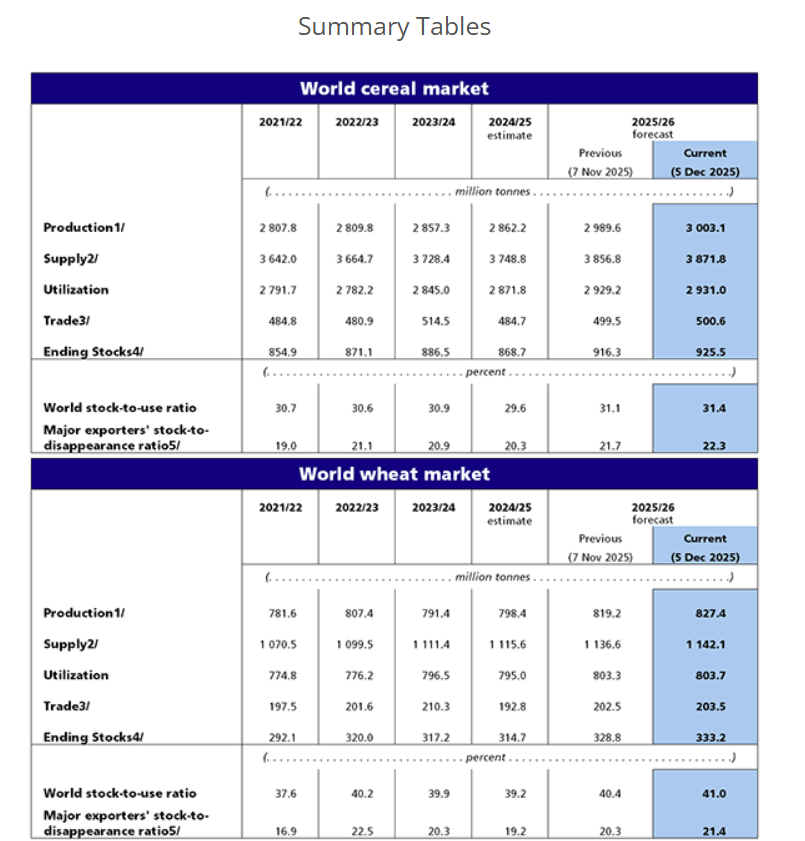
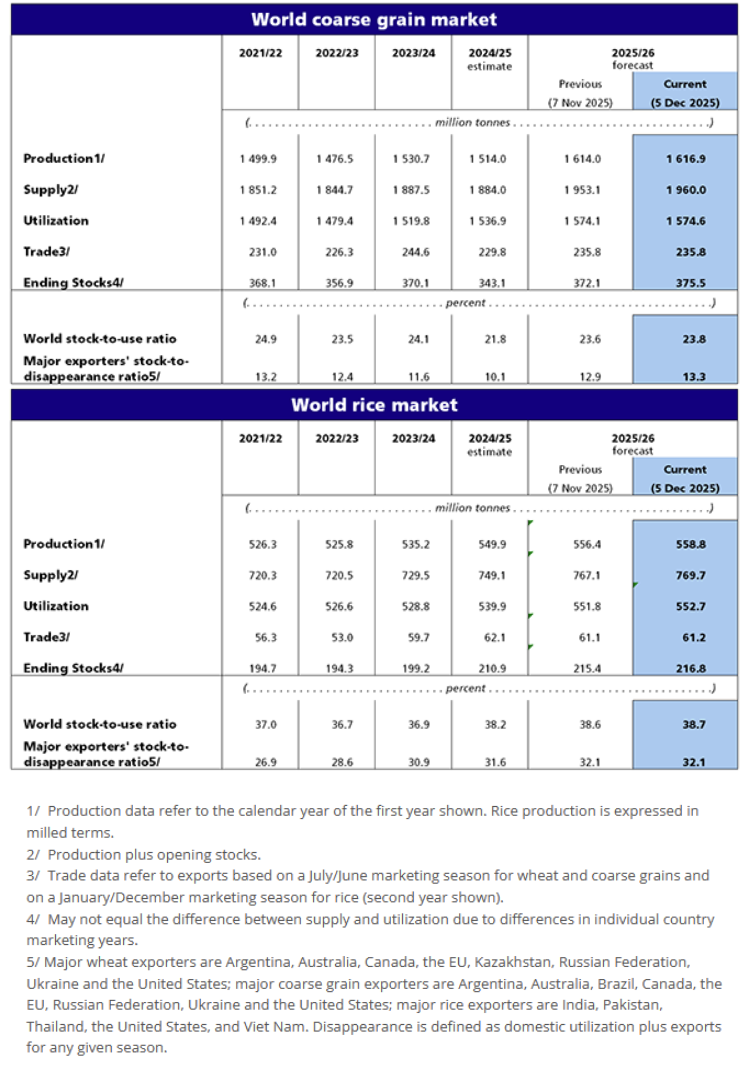
FAO’s latest forecast for world cereal production in 2025 has been revised upward this month to 3 003 million tonnes, marking the first time the global output is estimated to surpass the 3-billion-tonne level. Upward revisions to wheat production estimates are primarily behind the improved outlook, driven especially by Argentina, where larger-than-expected plantings and likely record yields, supported by favourable weather, are expected to result in an all-time-high harvest. Revisions to wheat production in the European Union and the United States of America also contributed to this month’s more buoyant outlook. Likewise, global coarse grain production has been raised, although to a lesser extent, mostly reflecting higher barley output. As for rice, FAO has upgraded its production forecast for Indonesia since November, as official assessments in the country indicate that continued area expansions are likely to translate into a higher-than-previously-expected offseason harvest. Coupled with improved crop prospects for Bangladesh and Japan, this revision raises the global production forecast for 2025/26 by 2.4 million tonnes to 558.8 million tonnes (milled basis). At that level, world rice output would be 1.6 percent above the 2024/25 result and at an all-time high. Bangladesh, Brazil, China, India, and Indonesia are forecast to spearhead this growth, more than compensating for contractions in Madagascar, Nepal, Pakistan, Thailand, and the United States of America.
Regarding 2026 crops, planting of the winter wheat crop is underway across the northern hemisphere. In the United States of America, winter wheat plantings are progressing at an average pace and were nearing completion by the end of November, with 45 percent of winter crop rated as good to excellent, 10 percentage points lower than last year amid continued dryness in parts. The winter wheat crop is being sown in the European Union amid generally favourable weather conditions, although localized rainfall deficits in Italy raised some early concerns for soft wheat establishment. Mostly beneficial weather conditions also prevailed in winter-wheat growing areas of the Russian Federation, with plantings completed by November. In Ukraine, improvements in soil moisture conditions partly allayed earlier concerns over drier conditions at the start of the planting period, and reports from the country point to a potentially larger wheat area in 2026, albeit remaining below the levels registered before the onset of the war in 2022. In Far East Asia, remunerative prices and government support policies are underpinning expectations of large wheat plantings in India, which could surpass last year’s record level, and an above-average area in Pakistan.
In southern hemisphere countries, the 2026 coarse grain crops are being planted. In South America, the preliminary production outlook for Argentina points to a rebound, based on an anticipated upturn in maize plantings, amid generally well-distributed early seasonal rains that have favoured crop establishment. In Brazil, strong domestic and export demand are expected to encourage an expansion in maize plantings in 2026, keeping production expectations above the five-year average level. In South Africa, maize plantings are estimated to increase marginally, mainly underpinned by larger planting intentions for yellow-maize varieties, supported by prospects of a favourable rainfall season.
World cereal utilization in 2025/26 continues to point to an increase of 59.2 million tonnes (2.1 percent) from 2024/25 with increases in the use of all major cereals, led by maize and rice. With prices stable and supplies ample, major producers of coarse grains are expected to use more maize (and, to a lesser extent, barley and sorghum) for animal feed while feed-quality wheat may represent an economically attractive alternative to other non-cereal feed ingredients. The forecast for global cereal utilization is up just slightly from the previous month with total utilization of coarse grains in 2025/26 lowered marginally, an upward revision to barley utilization for feed in Argentina being outweighed by slight downward adjustments to maize utilization for feed in Brazil and the European Union. Abundant supplies are forecast to facilitate a 2.4 percent annual expansion in global rice utilization in 2025/26 to a fresh peak of 552.8 million tonnes.
The forecast for world cereal stocks by the close of seasons in 2026, already projected at a record level, is revised further upward this month and now stands at 925.5 million tonnes, an increase of 56.8 million tonnes, or 6.5 percent, from their opening levels. The most marked growth in wheat stocks is expected in China and India with reserves of the major exporting countries expected to rise more modestly. In the case of coarse grains, the forecast increase is concentrated in the major exporting countries, especially Brazil and the United States of America while in the European Union stocks are expected to recover to levels seen more recently. This month, wheat stocks are raised for Argentina and the United States of America after improved production prospects reported by both countries. Similarly, maize stocks are raised for Brazil after an upgrade to the segunda safra crop. Accordingly, the ratio of major cereal exporters’ stocks to disappearance is expected to rise to 22.3 percent by the end of seasons in 2026, the highest level since the early 1990s. Largely reflecting an upward revision to stock expectations for Indonesia, FAO’s forecast of rice stocks at the close of 2025/26 marketing seasons has been raised by 1.5 million tonnes since November to 216.8 million tonnes. At that level, world stockpiles would exceed their record opening level by 2.8 percent and would be sufficient to cover 4.6 months of projected world utilization.
World trade in cereals in 2025/26 is forecast at 500.6 million tonnes, up 15.9 million tonnes or 3.3 percent from last season. Trade in wheat is expected to rebound from its subdued level in 2024/25 with the resumption of imports by Pakistan and Türkiye along with other importing countries in Asia continuing to reflect current market conditions that are characterized by stable prices and comfortable exportable supplies. Trade in coarse grains is also expected to grow in 2025/26 with Brazil making inroads into the sorghum market as an exporter. Adjustments to the forecast this month are mostly minor, although exports of wheat from Argentina are revised upwards with the record harvest expected to prove attractive to neighbouring countries such as Ecuador. International trade in rice is forecast at 61.2 million tonnes in 2026 (January-December), little changed since November, but down 1.4 percent from current 2025 trade expectations, largely due to lower anticipated imports by Asian countries.


-
Favourable short-term prospects for cereal markets
Release date: 07/11/2025

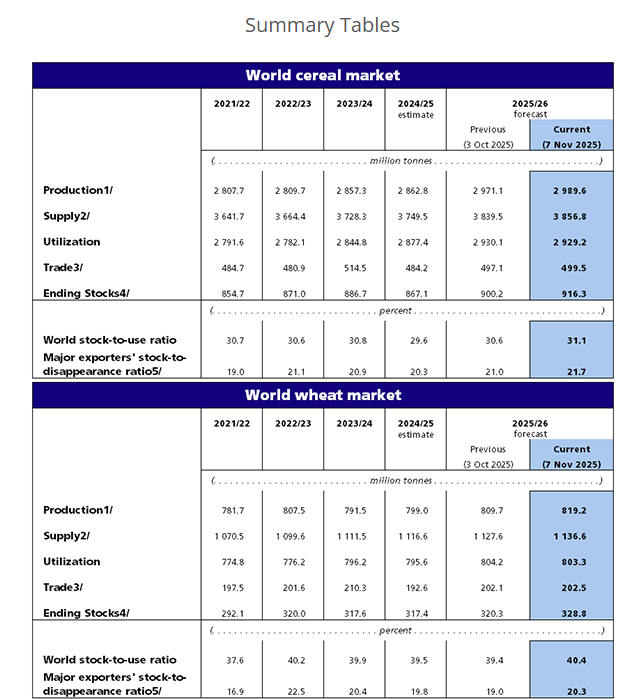
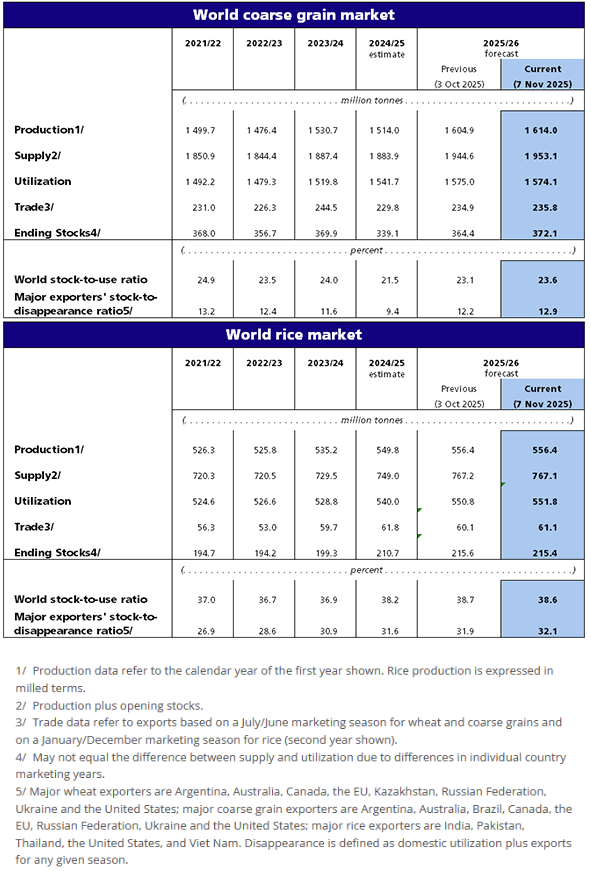
Forecast at 2 990 million tonnes, world cereal production (including rice in milled equivalent) is expected to reach a record level in 2025, up 4.4 percent from 2024. Outputs of all major cereals are anticipated to rise, with the largest year-on-year increase forecast for maize and the smallest for rice. Both maize and rice outputs are predicted to hit new record highs.
World cereal utilization in 2025/26 is forecast at 2 929 million tonnes, up 51.9 million tonnes or 1.8 percent from 2024/25. The growth is expected to result mainly from ample supplies and lower prices. Feed use of cereals is expected to rise by 2.1 percent, with major producers such as Brazil and the United States of America directing more maize to animal rations, while in Asia, strong demand from aquaculture is expected to be met though imports of feed-quality wheat. Other uses of cereals, particularly maize, are also set to increase. Human consumption of cereals is forecast to rise marginally, reflecting population growth and gradual dietary shifts.
Based on the current forecasts for global cereal production in 2025, stocks could rise by 5.7 percent from their opening levels to a record high of 916.3 million tonnes. Global maize inventories are expected to expand the most, especially in Northern America, followed by wheat and barley, while global sorghum stocks may decrease slightly. World rice stocks at the close of the 2025/26 marketing years are forecast to rise by 2.2 percent to a new peak of 215.4 million tonnes. Overall, the global cereal stocks-to-use ratio in 2025/26 is predicted to rise to 31.1 percent, the highest level since 2017/18. .
World trade in cereals in the 2025/26 season is anticipated to expand by 3.2 percent to 499.5 million tonnes. Wheat trade (July/June) is expected to rise by 9.9 million tonnes, or 5.1 percent from the previous season, driven largely by Asian imports, which are forecast to increase by 15.6 million tonnes. Global trade in coarse grains is anticipated to expand amid relatively low export prices and stronger demand for animal protein, though traded volumes will likely remain below the 2023/24 peak. By contrast, global rice trade is forecast to decline by 1.2 percent to 61.1 million tonnes in 2026.


-
Cereal markets remain well supplied, with a positive outlook for the short term
Release date: 03/10/2025

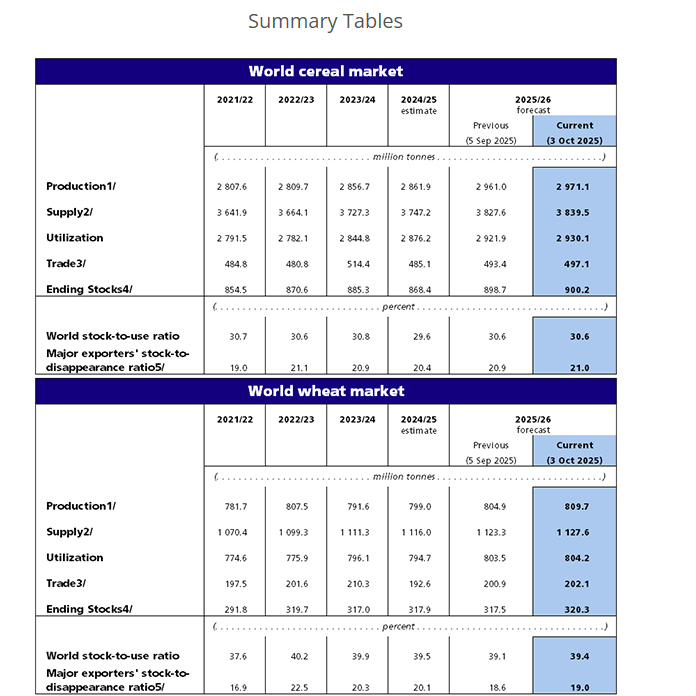
FAO’s latest forecast for global cereal production in 2025 has been raised by 10.1 million tonnes (0.3 percent) this month, putting the total at 2 971 million tonnes. The increase reflects upward revisions to production forecasts across all crops, led by wheat, maize and rice (in order of magnitude). At this level, world cereal production is 3.8 percent higher year on year, marking the largest annual growth since 2013.
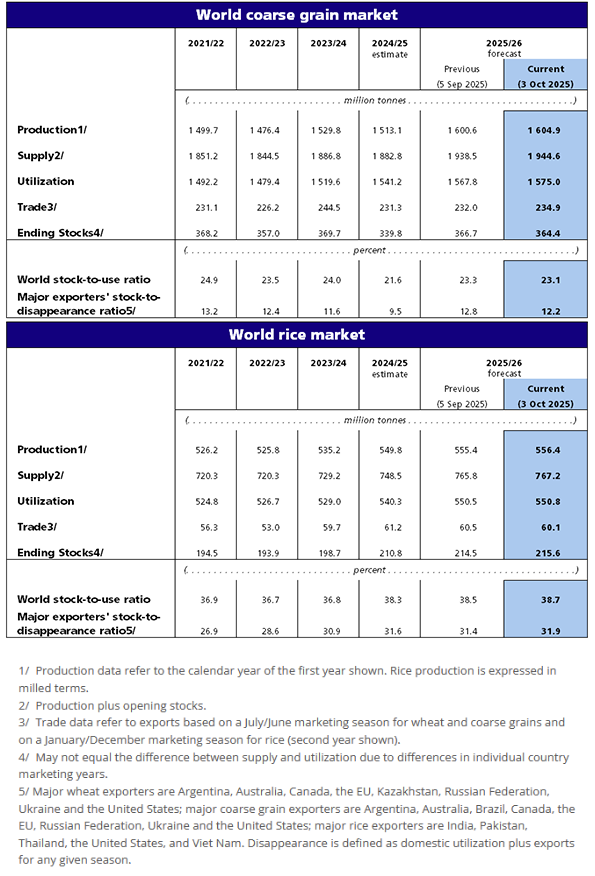
World wheat production is forecast at 809.7 million tonnes in 2025, up 0.6 percent compared to the previous month and now 1.3 percent above the 2024 output. Most of this month’s increase is linked to Australia, where favourable July-August rains, following a dry start of the season in parts, boosted yield expectations and lifted the 2025 production forecast to a level now on par with the five-year average. Forecasts for the European Union and the Russian Federation are also raised on stronger yields. Global coarse grains production in 2025 is forecast at 1 605 million tonnes, up 0.3 percent from last month’s figure and now 91.7 million tonnes higher than the 2024 outturn. The latest upward revision is principally driven by a higher forecast in Brazil, linked to better-than-expected yields. Maize production has also been raised for China (mainland), on newly released official data, and for the United States of America, tied to a larger area that outweighed a concurrent small cut to yields. At 427.1 million tonnes, the United States of America’s maize output would reach an all-time high and account for one-third of the global output, the highest share of global maize production since 2016. These increases offset cuts to production forecasts in the European Union, where dry and hot weather curtailed yield expectations, and in Mexico, where recent official figures point to a smaller-than-expected area. The forecasts for global barley and sorghum production in 2025 have also been raised marginally this month, largely reflecting improved prospects in Australia. As for rice, FAO has provisionally lowered its production forecast for Pakistan by 0.6 million tonnes (milled basis), owing to severe floods in Punjab, the country’s leading rice producing province. However, this downgrade is outweighed by 1.6 million tonne increase in production expectations for India, where a strong pace of Kharif crop plantings is reported, despite some challenges posed by deficient rains in some eastern and northeastern states and by floods in northwestern areas. As a result of these changes and various other smaller amendments, world rice production is now forecast to reach a record high of 556.4 million tonnes (milled basis) in 2025/26, up 1.0 million tonnes from September expectations and implying a 1.2 percent annual expansion.
FAO’s forecast for world cereal utilization in the 2025/26 season is now expected to reach a record level of 2 930 million tonnes following an upward revision of 8.1 million tonnes since September. At 1 575 million tonnes, the forecast for total utilization of coarse grains in 2025/26 is up 7.2 million tonnes since the previous report and 33.8 million tonnes (2.2 percent) higher than the 2024/25 level. This month’s upward revision mostly reflects higher use of maize and barley in feed rations and for industrial purposes. Plentiful supplies of maize are forecast be directed to animal feed in the leading producers Brazil and the United States of America, and in importing countries such as Egypt and Mexico. Wheat use in 2025/26 is also seen at a record level of 804.2 million tonnes with both feed use and human consumption expected to rise, the latter in line with population growth with per-capita food consumption broadly unchanged year on year. World rice utilization is forecast at a historical peak of 550.8 million tonnes in 2025/26, little changed from September expectations and up 2.0 percent from 2024/25.
The forecast for world cereal stocks by the close of seasons in 2026 has been revised upwards by 1.6 million tonnes since the previous month to 900.2 million tonnes, with upward revisions made to wheat and rice, while forecasts for coarse grains are scaled back slightly. Stocks of wheat are expected to grow by 2.4 million tonnes from their opening levels with some build-up in major producers such as Canada and the Russian Federation after large harvests. Stocks of maize are expected to rebound largely due to accumulations in major producers Brazil and the United States of America while stocks in the European Union could decline as production forecasts are scaled back, while feed use is expected to grow. Among other coarse grains, stocks of barley, sorghum and rye are expected to remain stable. The global cereal stocks-to-use ratio in 2025/26 is expected to remain nearly unchanged from last season at 30.6 percent, continuing to indicate comfortable supply prospects in the new season. Following a 1.1 million tonne upgrade to 215.6 million tonnes, FAO’s forecast of world rice stocks at the close of 2025/26 marketing years continues to suggest that world rice reserves could strike a record high, sustained by accumulations in rice exporting and importing countries.
FAO’s latest forecast for world trade in cereals in 2025/26 has been raised by 3.7 million tonnes to 497.1 million tonnes this month, pointing to an increase of 2.5 percent (12.0 million tonnes) from the 2024/25 level. World trade in wheat (July/June) is forecast to grow by 4.9 percent (9.5 million tonnes) in 2025/26 to 202.1 million tonnes, up 1.2 million tonnes from last month’s forecast. Lower export prospects in the European Union reflecting slow pace observed in the first quarter are outweighed by upward revisions to exports from Australia, on abundant supplies following a bumper harvest, and the United States of America on competitive prices and continuing strong demand from Iraq and Türkiye. Trade in coarse grains is also lifted by 2.9 million tonnes on upward revisions to barley and sorghum while global maize trade, at 189.9 million tonnes, is now expected to be near to the level of the 2024/25 season as importing countries take advantage of abundant supplies and low prices. The start of the 2025/26 season has seen strong demand for coarse grains from the European Union, Mexico and Türkiye while purchases by China remain subdued. International rice trade is forecast at 60.1 million tonnes in 2026 (January-December), down from a revised forecast of 61.2 million tonnes for 2025. The 1.8 percent annual reduction is expected to be demand driven, as ample availabilities from good local harvests and large purchases in 2025, could drive a second annual cut in Asian imports, while also easing purchases by African countries somewhat.


-
Improved prospects for coarse grains put global cereal production in 2025 forecast at all-time high
Release date: 05/09/2025

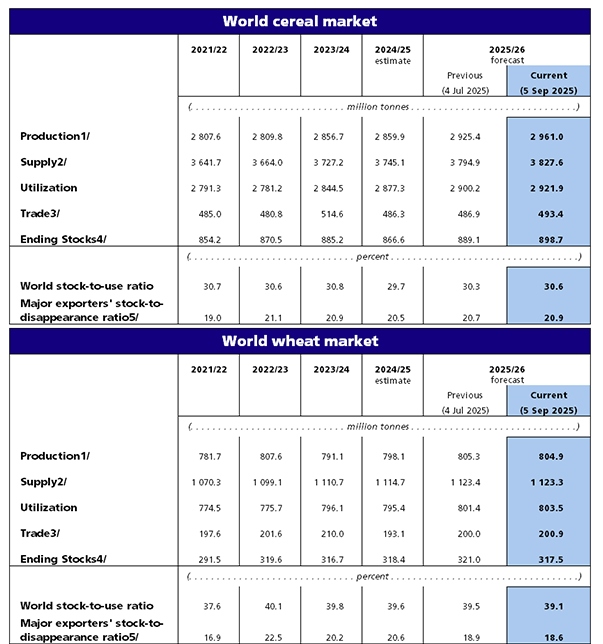
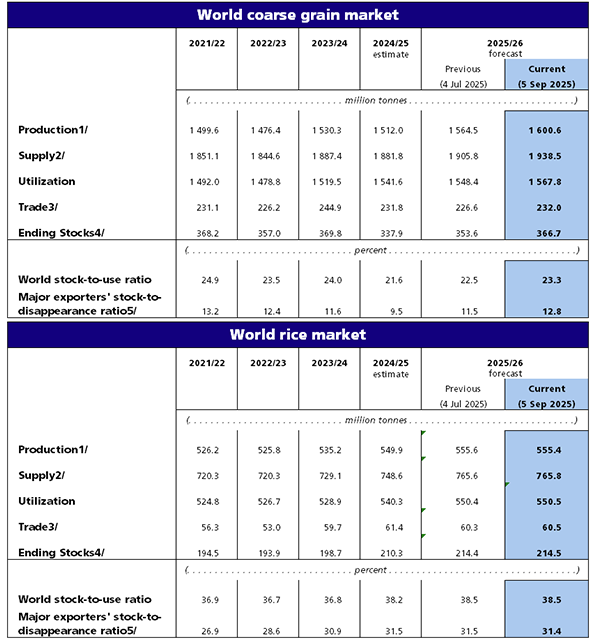
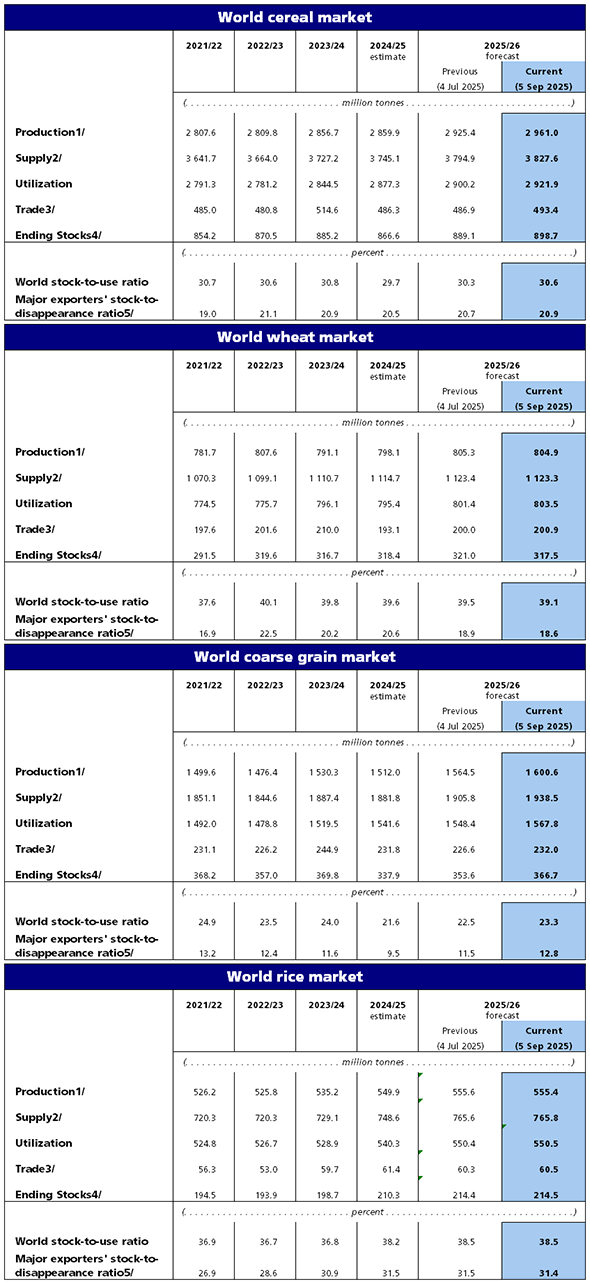
FAO’s latest forecast for world cereal production in 2025 has been revised up by 35.6 million tonnes (1.2 percent) compared to the projection from July, driven by improved prospects for coarse grain crops. This latest revision reinforces the expectation of a record-high global cereal output in 2025, which is now anticipated at 2 961 million tonnes, 3.5 percent above the previous year’s level.
The global production forecast for coarse grains in 2025 has been lifted to 1 601 million tonnes, a sharp increase of 36.1 million tonnes compared to July, and now at 88.6 million tonnes (5.9 percent) above 2024’s level. The marked upward revision is primarily due to a sizable increase in the maize output forecast in the United States of America, reflecting record-high yields and updated area estimates. Positive revisions to maize production outlooks are also made for Brazil and Mexico, driven by, respectively, higher yields and larger planted area to the main crop. Contrastingly, maize production forecasts have been trimmed in the European Union, as dry weather and higher-than-average temperatures are expected to reduce both harvested area and yields. Global sorghum production is also revised higher this month, by 2.2 million tonnes, to 66.6 million tonnes, 5.6 percent above the previous year’s level. The revision largely stems from better yield prospects in Brazil, which put the 2025 sorghum outturn at a record level. FAO’s forecast for the world wheat output stands at 804.9 million tonnes, marginally down from the previous projection in July, but 6.9 million tonnes higher year-on-year. The downward revision is mostly due to lower yield prospects in China (mainland) on account of adverse weather conditions and a smaller-than-expected acreage in Argentina. Partly offsetting these declines, upward adjustments have been made to the wheat production forecast in the European Union, driven by weather-improved prospects for yields. As for rice, FAO has downgraded its production forecast for Nepal, reflecting lower area and yield expectations owing to unconducive rains over parts of the country. Official forecasts have also been downscaled in the United States of America, where spring floods in southern producing areas compounded on prospects of reduced producer margins. However, these revisions are largely compensated by output upgrades for various other countries, most notably Indonesia, where favourable price prospects are now seen lifting plantings to seven-year highs. As a result, world rice production remains forecast to expand by 1.0 percent in 2025/26 to a record high of 555.5 million tonnes (milled basis). Production expansions in Bangladesh, Brazil, China, India, and Indonesia are anticipated to sustain the annual growth, more than compensating for contractions namely in Madagascar, Nepal, the United States of America, and Thailand.
The forecast for world cereal utilization in 2025/26 has been increased by 21.7 million tonnes since July, reaching 2 922 million tonnes, up 44.6 million tonnes (1.6 percent) from the 2024/25 level. Total utilization of coarse grains is forecast to rise by 1.7 percent to 1 568 million tonnes in the 2025/26 season due to increased use of maize and, to a lesser extent, sorghum. Amid plentiful supplies, use of maize for animal feed is seen rising in major producers Brazil and the United States of America while falling in Argentina. Feed use of barley in Saudi Arabia is revised upward, albeit to a level still below that of previous season. Feed use of wheat is also revised upwards this month, specifically in the European Union and in Thailand, where demand is increasing from the aquaculture sector. Global wheat utilization in 2025/26 is now forecast at a record level of 803.5 million tonnes, up 8.1 million tonnes from the 2024/25 level, with wheat expected to be increasingly incorporated into animal feed rations in China. FAO’s forecast of world rice utilization has changed little, pointing to 550.6 million tonnes being used in 2025/26, up 1.9 percent year-on-year and a record high.
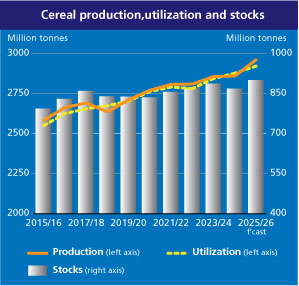
The forecast for world cereal stocks by the close of seasons in 2026 has been raised by 9.6 million tonnes since July, with global reserves now seen reaching 898.7 million tonnes, 3.7 percent above their opening levels and a record. This month’s upward revision is attributed to an upgrade to stocks of coarse grains, outweighing a downgrade to stocks of wheat. Among coarse grains, the bumper output in the United States of America is expected to result in significantly larger reserves of maize than previously anticipated with stocks in that country at the end of the 2025/26 season foreseen to reach a record level of over 50.0 million tonnes. Conversely, global wheat stocks are forecast lower than in July and are now expected to remain near to their opening levels after downward revisions to the Islamic Republic of Iran, where the production outlook is reduced and to the European Union, where a historical revision made to human consumption over previous seasons results in a lowering of 2025/26 ending stocks by 1.8 MMT. The global cereal stocks-to-use ratio in 2025/26 is expected to reach 30.6 percent, an increase of almost one percent on the previous season, confirming the comfortable supply outlook. World rice stocks at the close of 2025/26 marketing years remain forecast to expand by 2.0 percent to a record high of 214.5 million tonnes, sustained by buildups namely in Brazil, China, India, and Thailand, which could overshadow drawdowns namely in Indonesia, Madagascar, and the United States of America.
FAO’s forecast for world trade in cereals in 2025/26 is pegged at 493.4 million tonnes, up 6.5 million tonnes from the July forecast and pointing to a 1.4 percent increase from the 2024/25 level. This month’s upward revision is due mainly to an increase in trade of coarse grains, predominantly maize. Abundant exportable supplies of maize from bumper crops in Brazil and the United States of America are expected to attract importing countries and are behind a 5.1-million-tonne upward revision to maize trade, even though China is expected to continue its reduced purchases of maize in 2025/26. Barley trade is raised only slightly since July, despite lower prices and stronger demand expected from livestock farmers in Saudi Arabia. Trade in wheat in the new season is seen rising by 4.0 percent, or 7.8 million tonnes with continued strong demand from China, the Islamic Republic of Iran, Pakistan, Syrian Arab Republic and Türkiye. Among exporting countries, the major players will continue to supply markets with the European Union expected to regain market share after a reduced harvest in 2024. International trade in rice is anticipated to reach a fresh peak of 61.4 million tonnes in 2025 (January-December), up 2.9 percent year-on-year and 0.6 million tonnes more than previously reported. Bangladesh accounts for much of the import revision introduced this month, although imports were also raised namely for Ghana and Guinea-Bissau, more compensating for downward corrections for various other countries.


-
Global cereal production projected at all-time high, but uncertainties persist Release date: 04/07/2025
FAO’s latest forecast for global cereal production in 2025 has been lifted by almost 14 million tonnes (0.5 percent) in July compared to the previous month, and is now pegged at 2 925 million tonnes. The revised outlook is driven by improved prospects for wheat, maize and rice (in decreasing order of magnitude) and puts the forecast of the global output 2.3 percent above the previous year’s level, marking an all-time high. Global wheat production has been raised by 0.7 percent in July over the previous month’s level, now standing at 805.3 million tonnes in 2025, up 0.9 percent year on year. The monthly increase primarily reflects recent official data from India and Pakistan pointing to better-than-expected yields, with a record output forecast in the former country. Global coarse grain production is also revised marginally higher this month to 1 262 million tonnes, now standing 3.5 percent above the previous year’s level, and remaining the main driver behind global production growth this year. Most of the coarse grains quantity is comprised of maize and the improved prospects this month are driven by stronger maize yields in Brazil and an upgrade to the maize production outlook for India, where robust domestic demand for feed and industrial use is seen encouraging a larger area in 2025 compared to preliminary expectations. These positive revisions more than offset cuts to production forecasts in Ukraine where, in addition to the effects of the conflict, dry-weather conditions are weakening yield prospects, and in the European Union, owing to a minor revision to the area. Expectations of hotter and drier-than-average conditions in the coming months in parts of the northern hemisphere could impact yield potential, particularly for maize with plantings almost complete. As for rice, since June, FAO has raised its forecast of global rice production in 2025/26 by 4.1 million tonnes. The revision largely stems from upward adjustments to 2024/25 and 2025/26 production expectations for India, although crop prospects also improved for Bangladesh, Pakistan, and Viet Nam, in most cases owing to higher area expectations. By contrast, forecasts were downgraded for Iraq and the United States of America. Taking these adjustments into account, FAO now anticipates global rice production in 2025/26 to reach 555.6 million tonnes (milled basis), up 1.0 percent year-on-year and a record high.
The forecast for world cereal utilization in 2025/26 stands at 2 900 million tonnes, up 2.0 million tonnes since June and 0.8 percent higher than in 2024/25. Global coarse grain utilization in 2025/26 has been raised by 4.7 million tonnes, stemming from higher utilization of each major coarse grain (barley, maize and sorghum) than initially expected, bringing the forecast to 1 548 million tonnes, a marginal increase of 0.3 percent above the 2024/25 level. By contrast, world wheat utilization in 2025/26 has been lowered this month, by 4.0 million tonnes, underpinned by downward revisions to the forecast for China (mainland), Morocco, and the United States of America. Despite the downward adjustment, global wheat utilization is still projected to rise by 0.8 percent in 2025/26 from its 2024/25 level. FAO forecasts world rice utilization to reach 550.4 million tonnes in 2025/26, up 1.8 percent from the 2024/25 high, thanks to an expansion in food intake and, to a lesser extent, continued growth in use of rice for ethanol production in India.
FAO’s forecast for world cereal stocks by the close of seasons in 2026 has been raised by 15.5 million tonnes since the previous month to 889.1 million tonnes, pointing to a 2.2 percent rise compared to opening levels. Based on the latest forecasts, the global cereal stocks-to-use ratio would rise from 29.8 percent in 2024/25 to 30.3 percent in 2025/26, indicating sufficient supply prospects in the new season. The increase is linked to wheat, with the forecast for global stocks lifted by 11.0 million tonnes this month. Most of the upward revision is concentrated in Australia, China (mainland), Pakistan, the Russian Federation, and the United States of America. Following this upward revision, global wheat stocks are now expected to rise above their opening levels by 0.9 percent, reaching 321.0 million tonnes. Pegged at 353.6 million tonnes, global coarse grain stocks are lowered marginally (by 0.5 million tonnes) this month, stemming from a downward revision to barley stocks (mostly in Australia, China (mainland), and the Russian Federation), but are still set to increase by 3.6 percent above their opening levels in 2025/26. FAO has raised its forecast of world rice stocks at the close of the 2025/26 marketing seasons by 5.0 million tonnes to a fresh peak of 214.4 million tonnes. Much of this revision reflects prospects of higher reserves in India, consistent with the improved production outlook for the country and despite expectations of record-breaking Indian exports over the season. Carry-over forecasts are also raised for Bangladesh, Ecuador, and Pakistan.
International cereal
trade
in 2025/26 is expected to increase by 1.2 percent from the 2024/25 level, reaching 486.9 million tonnes, unchanged from the previous forecast. Standing at 226.6 million tonnes, global trade in coarse grains in 2025/26 (July/June) is forecast to decline by 0.6 percent from the 2024/25 level. Accounting for that decline, global maize trade is anticipated to decrease by 1.9 percent in 2025/26. The global maize trade forecast remains nearly unchanged this month at 182.8 million tonnes as a downgrade to exports from Ukraine is offset by an increase in Uganda’s exports, reflecting changes in production prospects in both countries. By contrast, international trade in barley and sorghum is projected to rise in 2025/26 (July/June) by 2.8 percent and 15.3 percent, respectively. The forecast for global wheat trade in 2025/26 (July/June) still indicates an increase of 4.0 percent from last season’s reduced level but has been trimmed by 0.6 million tonnes since the previous forecast to 200.0 million tonnes, reflecting a downward revision in the export forecast for the Russian Federation, which outweighs higher export prospects for Australia and Ukraine. On the import side, the decline is attributed to slightly lower imports anticipated for China (mainland), Morocco, and the United Arab Emirates. Following slight upward adjustments to export prospects for Cambodia and Viet Nam, FAO now anticipates international trade in rice to amount to 60.8 million tonnes in 2025 (January-December), up 2.0 percent from 2024 and an all-time high.
-
World cereal trade and stocks declined in 2024/25 with recovery expected in 2025/26 Release date: 06/06/2025
As the 2024/25 (July/June) marketing season concludes, global cereal production for 2024 is estimated at 2 853 million tonnes, representing a slight decrease of 0.1 percent compared to the 2023 output. This decline is attributed to a reduction in coarse grain production, particularly maize, which offset the increases in wheat and rice outturns. At 2 875 million tonnes, world cereal utilization in 2024/25 is estimated 1.2 percent above its 2023/24 level, reflecting growth in utilization of coarse grains (mostly maize and sorghum) and rice. As a result of the growth in utilization amidst stagnant production, cereal stocks at the end of seasons in 2025 are estimated 2.0 percent below their opening levels, at 865 million tonnes. The decline in cereal stocks stems entirely from a drawdown of barley and maize, which is partially offset by stock buildups of rice and, to a lesser extent, wheat. Pegged at 478 million tonnes, FAO’s estimate for global cereal trade in 2024/25 points to a 6.9 percent decrease below the 2023/24 level. The decline is driven by a sharp fall in global trade of wheat and all major coarse grains. By contrast, global trade of rice in 2024/25 is estimated above its 2023/24 level.
Looking forward to the 2025/26 season, world cereal production (including rice in milled equivalent) is expected to reach a record 2 911 million tonnes in 2025, surpassing the 2024 output by 2.1 percent. Production of all major cereals is anticipated to rise, with the largest year-on-year increase (in percentage terms) forecast for maize and the smallest for wheat. Maize, rice and sorghum outputs are all predicted to reach new record highs.
World cereal utilization is forecast to increase by 0.8 percent in 2025/26, reaching 2 898 million tonnes. Global food consumption of cereals is predicted to grow by 0.9 percent from 2024/25, while feed use is forecast to expand by 0.5 percent, with increases expected for all major cereals. Other uses of cereals are projected to rise by 1.0 percent, led by increased uses of wheat and rice.
With world cereal production expected to exceed utilization in 2025/26, world cereal stocks are predicted to expand by 1.0 percent (8.3 million tonnes) above their opening levels to 873.6 million tonnes. This would mark a partial recovery from the contraction recorded in 2024/25. The bulk of the anticipated increase is due to higher inventories expected for coarse grains, while a smaller rise is expected for rice. By contrast, wheat stocks are forecast to decline. Based on the current forecasts, the global cereal stock-to-use ratio should remain close to the 2024/25 level, at 29.8 percent.
After contracting by nearly 7.0 percent in 2024/25, global cereal trade is predicted to partially recover in 2025/26, rising by 1.9 percent to 487.1 million tonnes. The rebound is expected to be led by a 3.8 percent growth in global wheat trade, supported by a modest 0.9 percent increase in coarse grain trade. By contrast, international trade in rice is predicted to contract by 0.7 percent.
For a more detailed analysis of global cereal markets, see the forthcoming issue of Food Outlook, which will be released on 12 June 2025.
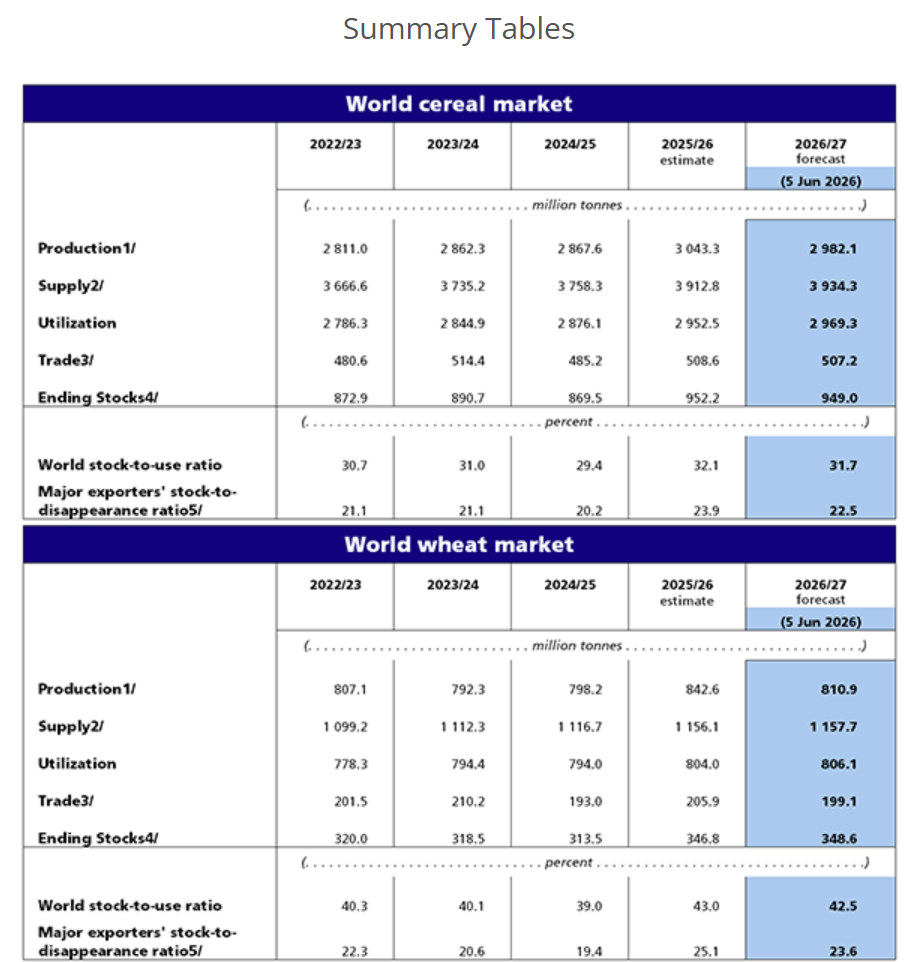
Summary Tables
-
Supply tightens slightly as 2024/25 marketing season wraps up; production outlook for 2025 wheat crop remains favorable
Release date: 02/05/2025
FAO has slightly lowered its estimate for global cereal production in 2024 by 1.1 million tonnes compared to the April figure. The global cereal output is now pegged at 2 848 million tonnes, remaining marginally lower year on year, largely due to a reduced world maize outturn. FAO’s forecasts of rice production in 2024/25 have changed only marginally since April. As a result, and largely due to a robust expansion in area planted, global rice output is forecast to expand by 1.5 percent year-on-year in 2024/25 to reach an all-time high of 543.6 million tonnes (milled basis).
The world cereal utilization for 2024/25 is forecast at 2 870 million tonnes, an increase of 1.9 million tonnes from last month and 28.2 million tonnes (1.0 percent) above the 2023/24 level. Global wheat utilization for 2024/25 is raised by 1.8 million tonnes, primarily reflecting higher expected use in Argentina and the European Union, bringing the forecast to 797 million tonnes, up fractionally (0.1 percent) from previous season. FAO’s projection for global coarse grain utilization in 2024/25 remains nearly unchanged at 1 534 million tonnes, indicating to a 1.1 percent growth from the 2023/24 level. The anticipated increase is mostly driven by higher feed use of maize, especially in China and the Russian Federation. Largely reflecting more buoyant use expectations for various countries located in Africa, FAO’s forecast of world rice utilization has been raised by 0.4 million tonnes since April to 539.4 million tonnes. At that level, world rice uses would stand at a fresh peak and exceed the previous season’s estimate by 2.0 percent.
The forecast for world cereal stocks by the close of season in 2025 is lowered further this month, by 5.1 million tonnes, bringing the forecast to 868.2 million tonnes, indicating a decline of 16.6 million tonnes (1.9 percent) below opening levels. The latest forecasts indicate that the world cereal stocks-to-use ratio in 2024/25 would stand at 29.9 percent, down from 30.8 percent in 2023/24, but still at a relatively comfortable level. Global wheat stocks are revised down by 1.9 million tonnes this month, mostly reflecting lower stock estimates in the European Union and Türkiye. Despite the downward revision, global wheat stocks are still forecast to increase marginally above opening levels, by 0.6 percent, to 318 million tonnes in 2024/25. Global coarse grain stocks are also lowered this month, by 3.1 million tonnes, on account of lower maize stocks, especially in the United States of America due to largest exports. The downward revision this month further lowers the forecast of global coarse grain stocks at the end of seasons in 2024/25 to 344.5 million tonnes, representing a 6.7 percent fall from opening levels with most of the decline attributed to a drawdown of global maize stocks. FAO’s forecast of world rice stocks at the close of 2024/25 marketing seasons has changed little since April, continuing to point to global reserves rising 3.1 percent above their already ample opening level to reach an all-time high of 205.7 million tonnes. At a country level, China, India, Indonesia, and the Philippines are seen spearheading the forecast stock expansion, which alongside build-ups in other countries could overshadow expected drawdowns in reserves namely in Japan, the Republic of Korea and Myanmar.
Nearly unchanged this month, world trade in cereals in 2024/25 is still forecast at 478.6 million tonnes and is expected to decline by 6.8 percent from the 2023/24 level. Global wheat trade in 2024/25 (July/June) is lowered marginally this month, by almost 1.0 million tonnes, mostly reflecting another downgrade in the Russian Federation’s export volumes and smaller purchases by Türkiye. With this further downward revision, global wheat trade in 2024/25 (July/June) is forecast to contract by 7.4 percent from the 2023/24 level to 194.0 million tonnes. The forecast for global trade in coarse grains in 2024/25 (July/June) still stands at 224.2 million tonnes, pointing to an 8.2 percent decline from the 2023/24 level. The steep decline stems from anticipated contractions in trade volumes of all major coarse grains (barley, maize and sorghum). These declines are largely driven by lower demand from China, the worlds largest coarse grain importer, as well as smaller exportable supplies in some of the major exporters, including maize in Brazil and barley in the Russian Federation. International trade in rice is now seen reaching 60.4 million tonnes in 2025 (January-December), up 1.2 percent from the 2024 all-time high and little changed from April expectations.
Looking ahead to 2025
Global prospects for wheat production remain mostly unchanged from the previous month, with only minor adjustments made due to weather-related developments. FAO’s latest forecast for 2025 wheat production stands at 795 million tonnes, on par with the previous year’s output.
In Europe, the wheat production forecast for the European Union has been revised slightly higher this month, as improved weather conditions in southern countries bolstered overall yield expectations, reinforcing the outlook of a strong production rebound in 2025 following the low of 2024. However, developing dryness in northern areas, marked by rainfall deficits and warmer-than-usual temperatures, poses a slight downside risk. In the United Kingdom of Great Britain and Northern Ireland, a higher-than-expected wheat area has edged the production forecast upward and closer to the five-year average, but as in some other northern European Union countries, unusually warm temperatures in April have raised some concerns for yield potentials. The forecast for the Russian Federation remains unchanged, with adverse weather and a reduced area expected to result in a lower year-on-year output. In Ukraine, April rainfall helped improve crop conditions in parts after earlier dryness, but the wheat outlook still points to a below-average output largely reflecting the impact of the conflict. In Northern America, Canada’s main spring season wheat planting is underway, with production prospects still pointing to an output on par with last year’s level. In the United States of America, drought concerns persist, likely keeping total wheat production slightly below 2024 levels. In Asia, hot and dry weather conditions in India prompted a trimming to the national production forecast. However, the widespread use of irrigation has limited the impact, and a record wheat harvest is still predicted in 2025. Pakistan’s production forecast is raised slightly this month, reflecting a larger-than-anticipated area; the wheat output is forecast to slightly exceed the five-year average. In the Near East, higher precipitation volumes in April were insufficient to offset earlier rainfall deficits and warmer-than-usual temperatures, consequently wheat production expectations in Iran (Islamic Republic of) and Türkiye remain below average. In Northern Africa, the outlook is mixed: Morocco faces a below-average harvest, Algeria is forecast to harvest a near-average wheat crop, and Egypt and Tunisia (where irrigation is extensively used) are expected to see average to above-average outputs. In the southern hemisphere, where wheat plantings are underway, Argentina’s production prospects have been bolstered by predictions of better-than-expected rainfall, underpinning a small upward revision to the production forecast, which remains above the five-year average. In Australia, wheat production is forecast to fall year-on-year but remain above 30 million tonnes.
Harvesting of the 2025 coarse grain crops is beginning in southern hemisphere countries. In Brazil, good price prospects have underpinned an estimated increase in the area, while overall conducive weather conditions are likely to result in a small upturn in yields. Overall, total maize production in 2025 is pegged above last year’s outturn and the five-year average. The maize production forecast for Argentina remains unchanged this month, and below the five-year average, mostly owing to a cutback in the sown area largely on the back of fears of maize stunt disease, spread by leafhopper insects. In South Africa, total maize production is revised slightly higher in May, reflecting continued beneficial weather since the turn of the year, and the 2025 harvest is forecast to recover after the dry-weather-reduced output in 2024. Planting of coarse grains crops is underway in the northern hemisphere countries, and early expectations in the United States of America, the world’s leading producer, point to a 5 percent increase in plantings, supporting expectations of a sizeable production increase in 2025.
-
Global cereal trade in 2024/25 expected to contract to lowest level since 2019/20
Release date: 04/04/2025
FAO has revised upward the estimate for global cereal production in 2024 by 7.1 million tonnes compared to the figure of March. Standing at 2 849 million tonnes, the world cereal outturn, however, remains 0.3 percent lower year on year. This month’s positive adjustment is primarily driven by larger-than-previously anticipated wheat outturns in Australia and Kazakhstan. The world output for barley is also raised, albeit by a lesser margin compared to wheat, and is mostly linked to a more abundant harvest in Australia. World rice production in 2024/25 is forecast at a record high of 543.3 million tonnes (milled basis), little changed from March expectations and implying a 1.6 percent area-driven expansion. India is expected to account for much of the season’s anticipated growth. Good harvests in Cambodia, China and the United Republic of Tanzania, among others, could however also contribute, more than compensating for weather-driven contractions, namely in Bangladesh, Indonesia and Myanmar.
The forecast for world cereal utilization in 2024/25 stands at 2 868 million tonnes, up 1.3 million tonnes since last month and 0.9 percent above the 2023/24 level. This month’s revision is due to an upward revision of 2.7 million tonnes in the global coarse grains’ utilization forecast with higher anticipated usage of all major coarse grains (maize, barley and sorghum) than previously anticipated. This adjustment raises the coarse grains utilization forecast to 1 534 million tonnes, indicating a 1.1 percent growth from last season. Conversely, the global wheat utilization forecast, now pegged at 795.4 million tonnes, is expected to decline fractionally below previous season’s level following a downward revision of 1.4 million tonnes, primarily reflecting an adjustment in India. The forecast for global rice utilization in 2024/25 remains at 539.0 million tonnes, up 2.1 percent from 2023/24 and a fresh peak. Food intake is seen driving this expansion, on a per capita basis, growing to 53.3 kg per year. Nevertheless, and although still accounting for a limited share of world rice uses, non-food industrial uses could also stage a notable (17 percent) annual expansion, largely due to greater use of rice for ethanol production in India.
World cereal stocks by the close of the 2025 seasons are still projected to decline below opening levels by 1.5 percent, reaching 873.3 million tonnes, despite a 4.0 million tonne upward revision this month. The latest forecasts indicate that the world cereal stocks-to-use ratio in 2024/25 would stand at 30.1 percent, slightly down from 30.9 percent in 2023/24, but still at a comfortable level. The projected decline in cereal stocks rests on an anticipated 6.0 percent decline in global coarse grain stocks. A reduction in maize inventories in China, driven by lower imports, leads to a further 3.3 million tonne decrease in global coarse grain stocks, bringing the forecast to 347.6 million tonnes. By contrast, the global wheat stocks forecast is raised this month, by 7.1 million tonnes, indicating an increase of 0.8 percent above their opening levels, reaching 320 million tonnes. The bulk of this upward revision is attributed to stock increases in India, Kazakhstan, and the Russian Federation. World rice stocks at the close of 2024/25 marketing years are forecast to expand by 3.2 percent year-to-year to reach a record high of 205.9 million tonnes, reflecting expectations of stock rebuilding among importing countries, as well as another accumulation among exporting countries.
FAO’s forecast for world trade in cereals in 2024/25 has been further reduced by 5.3 million tonnes to 478.9 million tonnes, marking a 6.7 percent decrease from the 2023/24 level and the lowest since 2019/20. The global coarse grain trade forecast for 2024/25 is lowered by 3.7 million tonnes this month, with both maize and sorghum trade revised downwards due to smaller expected purchases by China. Among the exporters, maize exports from Brazil are revised downwards in line with the export pace to date, and sorghum exports from the United States of America are reduced on account of anticipated lower flows to China, its main destination. These revisions bring the global coarse grain trade forecast to 224.2 million tonnes, a steep 8.2 percent decline from the 2023/24 level. Lower expected purchases by China also lead to a 1.7 million tonne downward revision in the 2024/25 global wheat trade forecast. Smaller wheat exports from Kazakhstan and the Russian Federation further contribute to the diminished global trade outlook. Now forecasted at 195 million tonnes, global wheat trade is expected to contract in 2024/25 by 7.2 percent from previous season. International rice trade is forecast to expand by 1.0 percent in 2025 (January-December) to reach a high of 60.0 million tonnes. On the demand side, although Indonesia, the Philippines and Viet Nam look set to diminish their purchases this year, import cutbacks from these counties could be more than compensated by higher purchases, most notably, by Bangladesh, Madagascar and Nepal.
Looking ahead to 2025
FAO’s forecast for global wheat production in 2025 remains broadly unchanged since the first outlook of March. Forecast at 795 million tonnes, the 2025 world wheat output is on par with the previous year’s level following the upward revisions made this month to the 2024 estimate.
Winter wheat crop conditions in the key producing countries of the northern hemisphere have remained broadly unchanged in the last month. In the European Union, official figures place the wheat output at 135.5 million tonnes, up 12 percent year on year, based on higher plantings and yields, following the weather-induced lows of 2024. However, continued rainfall deficits in eastern areas present a moderate downside risk to yield potentials. In the Russian Federation, low soil moisture levels and a reduction in plantings are set to result in a lower output in 2025. In Ukraine, production of wheat in 2025 is pegged at a level below the five-year average, underpinned by the effects of the ongoing war, while dry weather conditions are driving expectations of a likely modest year-on-year decline. In the United States of America, total wheat production is forecast to dip in 2025, on account of lower yields, with a larger area of the winter wheat crop affected by drought conditions relative to the previous year. In Canada, with the main planting period to start in May, preliminary projections indicate a price-driven expansion in the wheat area. However, this is likely to be offset by a decline in yields, keeping production largely unchanged year on year, albeit still above the five-year average. In India, driven by a record wheat area, on the back of strong price incentives and government subsidies for agricultural inputs, production is seen increasing in 2025, with wheat production forecast at an all-time high of 115.4 million tones. In Near East Asia, widespread rainfall shortages have impacted production expectations in both Iran (Islamic Republic of) and Türkiye, increasing the likelihood of a decline in wheat harvests in 2025; access to irrigation is, however, likely to limit the downturn. In North Africa, total wheat production in 2025 is anticipated to remain below the five-year average, reflecting the effects of poor early-season rainfall, notably in Algeria and Morocco, whilst in Egypt, wheat production – primarily irrigated – is expected to increase year-on-year, amid an expansion policy by the government. In the key wheat-producing countries south of the equator, the outlook for Argentina is generally favourable, with a reduction in export tariffs and prospects of remunerative prices underlying expectations of an increase in plantings. This is likely to push up production, despite an anticipated modest drop in yields. In Australia, the early outlook points to a moderate decline in wheat production, but the harvest is still expected to exceed 30 million tonnes.
For coarse grain production in 2025, planting in the northern hemisphere will start soon, while the bulk of the crops in southern hemisphere countries will be harvested during the second quarter of the year. Maize production in Brazil is set to increase in 2025, reflecting both a modest increase in plantings, stimulated by an uptick in prices during late 2024 prior to the main season sowing period, and likely improvements in yield levels. In Argentina, a steep decrease in plantings and rainfall deficits are weighing on production prospects, and consequently the maize outturn in 2025 is expected to fall. In South Africa, a sizeable upturn in white maize plantings, driven by record prices, and good weather conditions since the start of the year are underpinning expectations of a recovery in maize production following the low of 2024.
-
Early wheat production prospects for 2025 point to potential increase
Release date: 07/03/2025

Global cereal production for 2024 has been modestly revised upward this month to 2 842 million tonnes, narrowing the gap to 2023 output, which still exceeds the 2024 level by over 14.4 million tonnes. The adjustments to the 2024 output relate mainly to wheat, mostly reflecting recent official data pointing to a larger harvest in the Islamic Republic of Iran, and for rice. Since February, FAO has upgraded its forecast of world rice production in 2024/25 by 3.6 million tonnes to a fresh peak of 543.0 million tonnes (milled basis). The revision largely reflects more buoyant crop prospects for India, where, following a record-breaking Kharif harvest, secondary crop plantings have progressed at a robust pace to date. Nevertheless, higher-than-previously-anticipated plantings of offseason crops have also boosted the production outlook for Cambodia and Myanmar. These increases in wheat and rice offset reductions made to the global coarse grain production forecast, primarily driven by a smaller-than-previously-expected barley harvest in the Russian Federation.
The global cereal utilization forecast for 2024/25 has been reduced by 1.9 million tonnes this month, but still indicates a 1.0 percent increase over the 2023/24 level, reaching 2 867 million tonnes. The world wheat utilization forecast for 2024/25 remains nearly unchanged as a decrease in food consumption is offset by an increase in other use, mostly in China (mainland). The forecast for 2024/25 global coarse grain utilization has been lowered by 3.2 million tonnes to 1 531 million tonnes, reflecting a 1.0 percent decrease from 2023/24. This reduction is due to a cut in maize feed use (primarily Indonesia) as well as other use of barley (in South Africa, Thailand, and the United Kingdom of Great Britain and Northern Ireland). On the other hand, ample supplies are expected to facilitate world rice utilization to expand at an accelerated rate of 2.2 percent in 2024/25 to reach 539.0 million tonnes. This level would represent an all-time high and stands 1.7 million tonnes above February expectations.
Despite an upward revision of 2.7 million tonnes this month, global cereal stocks ending in 2025 are still expected to decline by 1.9 percent compared to opening levels to 869.3 million tonnes. The global cereal stocks-to-use ratio is expected to decrease from 30.9 percent in 2023/24 to 29.9 percent in 2024/25, still indicating a comfortable global supply situation. World wheat stocks are anticipated to decline by 1.6 percent to 312.8 million tonnes, despite an upward revision of 4.4 million tonnes this month, mostly due to higher imports in Egypt, increased production in the Islamic Republic of Iran and reduced exports from the Russian Federation. By contrast, global coarse grain inventories are further reduced by 3.7 million tonnes, and are now forecast to be 4.8 percent below their opening levels. The downgrade is primarily due to lower imports in China (mainland) and reduced domestic production in Indonesia and the Russian Federation. World rice stocks at the close of 2024/25 marketing seasons are forecast to expand by 3.1 percent year-on-year to a record high of 206.0 million tonnes. This level stands 2.0 million tonnes above February expectations, as upgrades to stock forecasts for Cambodia and, especially India, outweighed cutbacks to expected reserves namely in Myanmar.
The global cereal trade forecast for 2024/25 is pegged at 484.2 million tonnes, a slight increase of 0.7 million tonnes from last month, but still indicating a 5.6 percent decline from previous season. World wheat trade in 2024/25 (July/June) has been revised down marginally by 0.4 million tonnes since the last report, now expected to be 6.4 percent below its level in 2023/24. This month’s revision mostly reflects a cut to the export forecast for the Russian Federation and a downgrade in Türkiye’s imports. The forecast for global trade in coarse grains edges upwards fractionally (0.3 million tonnes), driven by higher maize trade prospects due to greater exports from Brazil and larger imports by Türkiye, but it is still projected to contract by 6.7 percent from 2023/24. Upgrades to import prospects for Bangladesh, Madagascar and various other countries have raised FAO’s forecast of international trade in rice in 2025 (January-December) by 800 000 tonnes to 59.9 million tonnes, implying a 1.5 percent increase from 2024 and a fresh trade peak.
Early outlook for 2025 crops
FAO’s preliminary forecast for global wheat production in 2025 indicates a modest increase, with world output projected at 796 million tonnes, a near 1 percent rise year-on-year. This growth is largely driven by expected production gains in the European Union, following a decline in 2024. Estimates suggest an increase in sowings, primarily for soft wheat, with most of the expansion centered in France and Germany. The average wheat yield among European Union countries is also expected to rise year on year; however, developing dry conditions in the east and excessive rainfall in the west, particularly in France, may limit these gains. In the United Kingdom of Great Britain and Northern Ireland, the winter wheat area is forecast to rebound after a 2024 reduction caused by overly wet conditions during the autumn planting period, leading to a modest production increase in 2025. In the United States of America, the total wheat area is expected to expand in 2025, driven by an increase in winter sowings and a likely rise in spring wheat acreage, potentially replacing some soybean plantings. Yields are projected to decline moderately year-on-year due to a greater portion of the winter wheat crop facing mild drought conditions compared to 2024. As a result, total wheat production is expected to decrease slightly, reaching 52.5 million tonnes. In Canada, early projections indicate an expansion in wheat plantings, supported by better soil moisture conditions and expectations of strong prices later in the year. Assuming a return to average yields, wheat production is forecast at 35 million tonnes, in line with 2024’s output. In the Russian Federation, winter wheat acreage has declined for a third consecutive year. Combined with low soil moisture levels and thin snow cover, which raises the risk of frost damage, production is forecast to fall by 2 percent year-on-year to 80 million tonnes. Ukraine’s 2025 wheat area remains below average due to the ongoing war, which continues to restrict field access, strain finances, and damage infrastructure, reducing profitability of the sector. Rainfall deficits have further weakened yield prospects, and production is projected to decline moderately year-on-year. In India, wheat plantings have reached a record level in 2025, supported by strong price incentives and government subsidies for agricultural inputs. Yields, however, are forecast to decline slightly, keeping production unchanged year-on-year at 113 million tonnes. In China, mid-February field assessments indicate favourable wheat crop conditions. The crop has recently broken dormancy in northern regions, while in eastern and central parts, it is progressing through the tillering and jointing stages. Production is expected to remain stable year-on-year and above the five-year average at 140 million tonnes. In Pakistan, wheat production is projected to decline to a near-average level in 2025, primarily due to lower yields. This reflects dry conditions that affected rainfed wheat crops and caused irrigation water shortages in northern regions. In Near East Asia, primarily Iran (Islamic Republic of) and Türkiye, rainfall deficits since late 2024 have curbed plantings and lowered yield expectations. Consequently, in both countries, wheat production is projected to fall in 2025, possibly slipping below the five-year average. In North Africa, total cereal production is anticipated to remain below average in 2025, as poor early-season rainfall delayed plantings and lowered yield potential, particularly in rainfed areas.
South of the equator, a surge in domestic maize prices in Brazil during late 2024 encouraged increased maize plantings for the main season, following below-average sowings of the minor maize crop, which is currently being harvested. Assuming normal weather patterns until the harvest period that starts in June, production expectations remain positive for 2025. In Argentina, dry conditions during sowing and early growth stages have limited yield potential. Coupled with reduced plantings due to concerns over stunt disease (spiroplasma) outbreaks, maize production is projected to be below average in 2025. In South Africa, overall maize production is forecast to increase in 2025, supported by expanded white maize acreage — driven by record prices — and a likely rebound in yields following drought-induced declines in 2024.