
 Australia
/
Westpac
Australia
/
Westpac
Australia Consumer Sentiment
About
Latest Releases
12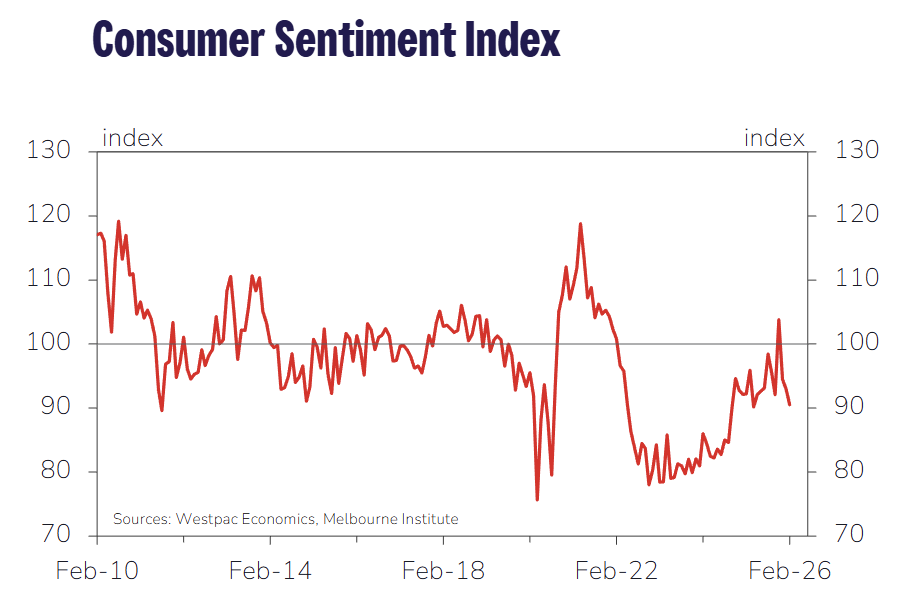
Westpac–Melbourne Institute Consumer Sentiment slips 2.6% to 90.5 in February.
- Muted response compared to previous rate hikes.
- Current conditions and medium-term outlook weaken; year-ahead views stable.
- Over 80% expect interest rates to rise further in the next 12 months.
- Homebuyer sentiment sinks as price expectations hit new 15yr high.
Previous surveys showed a significant weakening in sentiment as a lift in inflation stoked fears that the RBA was about to raise interest rates. Those fears were realised in February. The RBA’s 25bp hike – the first in over two years – has put renewed pressure on finances, dented attitudes towards major purchases and raised concerns about medium-term prospects for the economy. That said, the impact on sentiment overall has been relatively mild. The 2.6% decline this month compares to an average 3.8% fall following cash rate rises historically. At 90.5, the Index level is also still well above the extreme lows sustained through most of 2022–2024.
Some of the muted sentiment response to the RBA rate hike likely reflects the fact that it was widely anticipated. The February survey detail also suggests the messaging around the decision was not quite as bad as some had feared. Responses over the course of the survey week show a slight improvement amongst those surveyed after the decision was announced.
Component-wise, the February sentiment decline centred on current assessments. Recall that the Index is a composite measure based on five sub-indexes: one tracking assessments of family finances compared to a year ago; two tracking expectations for family finances and the economy over the next year; one tracking expectations for the economy over the next five years; and one tracking responses to whether now is a good time to buy a major household item.
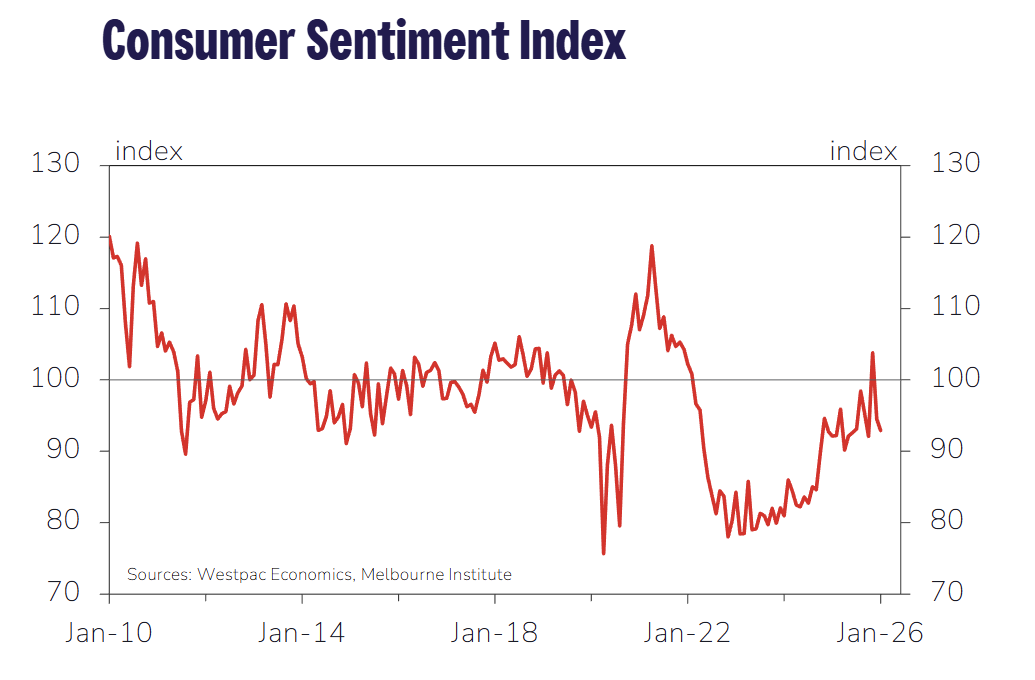
The Westpac–Melbourne Institute Consumer Sentiment Index slipped 1.7% lower to 92.9 in January from 94.5 in December.
- Deteriorating views on near-term outlook drive the move.
- About two thirds of consumers now expect mortgage rates to rise in 2026.
- Consumers less confident about job prospects.
- Less negative on ‘time to buy a dwelling’ – most 18-34 year olds positive.
- House price expectations cool a little but still very bullish.
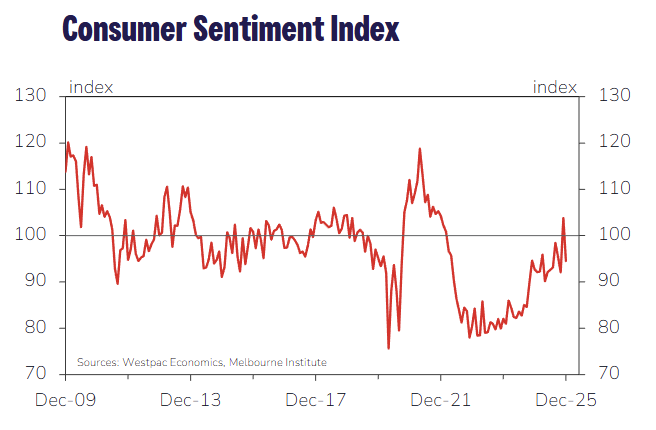
Westpac-Melbourne Institute Consumer Sentiment falls 9% to 94.5.
- Consumer mortgage rate expectations turn around sharply.
- Views on economic outlook and family finances deteriorate.
- Consumers broadly unfazed over prospects for labour market.
- Homebuyer sentiment weakens and house price expectations pare back.
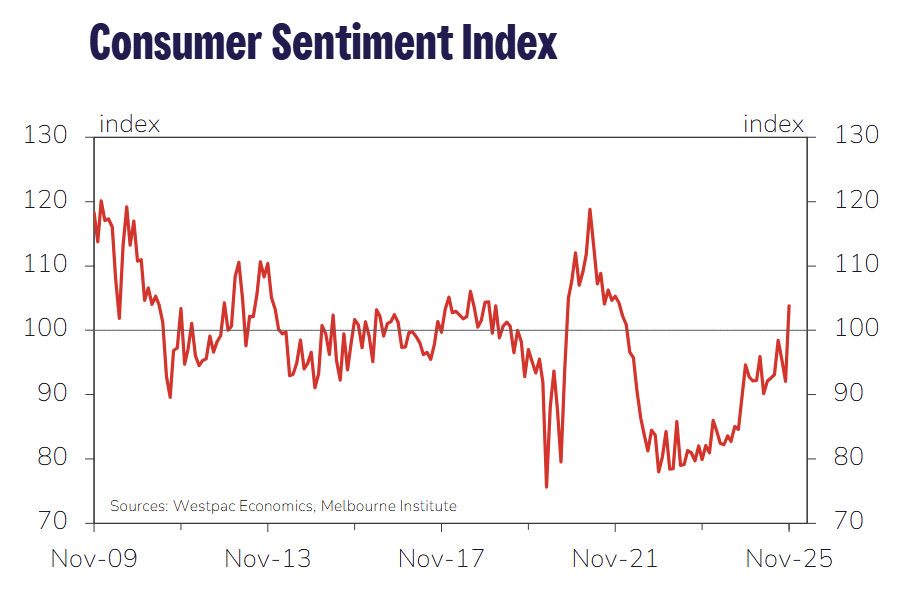
Westpac-Melbourne Institute Consumer Sentiment Index surges 12.8% to 103.8.
- First positive read since early 2022 and a seven-year high (excl. COVID period).
- Expectations improve as domestic recovery firms, trade risks subside.
- Strong gain is despite a less confident outlook for interest rates and jobs.
- ‘Mortgage belt’ is a notable exception, sentiment dipping across this sub-group.
- Christmas spending plans less restrained than last year.
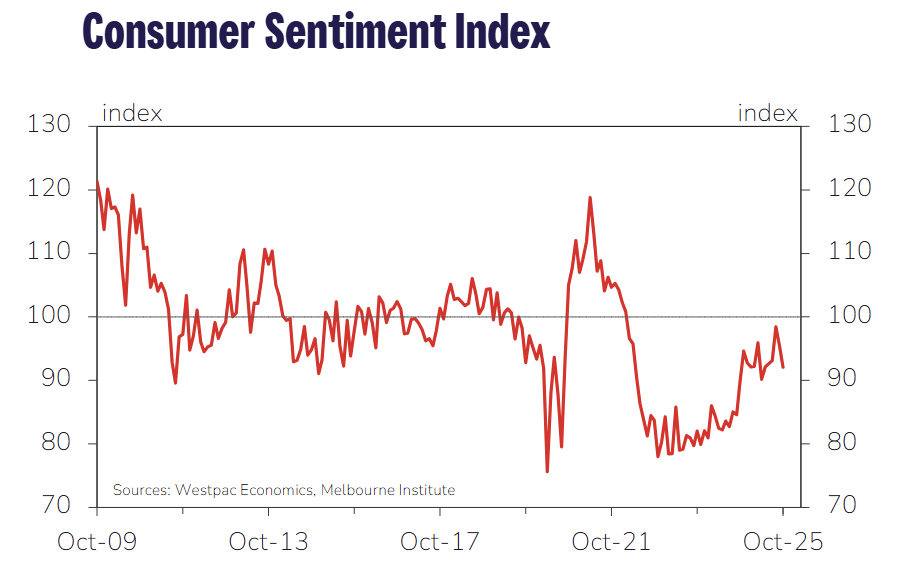
Australia’s Westpac–Melbourne Institute Consumer Sentiment Index fell -3.5% MoM to 92.1 in October 2025, a six-month low, as renewed inflation concerns dampened household optimism and reversed much of the mid-year recovery. The index remains +2.5% higher YoY but firmly in pessimistic territory.
-
Family finances next 12mths fell sharply (-9.9% MoM) to 97.1, the weakest since mid-2024 and only the second sub-100 reading since November, reflecting fading policy support and inflation worries.
-
Family finances vs a year ago declined -4.8% MoM to 82.1, reversing half of its prior two-month improvement.
-
Economic conditions next 12mths weakened -3.1% MoM to 89.9, the lowest in a year, while economic outlook next 5yrs edged up +1.4% to 94.0, slightly above its long-term average.
-
Time to buy a major household item dipped -1.1% MoM to 97.2, holding below its long-run average (124) despite a 22% gain since mid-2024, suggesting continued restraint in discretionary spending.
-
Mortgage Rate Expectations rose +15.6% MoM to 101.7, as consumers grew less certain about the RBA’s next move; 61% expected stable or lower rates, down from 69% in September.
-
Unemployment Expectations fell -2.9% MoM to 127.6 (lower = more optimism), remaining near its long-term average and consistent with a stable job market.
-
House Price Expectations climbed +2.1% MoM to a 15-year high of 171.9, with over 75% of respondents expecting price gains; Queensland led at 184, ahead of Victoria (165) and WA (166).
-
Time to buy a dwelling was little changed at 96.5 (+0.4% MoM), with sentiment strongest in Victoria (108) and weakest in Queensland (86), all still below long-run norms.
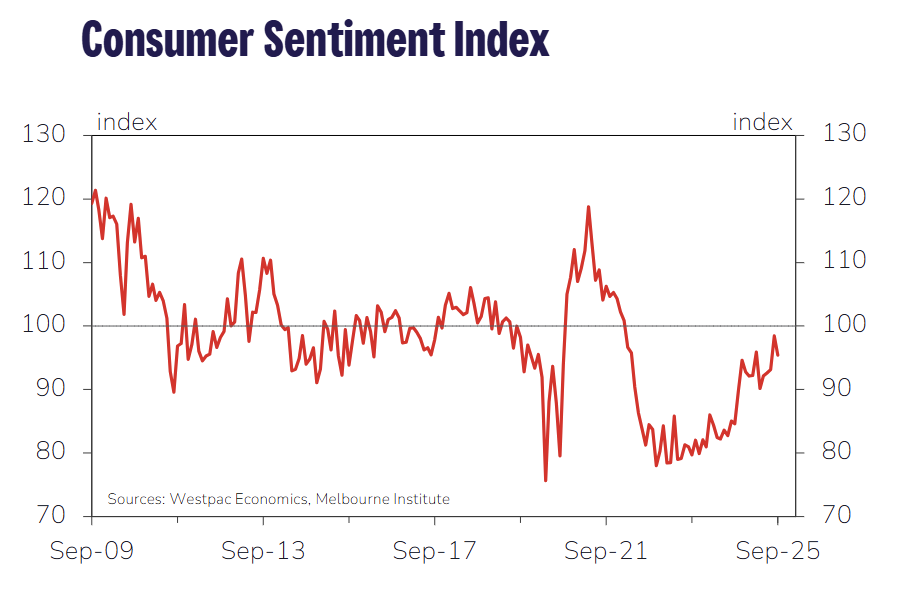
Australia’s Westpac Consumer Sentiment Index fell -3.1% MoM to 95.4 in September 2025, retreating from August’s post-rate cut boost but still up +12.8% YoY, leaving sentiment in “cautiously pessimistic” territory.
-
The ‘family finances vs a year ago’ sub-index rose +2.6% MoM to 86.3, the best since Jan 2022 but still below its long-run average.
-
The ‘family finances next 12mths’ sub-index edged up +0.9% MoM to 107.7, slightly above its long-run average, indicating improving forward household confidence.
-
The ‘economic conditions next 12mths’ sub-index dropped -8.9% MoM to 92.2, while the ‘next 5yrs’ measure fell -5.9% to 92.7, signaling renewed pessimism.
-
The ‘time to buy a major household item’ sub-index declined -3.4% MoM to 98.2, slipping back into negative territory despite still being up +18.9% YoY.
-
Homebuyer sentiment eased, with the ‘time to buy a dwelling’ index down -1.7% MoM to 96.1; Victoria was strongest (110), while WA (74) and QLD (82) remained weak.
-
The Unemployment Expectations Index rose +4.6% MoM to 131.4, back around its long-run average, indicating stable but not improving labor market sentiment.
-
House Price Expectations hit a 15-year high, rising +2.6% MoM to 168.4, with over three-quarters of consumers expecting prices to increase in the next year.
-
Mortgage Rate Expectations rose +5.2% MoM to 88.0, with 69% of consumers expecting rates to be the same or lower in 12 months.
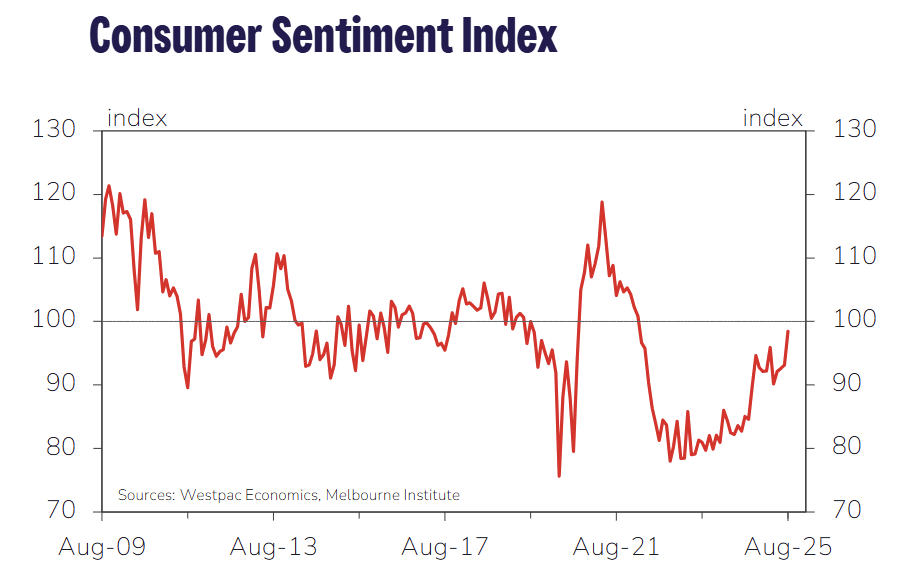
Australia’s Westpac Consumer Sentiment Index rose 5.7% MoM to 98.5 in August 2025 (up 15.8% YoY), marking its highest level since July 2023 and reflecting easing financial pressures amid recent RBA rate cuts.
-
The ‘family finances vs a year ago’ sub-index increased 6.2% MoM (to 84.2), while ‘family finances next 12mths’ rose 5.4% MoM to 106.8, suggesting improving household confidence about current and future finances.
-
Economic conditions next 12mths improved 7.6% MoM to 101.2, and economic conditions next 5yrs rose 5.4% MoM to 98.4, indicating broad-based optimism.
-
The ‘time to buy a major household item’ index climbed 4.2% MoM to 101.7, its highest since early 2023.
-
The ‘time to buy a dwelling’ index surged 10.5% MoM to 97.8, reflecting stronger home-buyer sentiment as interest rate expectations ease.
-
The Unemployment Expectations Index declined -2.4% MoM (to 125.6), while House Price Expectations rose 0.9% MoM to 164.2, signaling resilient housing market outlooks.
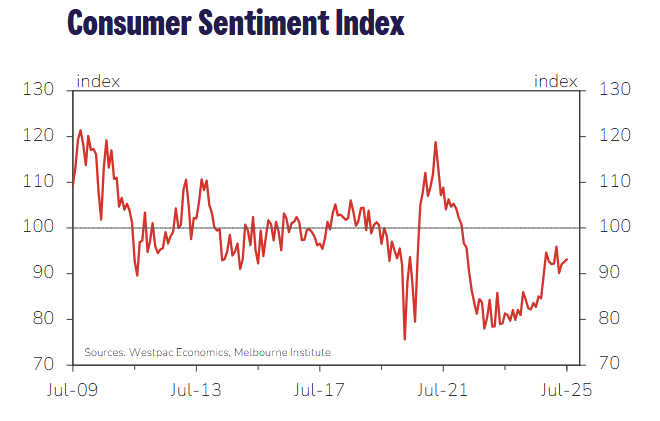
The Westpac–Melbourne Institute Consumer Sentiment Index rose 0.6% MoM to 93.1 in July, though optimism was dampened following the RBA’s surprise decision to keep rates on hold.
- The ‘family finances vs a year ago’ sub-index rose 5.0% MoM, but spiked 12% among those surveyed before the RBA decision; the ‘next 12 months’ sub-index rose 2.6% to 101.4.
- ‘Time to buy a major item’ fell -2.6% to 97.6, while the ‘time to buy a dwelling’ index dropped -5.1% to 88.5, with sentiment weakest in Queensland (69).
- Economic outlook for the next 12 months improved 1.8% to 94.1, but the 5-year outlook fell -2.8% to 93.4 amid tariff-related uncertainty.
- The Unemployment Expectations Index rose 1.1% to 128.7, signaling a neutral-to-weak jobs outlook.
- House Price Expectations dipped -2.2% to 162.8, but 75% of respondents still expect prices to rise over the next year.